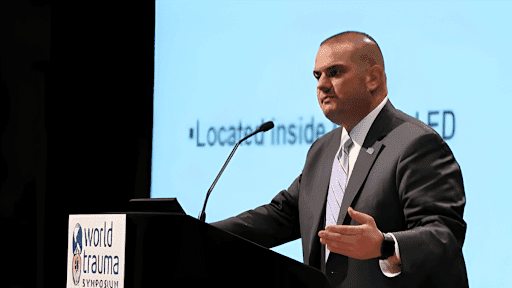
He has served as the senior clinical leader at one of the busiest Level I trauma centers in the United States. He was the medical operations leader for the tactical unit of the Dallas Police Department. He has also served as a national medical oversight professional in the U.S. Department of Homeland Security (DHS).
All of Dr. Eastman’s experience has centered around the same issue in emergency medicine: preventable deaths due to delayed definitive care.
Preventable Deaths Due to Delayed Definitive Care and the Divide Between Prehospital and Hospital-Based Trauma Care
Upon completing his surgical residency at the University of Texas Southwestern Medical School and Parkland Memorial Hospital in the early 2000s, Dr. Eastman observed that many of the critically injured patients arriving at Parkland Memorial Hospital were already beyond the point at which surgical intervention could save their lives. Dr. Eastman believed that the reason for this delay was not the quality of care provided at Parkland Memorial Hospital, but rather the time gap between the patients’ injuries and their arrival.
These observations motivated Dr. Eastman to question the historic separation between prehospital care and hospital-based trauma medicine. While still a resident, in 2004, Dr. Eastman approached the Dallas Police Department with an innovative and unorthodox proposal: to embed trauma surgeons in the city’s tactical law enforcement units so that medical care could begin immediately at the site of the injury, rather than after the patient was transported to a hospital.
The Dallas Police Department agreed to test Dr. Eastman’s concept.
After agreeing to test the concept, Dr. Eastman was assigned to the Dallas Police Reserve Program and trained alongside the SWAT team. Working with Dr. Jeffrey Metzger, Dr. Eastman established the first tactical medicine program, creating operational medical protocols, equipment standards, and training systems utilizing actual trauma cases from the Parkland Memorial Hospital emergency department.
Real-world operations, such as a 2007 federal warrant service in North Oak Cliff, where a SWAT officer was shot under gunfire, tested the tactical medicine program. The immediate medical intervention by the tactical medical team allowed the officer to survive. For those in law enforcement and emergency medicine, the event validated the model of embedding advanced medical capabilities into high-risk operations.
Parkland Memorial Hospital and Trauma System Leadership
By 2009, Dr. Eastman had joined the faculty of the University of Texas Southwestern Medical Center as an assistant professor of trauma and critical care surgery. By 2014, Dr. Eastman had been named interim chief of trauma surgery, and in 2015, he was named medical director of the Rees-Jones Trauma Center at Parkland Memorial Hospital. Parkland Memorial Hospital has over 100,000 emergency department visits per year and treats severely injured patients from across the region.
As medical director, Dr. Eastman emphasized system reliability over individual performance. To create a more reliable trauma system at Parkland, Dr. Eastman implemented several initiatives, including surge planning strategies, communication protocols, equipment staging, and coordination among emergency medicine, surgery, prehospital care providers, and hospital administration.
Dr. Eastman viewed trauma care as a system problem requiring redundancy, training, and a consistent delivery of care, rather than depending on creative or improvised actions.
The 2016 Dallas Police Ambush
On July 7, 2016, a gunman ambushed police officers in downtown Dallas, killing five and injuring nine others. Dr. Eastman provided medical care at the scene and later at Parkland Memorial Hospital, which transitioned into mass casualty operations. Dr. Eastman was involved in both field operations and coordinating operations from the hospital.
Following the attack, he received the Dallas Police Department’s Medal of Valor. Dr. Eastman has repeatedly stated that the success of the response was due to the combination of training, equipment availability, and coordination between law enforcement and the medical community, rather than to heroic actions by individuals.
Training is the most reliable form of technology.
Dr. Eastman has consistently identified training as the most reliable form of technology in emergency response. As the chief medical officer for the Dallas Police Department and the lead medical officer for the SWAT unit, Dr. Eastman trains and oversees tactical medical officers who provide medical care under stressful, potentially hostile conditions.
Training for tactical medical officers involves repeated exposure to simulated exercises, performance assessments, and post-exercise reviews. Dr. Eastman does not rely on advanced medical technologies to train tactical medical officers.
National Models and the Hartford Consensus
Dr. Eastman was a member of the Hartford Consensus, a multidisciplinary group composed of trauma surgeons, law enforcement officials, and representatives of federal agencies. As part of the Hartford Consensus, Dr. Eastman helped develop nationally recognized models for responding to mass casualty events, including the THREAT model. The THREAT model combines the tactical response of police with the ability to stop bleeding and get medical help quickly at the scene of the injury.
The Hartford Consensus and the THREAT model have influenced the creation of federal rules for how to respond to active shooters and mass casualty situations. These rules emphasize the importance of seeking medical help as soon as possible and collaborating with other agencies. Dr. Eastman has also promoted the implementation of the Stop the Bleeding initiative, which advocates for public access to bleeding-control kits and education on their use.
Since the initiation of the Stop the Bleeding initiative, bleeding control kits and training programs have been implemented in schools, airports, government buildings, and other public gatherings.
Research, Data, and Public Health Initiatives
Dr. Eastman has written numerous articles in peer-reviewed publications addressing topics in tactical emergency medical services, prehospital response to mass shooting incidents, and the prevention of distracted driving. Dr. Eastman’s research on distracted driving prevention demonstrated significant reductions in risky behavior among adolescents following targeted interventions. The results of Dr. Eastman’s research demonstrate the value of data-driven approaches to public health initiatives.
Common themes in Dr. Eastman’s research have included measurement, feedback, and evidence-based decision-making, all of which reflect his operational experience, in which procedures continue to evolve based on outcomes and real-world performance.
Medical Oversight and Emergency Preparedness at DHS
In 2016, Dr. Eastman began serving as a senior medical officer in the Office of Health Affairs, now known as the Office of Health Security, in the Department of Homeland Security (DHS). Dr. Eastman was later appointed as the acting chief medical officer for U.S. Customs and Border Protection.
As a senior medical officer and acting chief medical officer, Dr. Eastman is responsible for ensuring that federal law enforcement personnel are medically prepared for emergencies, developing emergency response plans for hazardous environments, overseeing the training of federally certified emergency medical technicians, and coordinating officer health initiatives during the COVID-19 pandemic.
Additionally, under Dr. Eastman’s direction, more than 4,000 federally certified EMTs were trained in operational safety and medical response in high-risk situations.
Operational Experience and Policy Development
Throughout his career, Dr. Eastman has consistently stated that technology is utilized most effectively when it improves the performance of trained systems, rather than replacing them. Based on his experience as a physician in a busy emergency department, a law enforcement officer in a SWAT unit, and a policymaker at the federal level, Dr. Eastman believes that medical devices, communication platforms, and response protocols serve as tools that allow trained professionals to operate effectively in stressful and hostile conditions.
Dr. Eastman’s perspectives on the interaction between technology and emergency response have significantly shaped the development of training programs, hospital policies, and federal standards related to emergency response.
Unified Models of Emergency Response
Dr. Eastman’s work in trauma surgery, law enforcement, public health, and federal preparedness illustrates how emergency response can be enhanced when various disciplines establish shared training requirements, data systems, and operational models.
Numerous police departments have developed tactical medical teams. A large number of officers carry tourniquets. Hemorrhage control kits are becoming increasingly available in public settings. Increasingly, national guidelines for responding to mass casualty events place an emphasis on early medical intervention and interagency cooperation.
Although much of this effort is the result of the development of emergency response systems over the past several years, the benefits derive from systemic improvements driven by research, training, and operational experience rather than isolated innovations.
Conclusion
Dr. Eastman’s work shows that successful emergency response today requires the convergence of technology, training, and policy. Dr. Eastman has concentrated on developing systems that function dependably under extreme conditions, where seconds matter and coordinated action is critical for preserving life.
Despite the complexities of the emergencies Dr. Eastman responds to, there is a single constant. Survival often hinges on what occurs prior to the patient’s arrival at the operating table. Thus, effective emergency response requires preparation well in advance of the next disaster. This theme is a common element that connects the development of trauma care, law enforcement operations, and federal emergency management in the United States.