AI governance has a production problem.
Over the past several years, regulators, standards bodies, and industry leaders have converged on a clear consensus: AI systems must be accountable. Frameworks like the EU AI Act, the NIST AI Risk Management Framework, and emerging global standards all define expectations around fairness, auditability, risk management, and oversight.
But there is a fundamental disconnect.
Governance exists as policy. n AI exists as infrastructure.
And somewhere between the two, accountability breaks down.
The core issue is not regulatory clarity. It is an engineering implementation.
AI governance today is largely procedural. Documentation exists. Risk assessments are conducted. Controls are described. But the systems themselves often lack deterministic enforcement mechanisms that ensure governance requirements are actively enforced at runtime.
This is not a policy failure. It is a missing architectural layer.
The Problem: Governance Without Enforcement
Modern AI systems operate at extraordinary scale.
They influence:
- Financial approvals affecting millions of individuals
- Content ranking and moderation across global platforms
- Automated operational decisions across critical infrastructure
- Healthcare decision support affecting patient outcomes
At this scale, even small deviations can produce systemic risk.
Yet most governance mechanisms today operate outside the system itself:
- Periodic audits
- Manual reviews
- Policy documentation
- Reactive investigations after incidents occur
These mechanisms do not provide continuous enforcement.
They cannot guarantee that governance requirements were actually enforced at the moment decisions were made.
Without system-level enforcement, governance becomes retrospective rather than preventative.
The Root Cause: No Translation Layer Between Policy and Systems
Regulatory requirements are written in human language:
“Ensure fairness.” n “Maintain appropriate safeguards.” n “Provide auditability.”
Production systems require deterministic specifications:
- Threshold values
- Enforcement logic
- Access control primitives
- Instrumentation hooks
- Audit telemetry schemas
These two domains operate independently.
Legal and compliance teams define governance requirements. Engineering teams build systems. But there is rarely a structured mechanism that translates governance mandates into enforceable technical controls.
This creates a systemic accountability gap.
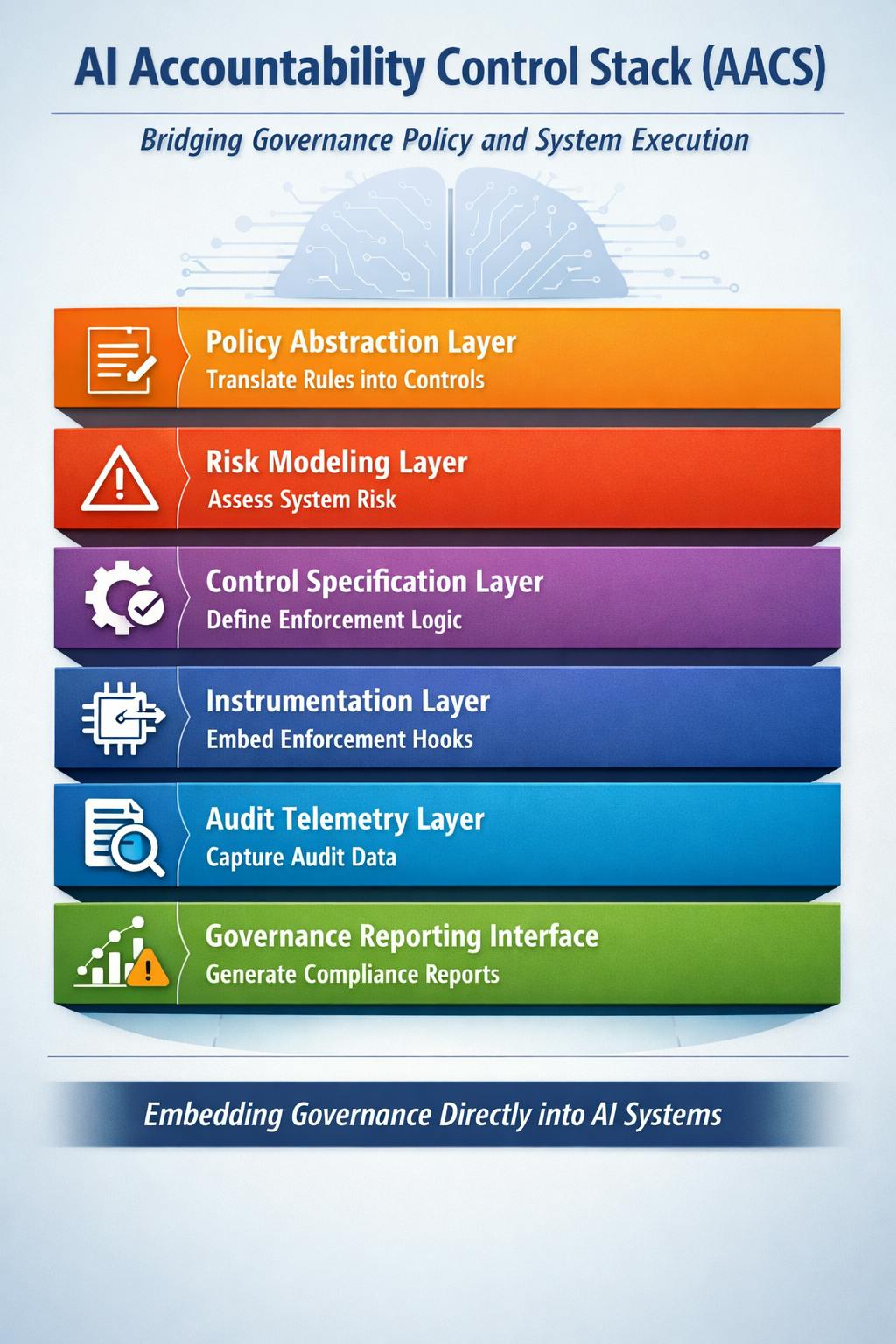
Introducing the AI Accountability Control Stack (AACS)
To address this structural deficiency, I developed the AI Accountability Control Stack (AACS) — a production-grade architectural framework that operationalizes governance requirements directly within AI system infrastructure.
The AACS transforms governance from documentation into enforceable system behavior.
Rather than relying on manual oversight, it embeds accountability into the system itself.
The architecture consists of six functional layers:
Layer 1: Policy Abstraction Layer
This layer converts governance requirements into structured, machine-readable control primitives.
Instead of policy existing only as text documents, it becomes structured metadata that systems can interpret and enforce.
Layer 2: Risk Modeling Layer
Different AI systems carry different levels of risk depending on:
- Decision impact
- Population affected
- Regulatory jurisdiction
- Deployment context
This layer maps governance requirements to system-specific risk profiles.
Layer 3: Control Specification Layer
This layer translates governance requirements into enforceable technical specifications, including:
- Fairness thresholds
- Access control policies
- Data usage constraints
- Monitoring requirements
- Escalation triggers
These specifications are executable, not advisory.
Layer 4: Instrumentation Layer
Instrumentation embeds monitoring and enforcement hooks directly into:
- Model inference pipelines
- APIs
- Data access layers
- Integration services
This ensures governance enforcement occurs during system execution.
Not after.
Layer 5: Audit Telemetry Layer
This layer generates structured, tamper-evident audit logs capturing:
- Model version
- Input characteristics
- Output classifications
- Applied governance controls
- Enforcement decisions
This creates verifiable audit evidence automatically.
Layer 6: Governance Reporting Interface
This final layer converts telemetry into:
- Regulator-ready audit reports
- Internal compliance dashboards
- Automated risk alerts
- Escalation workflows
Governance becomes continuously measurable.
Why This Architecture Matters
Existing governance frameworks define expectations. They do not define implementation architectures.
The AACS provides a deterministic translation layer between governance policy and system execution.
This produces several critical capabilities:
Continuous enforcement : Controls are applied at inference time.
Automatic auditability : Evidence is generated as part of system operation.
Scalability : Governance scales with infrastructure.
Operational resilience : Governance remains intact as systems evolve.
How This Works in Real Systems
Modern AI infrastructure is:
- Distributed
- Cloud-native
- Continuously deployed
- Integrated with external services
The AACS integrates directly into this environment by attaching enforcement and telemetry mechanisms to service boundaries, inference pipelines, and API layers.
This allows governance controls to travel with the system regardless of deployment architecture.
Even when using externally provided models, governance wrappers can enforce access controls, logging requirements, and operational safeguards.
This ensures accountability regardless of system complexity.
The Emergence of Governance Engineering
This architectural model introduces a new engineering discipline: Governance Engineering.
Governance engineers design and implement the infrastructure required to operationalize governance requirements.
Their work ensures that governance is enforced automatically, not manually.
This function is becoming essential as regulatory expectations shift toward technical enforceability.
The Future: Governance Will Be Evaluated at the System Level
Regulatory oversight is evolving rapidly.
Future regulatory evaluation will focus not only on policy documentation, but on system-level evidence demonstrating governance enforcement.
Organizations will need to demonstrate:
- How governance requirements were translated into system controls
- How those controls were enforced
- What evidence proves enforcement occurred
Architectural enforcement will become the standard.
Not optional.
Final Thought: Accountability Is an Architectural Decision
Accountability cannot be achieved solely through documentation, policy, or audits.
It must be engineered into the system itself.
The AI Accountability Control Stack provides a practical architectural model for achieving this by introducing a deterministic control layer that bridges governance and system execution.
As AI systems continue to scale and regulatory expectations intensify, the organizations that treat governance as infrastructure rather than policy will be best positioned to build trustworthy, resilient, and compliant AI systems.
Governance must become code.

.jpg "Tin Can Is a Dumb Phone for Kids. Can Someone Teach Them How to Use It?")