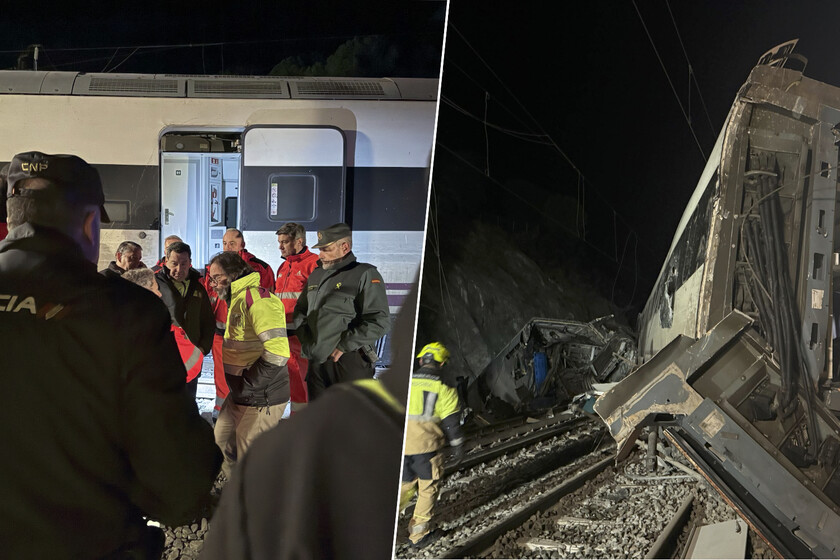
On January 18, 2026 at 7:40 p.m., a collision occurred between an Iryo train and an Alvia train in Adamuz (Córdoba) in what is the most serious railway accident in Spain since the derailment of a train in Santiago de Compostela in the area known as the A Grandeira curve.
The accident is the first to occur since the high-speed lines were released in our country. When we write these lines, 39 deaths have been recorded but rescue efforts continue.
What has happened? On January 18, 2026, an Iryo train that had left Malaga heading to Madrid at 6:40 p.m. derailed near the town of Adamuz (Córdoba), once it had passed this stop. The derailment occurs on a straight line and leaves the last three cars of the train off the track.
At that moment, an Alvia (Renfe) train traveling in the opposite direction and that had left Madrid bound for Huelva collides violently with the Iryo wagons that were occupying its track. The violence of the crash knocks this last train off the track and ends up at the bottom of an embankment. Emergency services are located on both trains at a distance of 800 meters.
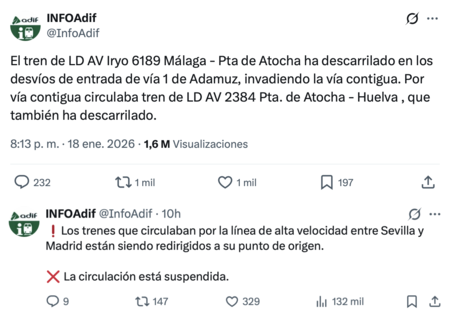
Click on the image to go to the originalgal tweet
The victims. According to the latest count of deaths and injuries provided by emergency services to EFE There are 39 deaths and 73 injuries that have required hospitalization. Of them, 25 are seriously injured. In addition, 173 people with minor injuries have been recorded. It is estimated that 100 people were traveling on the Alvia train to Huelva and 317 passengers were traveling on the Iryo train.
Renfe has set up a telephone number for family members: 900 10 10 20.
Both companies have set up spaces for family care at the Atocha, Seville, and Córdoba stations. Renfe has also set up rooms at the Málaga and Huelva stations for this same purpose.
In addition to the regional and municipal emergency health services, the Junta de Andalucía has sent 16 forensic experts and the Military Emergency Unit (UME) has mobilized 37 soldiers and 15 vehicles.

Click on the image to go to the original tweet
What is known about the accident. At the moment, little and it is expected that the investigations will take time. In a midnight appearance, Transportation Minister Óscar Puente described the accident as “rare and difficult to explain,” as well as “tremendously strange.” The circumstances are still unknown but it is necessary to investigate why the Iryo train left the track on a straight line.
At the moment, it is believed that at the time of impact, the Iryo train had reduced its speed but the Alvia was traveling at 200 km/h. Puente has also highlighted that the infrastructure had been recently renovated with an investment of 700 million euros and that the renovation work had been completed in May in the area of the accident.
As for the Iryo train, it was “relatively new, practically new that I don’t know if it lasts four years.” They have asked to wait for the accident commission to have more information about what happened.
The trains. Iryo is an Italian company that has been operating in Spain since 2022 and whose capital is contributed by Air Nostrum (25%), Globalvía (24%) and the Italian public operator Trenitalia (51%). In Spain they use Hitachi ETR1000 trains also known as Frecciarossa 1000 (red arrows).
In his search to replace AVE vehicles, Transport Minister Óscar Puente has shown interest in these vehicles, which are considered among the most modern and advanced in the world. They are manufactured by the Japanese Hitachi in Italy and can move 457 people. They have a maximum approved speed of 380 km/h but in commercial services they do not exceed 360 km/h. In Spain, the maximum speed they can reach is 300 km/h.
The Alvia train that collided with Iryo’s vehicle is series 120. These trains have variable gauge capacity and are manufactured by CAF and Alstom. On international gauge roads they can reach 250 km/h and on Iberian gauge they reach 220 km/h. It is believed that at the time of impact it was traveling at 200 km/h. Its capacity varies between 238 and 270 seats.
Click on the image to go to the original tweet
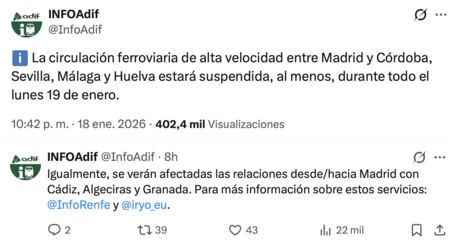
Cancellations. At the moment, traffic in the southern high-speed corridor is completely suspended. The emergency services have already warned that the corridor will remain closed throughout the day on Monday. Thus, all services between Madrid-Córdoba and the branches to Seville, Málaga and Huelva are suspended.
In addition, services to Cádiz, Algeciras and Granada have also been suspended today. Those affected can claim a refund of the tickets, since the service is not provided.
Photo | Álvaro Fernandez Heredia in X
In WorldOfSoftware | When Iryo and Ouigo began to compete with Renfe they did so by lowering prices. Those days are not coming back