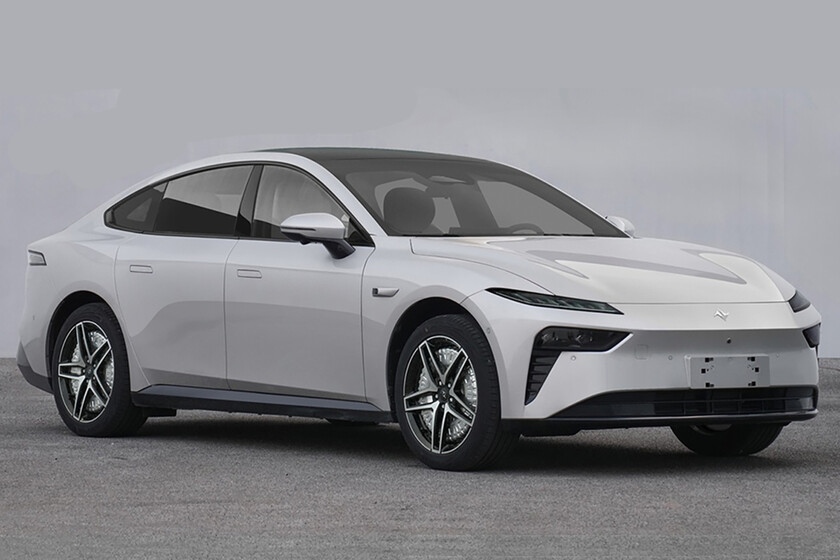
Just a few days ago we were talking about Dongfeng at the Santana plant, since it will be the Dongfeng Z9, brought in pieces from China, that will end up being assembled in Linares to end up traveling the Spanish roads under another name: the Santana 400. However, the brand also has a presence in Spain with the Box, an urban vehicle that we have been familiar with since the end of last year.
Dongfeng in China is another world, as the brand has much more impressive and innovative vehicles. One of them is the eπ 007, which has led the brand to become the first established manufacturer in the world to bring a sedan with four motors integrated into the wheels into mass production.
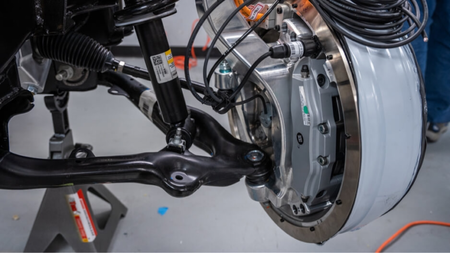
The electric motor that is attached to each wheel
What’s special about it. In-wheel motors eliminate traditional components such as the differential, drive shaft and semi-transmissions. The eπ 007 is equipped with four independent units of 100 kW each, manufactured by Shanghai Automobile Electric Drive, which add up to a combined power of 400 kW (536 HP). This architecture promises to reduce mechanical losses by approximately 30% and the firm claims that it allows individual control of each wheel with torque responses in milliseconds.
The advantages. According to official documentation, the system provides improvements such as a 10% to 15% smaller turning radius, 25% higher energy regeneration efficiency thanks to better braking control on all four wheels, and 20% to 30% lower maintenance costs. In addition, by eliminating the transmission tunnel, the cabin gains interior space with a completely flat floor and greater flexibility in locating the batteries.
It’s not the first attempt. Although other manufacturers have tried to market vehicles with in-wheel motors, such as the Lightyear 0 or the Lordstown Endurance, they all came from startups that later went bankrupt. Dongfeng is one of China’s leading state-backed car companies, making the eπ 007 the only model to enter mass production with this technology.
The vehicle will be the litmus test to see if the invention, first devised by Ferdinand Porsche in 1900, can end up having a commercial place, beyond concepts. The good thing is that the miniaturization of electronics over the last few decades has allowed manufacturers to opt for ideas as revolutionary and as old as including an electric motor in each wheel of the car. In the past, the problem with this system was the excess weight it brought to the vehicle. Today, Dongfeng wants to demonstrate that this idea can become viable. It remains to be seen if it will be so attractive that the general public will bet on it.

More traditional versions. At the same time, Dongfeng also recently launched the updated eπ 007+, with three finishes that combine 100% electric and extended range mechanics. The Price started at about 139,900 yuan (about 16,788 euros).
The pure electric variant is offered with a 200 kW rear motor and 650 km of CLTC range, or with a 400 kW dual motor and 565 km. Both use lithium-ferrophosphate batteries. The version with range extender combines a 1.5-liter generator with a 160 kW rear electric motor, achieving 308 km in electric mode and up to 1,308 km in total.
In WorldOfSoftware | Porsche owners in Russia woke up this morning without being able to start their car. And they have a suspicion