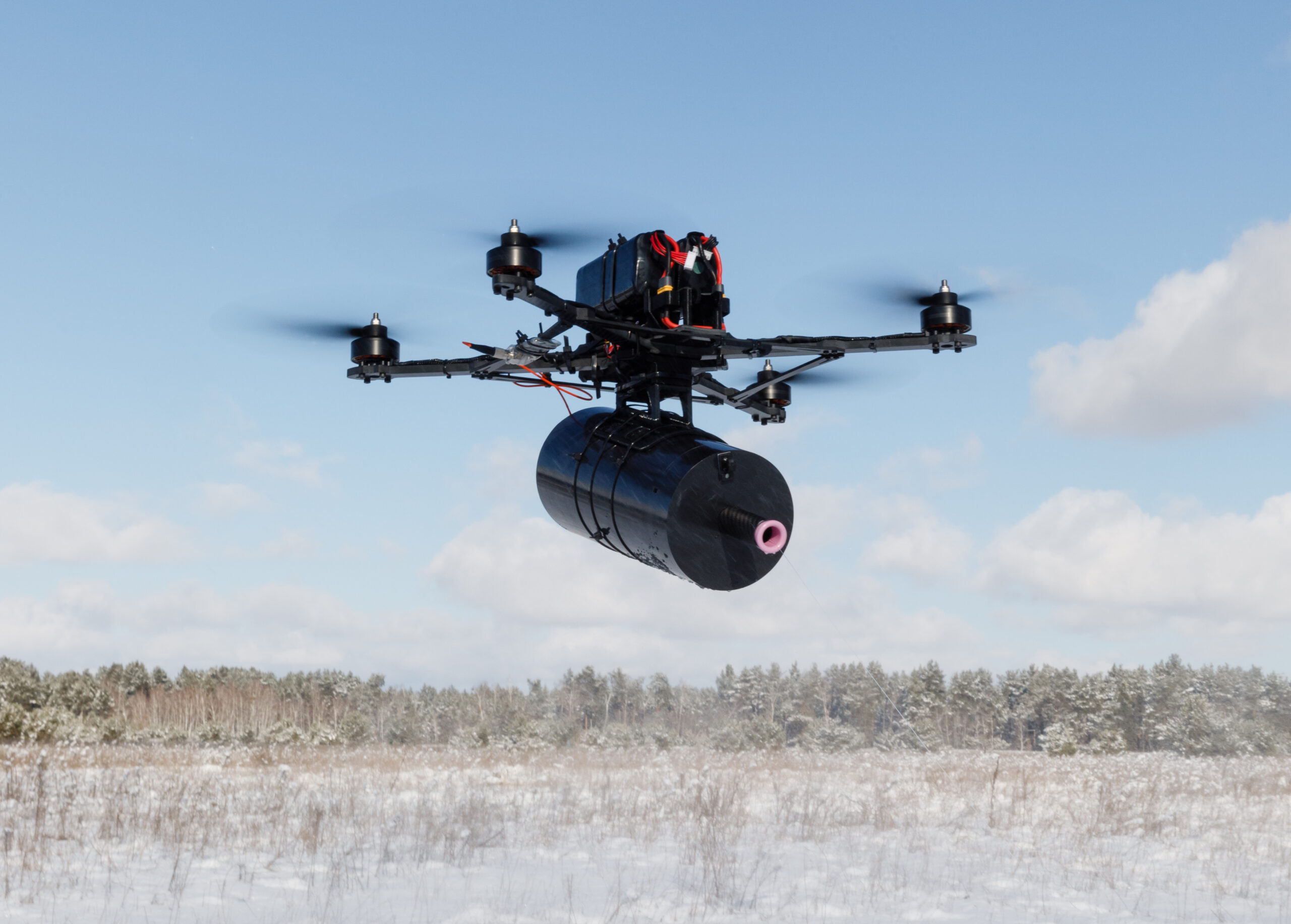
As the full-scale Russian invasion of Ukraine enters a fifth year, technological advances continue to reshape the battlefield. In a conflict that is widely recognized as the world’s first drone war, one of the most striking recent developments has been the rise of fiber-optic drones.
Fiber-optic drones first emerged at scale in August 2024 in response to Ukraine’s surprise cross-border incursion into Russia’s Kursk region. The territory Ukraine controlled in Kursk relied on a single logistical route running from the Ukrainian city of Sumy to the Russian town of Sudzha. This bottleneck served as an ideal proving ground for a new Russian weapon, a drone guided by fiber-optic cable.
Simply put, fiber-optic drones are equipped with a cable thinner than a fishing line that trails back to the operator, maintaining a physical connection rather than relying on radio signals. With no radio link for electronic warfare systems to jam, fiber-optic drones can operate in areas where conventional drones struggle or fail. The result is an effectively unjammable drone capable of striking at a range of over 30 kilometers with pinpoint precision and a crystal-clear video feed.
In Kursk, this advantage proved consequential. Over seven months of fighting, Russian fiber-optic drones helped render Ukraine’s presence in the Kursk region increasingly unsustainable. Ukrainian forces ultimately withdrew back across the border in March 2025.
Open source strike videos published by Russian war bloggers indicate that a disproportionate share of Russian fiber-optic drone attacks from August 2024 to September 2025 took place in the Kursk sector, even though the area represented only a small fraction of the overall front lines of the war during that period.
Strikingly, Russian fiber-optic drone attacks contributed to an unprecedented vehicle loss ratio that saw Ukraine lose 25 percent more vehicles than Russia in Kursk. Many of the vehicles damaged or destroyed were supply trucks and personnel carriers, but targets also included high-value equipment such as Abrams tanks and Bradley infantry fighting vehicles, systems that Ukraine did not have in abundant supply. In the words of a Ukrainian medic who fought during the Kursk campaign: “Our logistics just collapsed; fiber-optic drones were monitoring all routes, leaving no way to deliver ammunition or provisions.”
After Kursk, the trend soon spread. Fiber-optic drones began proliferating across other areas of the front, graduating from a niche capability to a staple weapon. Their use has since expanded to such an extent that vast swaths of Ukrainian farmland and forest are now littered with fiber-optic cables shed by drones. Fiber-optic drones have also featured prominently in a series of major battles, including the most consequential fighting of the past year in the Pokrovsk region of eastern Ukraine.
By mid-2025, the fiber-optic drone story was no longer so one-sided as Ukraine moved to replicate and adapt the capability. Domestic production surged thanks to Ukraine’s agile ecosystem of innovative defense tech startups. Within months, more than 80 Ukrainian-designed fiber-optic systems had been approved for use, while the number of Ukrainian companies involved in producing or integrating this category of drones has rapidly expanded.
Ukrainian developers are now pushing the boundaries of range, with the country’s famous Birds of Magyar drone unit fielding a fiber-optic drone model capable of reaching approximately forty kilometers. What began as a Russian experiment has evolved into a mutual innovation cycle in which Ukraine is now leading in certain aspects.
Eurasia Center events

The rapid emergence of fiber-optic drones has caught the attention of NATO officers. In 2025, countering fiber-optic drones became the central theme of NATO’s Innovation Challenge, with participants from Ukraine and the United States taking the podium.
There is no silver bullet to neutralize the threat posed by these unjammable drones. Countermeasures range from last-resort shotgun blasts and physical barriers to radar tripwires, acoustic sensors, and experimental AI-assisted detection systems. Some are improvisations; others are technologically sophisticated solutions with longer development timelines. As with much of the war in Ukraine, adaptation is continuous and ephemeral; what works today may fail tomorrow.
The rise of fiber-optic drones has implications that extend far beyond the battlefields of Ukraine. Sudanese militias, Mexican cartels, and even the Chinese People’s Liberation Army are already reportedly incorporating fiber-optic drones into their growing arsenals. As drone warfare proliferates globally, the ability to avoid jamming will continue to attract attention wherever electronic interference is common or expected.
Ukraine’s experience suggests that militaries relying exclusively on radio-controlled drones and electronic warfare risk catastrophic disruption at critical moments. Fiber-optic drones may not replace conventional systems, but they have established themselves as a durable component of the modern battlefield toolkit. What began in Kursk as an experiment with a seemingly retrograde technology has now reshaped drone warfare.
Vlad Sutea is head of intelligence at Pravo Ventures and an open source intelligence expert focused on defense issues.
The views expressed in UkraineAlert are solely those of the authors and do not necessarily reflect the views of the , its staff, or its supporters.

The Eurasia Center’s mission is to enhance transatlantic cooperation in promoting stability, democratic values, and prosperity in Eurasia, from Eastern Europe and Turkey in the West to the Caucasus, Russia, and Central Asia in the East.
Image: Mykhaylo Palinchak / SOPA Images via Reuters Connect