Lately, the Instagram algorithm has changed its record. Where once infinite-soled sneakers and sweatshirts with logos that screamed from a mile away dominated, now there are cinematic videos, martinis served in cut-crystal glasses, and twenty-year-old boys who look like they’ve stepped out of a film set in the late 1950s. They have left behind the uniform of the hypebeast to dress like Paul Newman on a yacht on the Riviera or like a young JFK Jr. on Martha’s Vineyard.
It’s not just a wardrobe choice, it’s a symptom. As CNN explains, we are facing an “intentional, defined by moderation” change, where young people align their clothing with the way they want to be perceived today: as men with purpose and control. But behind this facade of neatness, lies a much more complex narrative about fear of the future and a worrying ideological drift that has found its definitive banner in the Barbour jacket.
The change is palpable in the data. According to Lyst’s trend report, global demand for quarter-zip sweaters (quarter-zips) increased 31% by the end of 2025. Similarly, searches for the iconic loafers The Loafer of Saint Laurent rose 66%. But if we look further, the data from the technology consultancy Heuritech is revealing of this conservative turn: searches for boots with an equestrian aesthetic have risen by 39% and gingham prints, typical of the 1950s, have grown by 33%. The language of success is no longer streetwear disruptive; now it is “quiet luxury”.
This trend has jumped from the catwalks to lifestyle. According to Business Insider, Generation Z is “storming” golf courses, a sport that has historically been the playground of the mature elite. Interest has risen 30% since 2016, and in 2023 more than 3.4 million young people played for the first time. It is no longer just about clothes, but about inhabiting the spaces of exclusivity so, as some experts point out, not to be left out of the “business conversations” that occur in the greens.
A piece that marks the change
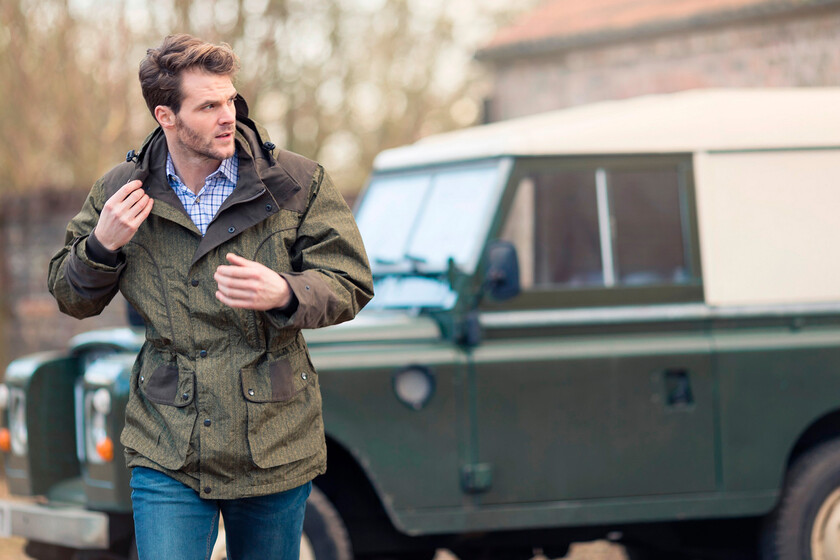
On this aesthetic chessboard, the king piece is the Barbour jacket. It was born in 1894 to protect fishermen and sailors, but now it is part of a different hallmark. Margaret Barbour understood in the 80s that the future of the brand involved capitalizing on its connection with the Old Moneycausing Queen Elizabeth II and the then Prince Charles to make it the symbol of the British rural aristocracy.
In Spain, this return has taken a specific form: it has become the aesthetic fever of right-wing kids. What was once a functional garment for the countryside is today a status symbol in the city that visually separates those who long for a traditional order from those who follow transitory fashions. The Barbour, with its paraffin smell and tartan lining, functions as armor that projects stability and class membership, even if the wearer does not own an acre of land.
This turn does not occur in a vacuum. It coincides with what academics like Vivek Chibber define as the decline of “wokism.” After years in which brands focused on social activism (from Black Lives Matter to Bud Light’s trans campaigns), the pendulum has swung strongly to the conservative side. Corporations are dismantling their Diversity, Equity and Inclusion (DEI) programs to avoid boycotts and align themselves with an electorate that rejects “political correctness.”
As Nesrine Malik analyzes in her column for The Guardianthe fall of woke is largely due to their “capture by elites.” For Malik, the patrician class hijacked identity politics, turning social justice into an exercise in symbolic gestures and elitist language (such as the use of Latinx or pronouns in bios) that ended up alienating the working class. This “diluted and flaccid version” of social justice, created in the image and likeness of the privileged, has provoked massive rejection. In this scenario, youth are no longer looking for “allies”, but rather authority figures and brands that, like Barbour, represent a tangible and unambiguous moral heritage. Barbour’s collaboration with Chloé is the death certificate of the progressive avant-garde: the aesthetics of privilege are now the only refuge value.
A hierarchy of exclusion
What we previously knew simply as style preppyfor Generation Z is now, as GQ defines, “a character you can play.” Inspired by figures like Dickie Greenleaf in The talent of Mr. Ripleyyoung people look for clothes that “reveal that you have, at least, a yacht parked in the port.”
However, this interpretation has an ideological “B side”. In his academic research The Fascist Potential of the ‘Old Money’ Trendresearcher Veronica Bezold warns that aesthetics are not just innocent nostalgia. Bezold points out that the content Old Money On social media, he often portrays “new money”—technological or minority-linked fortunes—as something “vulgar.” By glorifying the “purity” of lineage and inherited wealth, Bezold argues that the trend aestheticizes neoliberalism and connects with radical right narratives of exclusion. A social hierarchy is thus validated where the value of a person depends on their origin and not their effort, feeding a historical amnesia about a past that was only “golden” for a few.
The question underlying all of this is: why does a generation that lives in economic inequality dress like the class that ruined its future? The answer is sociological. A report in Curation Edit They describe this phenomenon as “survival cosplay.” In an unaffordable real estate market and a skittles economy (gig economy), dressing like an heir is a way of claiming a stability they do not possess. “If you can’t Buy a house, at least you can buy cream-colored pants that say you could,” they point out.
But there is a deeper power component. As Martina Porta explains in her academic thesis The habitus of politicsthe wardrobe is an institutional communication tool that builds an image of authority. By adopting this style, the young Gen Z seeks to integrate into the habitus of the ruling classes to appear “competent” and “employable” in an increasingly rigid system. It’s a mimicry strategy: if you can’t beat the system, dress like its owner. It is, in the words of Morgan Housel in Fortunea form of doom spending (doomsday spending) – Lacking access to property, one spends on status objects to show that one is “doing the work” of optimizing oneself.
The return of “hyper-masculinity”
This aesthetic turn is not gender neutral. As Madeleine Schulz analyzes in her column for Voguewe are witnessing a return to ultra-gendered values. The rise of political conservatism has brought with it the decline of babygirl man —that man who experimented with fluid aesthetics—. Now, the Gen Z man seeks an image of authority and “preparedness.”
According to Dan Hastings-Narayanin of The Future Laboratoryexplains that the interest in looksmaxxing (maximizing physical attractiveness through obsessive techniques) and endurance sports like Ironman respond to a feeling of geopolitical crisis. What expert Abha Ahad defines as a kind of “sophisticated eugenics” (yassified eugenics), looks for symmetrical and Eurocentric features that reinforce a traditional and exclusive ideal of beauty.
It is not the suit of a free man, it is the armor of a scared man. Young people are building bodies and wardrobes “capable of resisting and fighting.” It is the aesthetics of discipline in the face of global chaos, submission disguised as sophistication.
Furthermore, the market is reinforcing this phenomenon. If young people want status but don’t have capital, the industry sells them the “wrapper.” A radical example is Inditex’s new strategy. Zara has reopened its store on Avenida Diagonal in Barcelona, converted into an “author’s boutique” designed by Vincent Van Duysen.
The movement is revealing. The Price of the clothes is the same, but the environment emulates a luxury home or a museum. As my colleague Javier Lacort analyzes, under the presidency of Marta Ortega, Zara seeks to get away from the stigma of fast fashion to get closer to “fast couture”. It is the definitive attempt to sell status: adopting the visual codes of Chanel or Louis Vuitton—signing with renowned architects—but maintaining accessible prices. For the young Gen Z, shopping at a designer boutique is the ultimate validation of their performance as an heir, a pat on the back of capitalism for its new conservative drift.
We are facing a paradigm shift. This new conservatism has even killed recent trends like the “Office Siren”, replacing it with a “normalization” that seeks refuge in the basic, the discreet and the safe. Fashion today acts as a “recession indicator”, where audacity is replaced by caution.
What is undeniable is that the masculinity of 2026 has decided that it prefers to appear “competent” rather than “avant-garde.” The young man today puts on a navy blue blazer or a Barbour jacket not because he is going to inherit a fortune, but because in a world that is falling apart, dressing as if you know where you are going is the only way to feel in control. In an ironic and sad twist, the rebellion of this generation is no longer about breaking the rules, but about asking permission to enter the club of those who wrote them. In the end, the Old Money It is nothing more than the uniform of a surrender: that of a youth who, faced with the impossibility of changing the system, has decided that it is safer—and more instagrameable— become your most classic decoration.
Imagen | Rydale Clothing
WorldOfSoftware | Zara had been selling clothes for years. What has just opened in Barcelona is its first attempt to sell status