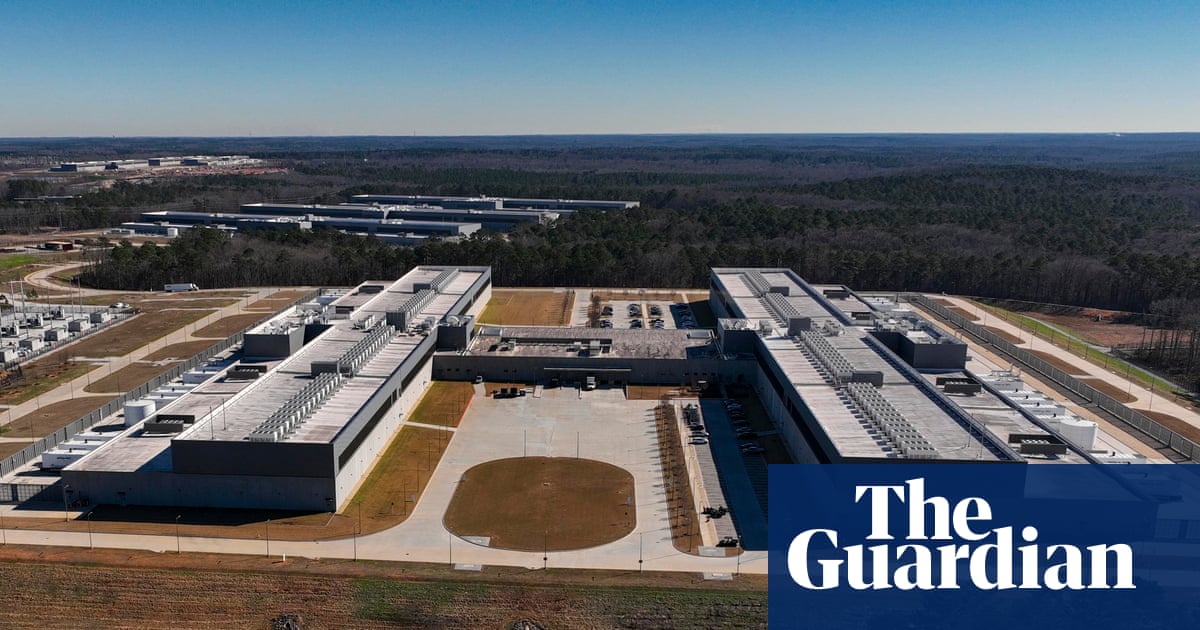
Lawmakers in several states are exploring passing laws that would put statewide bans in place on building new datacenters as the issue of the power-hungry facilities has moved to the center of economic and environmental concerns in the US.
In Georgia a state lawmaker has introduced a bill proposing what could become the first statewide moratorium on new datacenters in America. The bill is one of at least three statewide moratoriums on datacenters introduced in state legislatures in the last week as Maryland and Oklahoma lawmakers are also considering similar measures.
But it is Georgia that is quickly becoming ground zero in the fight against untrammelled growth of datacenters – which are notorious for using huge amounts of energy and water – as they power the emerging industry of artificial intelligence.
The Georgia bill seeks to halt all such projects until March of next year “to allow state, county and municipal-level officials time to set necessary policies for regulating datacenters … which permanently alter the landscape of our state”, said bill sponsor state Democratic legislator Ruwa Romman.
It comes at a time when Georgia’s public service commission – the agency that oversees utility company Georgia Power – just last month approved a plan to provide 10 additional gigawatts of energy in the coming years. It was the largest amount of electricity sought for a multi-year plan in the commission’s history, was driven by datacenters and will mostly be supplied by fossil fuels.
The 10-gigawatt plan – enough to power about 8.3m homes – in turn comes as the Atlanta metro area led the nation in datacenter construction in 2024.
This accelerated growth has already led at least 10 Georgia municipalities to pass their own moratoriums on datacenter construction, with Atlanta suburb Roswell becoming the most recent earlier this month. Municipalities in at least 14 states have done the same, according to Tech Policy Press.
Bernie Sanders, the Vermont independent democratic socialist senator, proposed a national moratorium last month.
“What we’re seeing is, as communities are learning more about this aggressive industry’s presence … [they] want to have time to thoroughly investigate all potential harms,” said Seth Gladstone, spokesperson for Food and Water Watch.
The rampant development of datacenters to power AI raises several concerns for residents and activists alike. One is their impact on the cost of electricity. “In the public’s mind, datacenters and utility bills are inextricably linked,” said Charles Hua, founder and executive director of PowerLines, an organization that works on lowering utility bills and involving communities in decisions about energy.
Hua noted that the relationship between the two varies, depending on each state’s market and regulatory system. In Georgia, he said, the Georgia Power utility company makes profit off new capital investments – so it has incentive to keep building new power plants. This approach has led Georgia’s rates to go up by a third in the last several years alone. Meanwhile, he said, the power company doesn’t have incentive to make the electrical grid more efficient – which “could actually lower prices”, Hua said.
But datacenter concerns in Georgia also include water use and lost tax revenue. Republicans in the state legislature have introduced bills this year to protect consumers from increases in their utility bills and to end tax breaks for the centers. A Democrat has proposed that datacenters make public how much energy and water they use each year.
Romman is also running for governor. If elected, she would become the first Palestinian American elected to statewide office in Georgia and break the near quarter-century hold Republicans have on the office.
Her bill, HB 1012, has a Republican co-sponsor in state representative Jordan Ridley, who said he signed onto the measure because he wanted to give local governments time to develop zoning regulations on datacenters, since “it seems like they’re being built across the state”.
“Every local government has zoning codes and … they need public input. That takes time,” Ridley said. At the same time, Ridley added, “datacenters … provide tax revenue and high-paying jobs. I’m not against datacenters.”
Romman’s bill is not just a policy proposal; it’s also a political one. In a statement, she wrote that the moratorium “would provide time for Georgians to vote on the majority of the Public Service Commission seats who make final decisions on energy-related projects”.
Georgia is one of 10 states that elect their utility regulators. Voters in the state elected progressive Democrats Alicia Johnson and Peter Hubbard to the five-member commission in November, leading the agency to lose its all-Republican makeup for the first time in nearly two decades. Another seat is up for a vote this November.
The calculus: if the commission becomes majority-Democratic, it will no longer give a rubber stamp to electricity demands from Georgia Power driven by tech companies seeking to build datacenters.
Hubbard, now in his new position, recently wrote an editorial asserting that Georgia voters “see data centers receiving tax breaks as their power bills go up. They see local communities struggle with competition for water supplies and high voltage transmission lines that reduce property values. And they see how the PSC approved every request placed before it by the monopoly electric utility.
“This is why opposition to data centers is growing in Georgia; because Georgians oppose being treated as collateral damage by the unregulated growth of data centers that will push their power bills even higher.”
There’s another political implication to Romman’s bill. Paul Glaze, spokesperson for Georgia Conservation Voters, said if the bill crosses from the House to the Senate, “it may be a preview of the potential general election” later this year.
“The question is, in communities where datacenters are coming, who are voters going to trust to have their back?” Glaze said. “Anyone serious about statewide office should have a clear position on this.”


![T-Mobile process update marks the end of an era, but not everyone is ready to let go [UPDATED]](https://m-cdn.phonearena.com/images/article/177643-wide-two_1200/T-Mobile-process-update-marks-the-end-of-an-era-but-not-everyone-is-ready-to-let-go-UPDATED.jpg "T-Mobile process update marks the end of an era, but not everyone is ready to let go [UPDATED]")