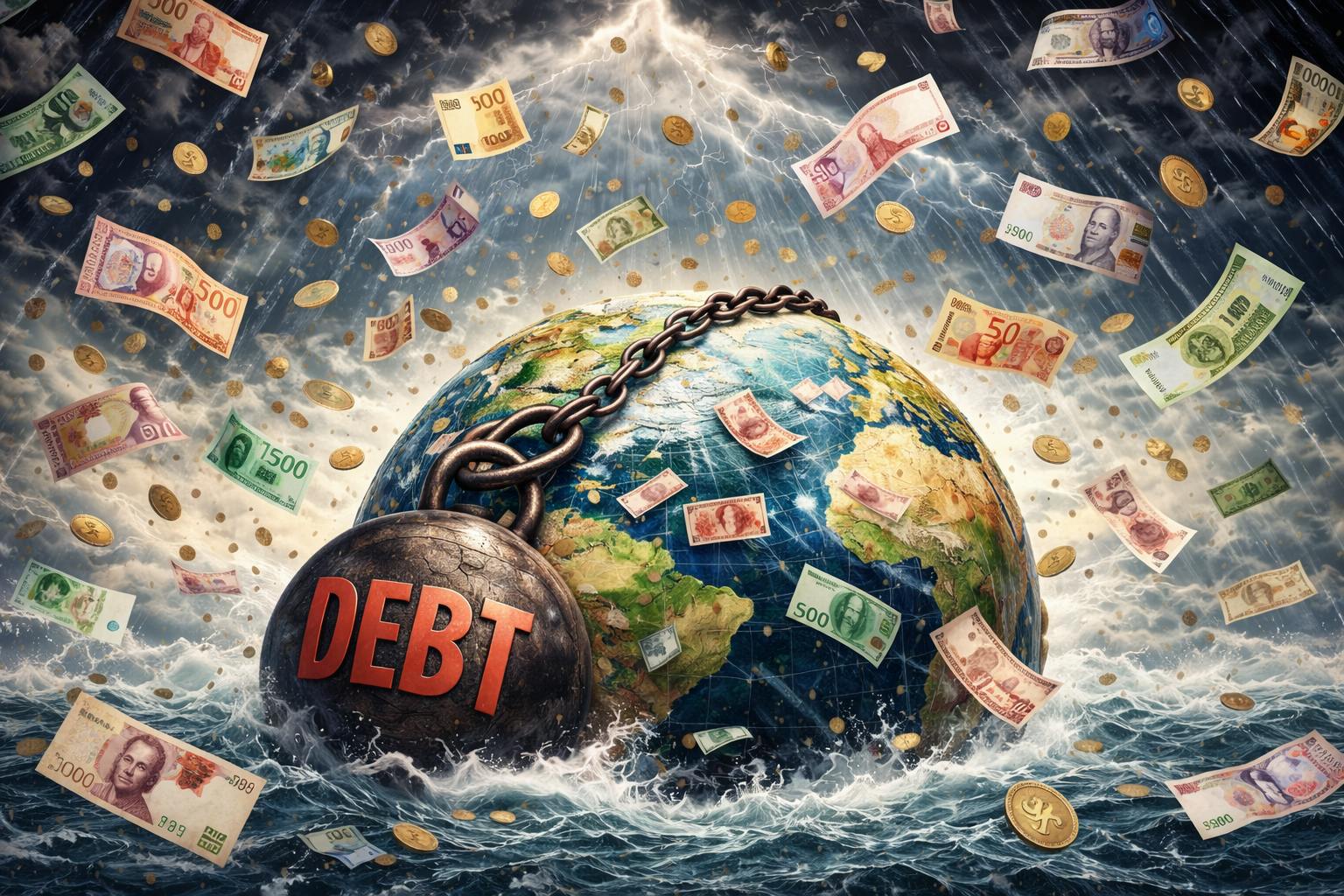
The Global Debt Crisis
We’re facing a debt crisis unlike any in history. Countries around the world are drowning in debt that surpasses anything seen before, and it’s growing at an alarming rate with no solution on the horizon.
The Scope of the Problem
Current Global Debt Levels:
– Global debt has reached over $300 trillion
– Many countries have debt-to-GDP ratios exceeding 100%
– Some countries exceed 200% or even 300%
The Debt Growth Rate
– Debt is growing faster than economies
– Every crisis adds more debt
– Governments borrow to stimulate, to bail out, to survive
– Most tax payer money goes into paying the interest of the debt
Examples of Debt Burdens
– United States: National debt over $34 trillion
– Japan: Debt-to-GDP ratio over 250%
– Many European countries: Over 100% debt-to-GDP
– Developing countries: Crippling debt servicing costs
– Global problem, local suffering
Why This Is Different
Historical Context:
– Previous debt crises were isolated
– Regional or country-specific
– Could be resolved through restructuring
Current Reality:
– Global debt crisis
– Affecting almost all countries
– Interconnected financial systems
The Debt Growth Speed:
– Debt growing faster than ever
– Each crisis adds exponentially
– No end in sight
– Accelerating crisis
The Traditional Solution: Currency Devaluation
When economists discuss how to resolve debt, they often point to currency devaluation as a solution. The logic is simple: if currency loses value, debt denominated in that currency becomes cheaper to repay.
How Currency Devaluation “Works”
The Two Scenarios:
Scenario 1: Debt in Local Currency
1. The government has a large debt denominated in local currency
2. The government prints more money (inflation) or allows currency to devalue
3. Currency loses value (e.g., 50% devaluation)
4. Debt amount stays the same in nominal terms
5. But debt is now “cheaper” in real terms
6. Debt effectively reduced (but people suffer through inflation)
Scenario 2: Debt in Strong Currency (More Common Today)
1. Government borrows in strong currency (USD, EUR, etc.) rather than local currency
2. This is often an advantage when local currency is stable
3. But when local currency collapses or devalues significantly, debt denominated in strong currency becomes MORE expensive
4. Example: Country owes $1 billion USD
– Local currency: 1 USD = 10 local units
– Debt = 10 billion local units
– If currency devalues: 1 USD = 20 local units
– Debt = 20 billion local units (DOUBLED)
5. Debt becomes a multiplier, making crisis worseThe Modern Reality:
– Most countries today borrow in strong currencies (USD, EUR)
– They do this because strong currencies offer lower interest rates
– But this creates vulnerability: local currency collapse = debt explosion
-Advantage becomes a disadvantage during crisis
Historical Examples:
– Post-WWII Germany: Currency reform erased old debt (local currency debt)
– Various Latin American countries: Borrowed in USD, local currency collapsed, debt multiplied
– Asian Financial Crisis (1997): Countries with USD-denominated debt suffered most
– Zimbabwe: Currency collapse eliminated local debt but destroyed economy
– It “works” for local currency debt, but multiplies for strong currency debt
The Problem: People Suffer First
Who Pays the Price:
– Currency devalues
– Prices rise (inflation)
– People’s savings lose value
– People suffer first
Purchasing Power Loss:
– Wages don’t adjust immediately
– People’s income buys less
– Savings become worthless
– Immediate suffering
The Delay Problem:
– Incomes adjust slowly to new reality
– People suffer in the meantime
– Can take years to recover
– Long-term pain
The Inequality:
– Those with assets in other currencies protected
– Those with only local currency suffer
– Poor suffer most
– Unfair burden
Why This Approach Is Flawed
People Are Collateral Damage:
– Debt reduction comes at people’s expense
– Purchasing power destroyed
– Savings wiped out
– People pay for the government’s debt
It’s a Transfer:
– Debt doesn’t disappear
– It’s transferred to people
– Through inflation and devaluation
– Hidden tax on people
Doesn’t Solve Root Causes:
– Doesn’t address why debt was created
– Doesn’t prevent new debt
– Just postpones the problem
– Temporary solution
The Blockchain Solution: A Fresh Start
Cryptocurrency and blockchain technology offer a revolutionary alternative: replacing current currencies with new ones that are stable, strong, fair, and independent. This provides a way to eliminate debt without the suffering of devaluation.
How Currency Replacement Works
The Mechanism:
1. Adopt new stable currency (blockchain-based)
2. Old currency value falls to zero (or near zero)
3. All debt denominated in old currency becomes worthless
4. Fresh starting point with new currency
5. Debt eliminated, fresh start
Why This Is Different from Devaluation:
– Old currency completely replaced
– New currency is stable from the start
– No gradual devaluation suffering
– Clean break
The Opportunity: a Stable, Strong, Fair, Independent Currency
Stable:
– Value doesn’t fluctuate wildly
– Predictable purchasing power
– Reliable store of value
– Stability for peopleStrong:
– Not subject to manipulation
– Based on objective measures
– Maintains value over time
– Strength through design
Fair:
– Equal access for all
– No privileged access
– Transparent rules
– Fairness by design
Independent:
– Not controlled by governments
– Not subject to political manipulation
– Algorithm-based, open source, transparent
– Independence through technology
Historical Precedent: Currency Replacement
Post-WWII Germany:
– Old Reichsmark replaced with Deutsche Mark
– Old currency became worthless
– Fresh start with new currency
– Successful transition
Eastern Europe (1990s):
– Various currency replacements
– Old communist currencies replaced
– New market-based currencies
– Fresh starts
The Pattern:
– When old system fails completely
– Replace with new system
– Fresh start with stable foundation
– Proven approach
The Critical Condition: Preventing New Debt
Currency replacement can eliminate existing debt, but it only works if we prevent generating new debt. Otherwise, we’re just resetting the clock for another debt crisis.
Why This Matters
The Cycle:
1. Eliminate old debt
2. Start with clean slate
3. But systems still create debt
4. Debt accumulates again
5. Cycle repeats
The Requirement:
– New system must prevent debt accumulation
– Need mechanisms to prevent overspending or uncontrolled spending
– Need stable foundation
– Prevention is key
n How Technology Can Help
Reduce Government Expenses:
– Technology automates many services
– Reduces need for large government bureaucracy
– Lower operational costs
– Technology = efficiency
Efficiency Gains:
– Digital services cheaper than manual
– Automation reduces labor costs
– Technology scales efficiently
– Lower costs, better services
Examples:
– Digital government services
– Automated tax collection
– Online public services
– Cost reduction through technology
n Universal Basic Income: Reducing Government Costs
Current System:
– Government provides many services to help his citizen
– Funded by taxpayer money
– Complex bureaucracy
– Expensive and inefficient
UBI Alternative:
– Give people money directly (UBI)
– People buy what they need
– No need for complex service delivery or administration
– Simpler and cheaper
Cost Reduction:
– UBI replaces many social programs
– Eliminates bureaucratic overhead
– People choose their own services
– Lower costs, better outcomes
The Math:
– Current system: High administrative costs
– UBI system: Direct transfers, lower costs, no filtering or selection
– Same or better outcomes
– More efficient
n The O Blockchain Model: Foundation for a Debt-Free Future
O Blockchain offers a universal, water price-based currency that can serve as the foundation for both UBI and a stable replacement for fiat currencies. This provides a complete solution to the debt crisis.
Water Price-Based Currency: Stable and Universal
How It Works:
– 1 O Coin = 1 liter of water price in each currency
– Value determined by measurement, not manipulation
– Stable across all countries
– Universal stability
Why This Works:
– Water price is universal
– Can’t be manipulated easily
– Provides objective measure of value
– Stable foundation
Advantages:
– Stable value
– Not subject to government manipulation
– Universal standard
– Perfect for currency replacement
Direct UBI Distribution
How It Works:
– O Coin UBI sent directly to people’s wallets
– No government intermediary
– No bureaucratic overhead
– No tax payer funding
– Direct and efficient
Benefits:
– People receive money directly
– No complex service delivery needed
– No administrative costs
– Cost-effective
Impact:
– Reduces government expenses and tax payer money
– Provides basic needs for all
– Enables fresh start
– Foundation for debt-free future
Preventing New Debt
Stable Currency:
– O Coin value doesn’t fluctuate wildly
– Prevents currency manipulation
– Provides stable economic foundation
– Prevents debt creation
Direct UBI:
– Reduces government expenses
– More efficient than current systems
– Not funded by tax payer money
– Eliminate debt accumulation
Technology Efficiency:
– Automation reduces costs
– Technology scales efficiently
– Lower operational expenses
– Prevents debt necessity
The Results: A Debt-Free Future
If we implement currency replacement with blockchain-based stable currency, establish UBI, and reduce government expenses through technology, we can achieve remarkable results.
Debt Elimination
Immediate Effect:
– All debt in old currency eliminated
– Fresh starting point
– No debt burden
– Clean slate
Long-Term:
– Stable currency prevents debt creation
– Stable currency provide a stable future vision for businesses and governments
– Lower government expenses
– No need to borrow
– Debt-free future
Reduced Government Costs
Through Technology:
– Automation reduces operational costs
– Digital services cheaper
– More efficient government
– Lower expenses
Through UBI:
– Replaces complex social programs
– Eliminates bureaucratic overhead
– Direct transfers more efficient
– Cost reduction
Result:
– Governments spend less
– No need to borrow
– Balanced budgets possible
– Sustainable finances
Universal Basic Income for All Humans
Direct Distribution:
– O Coin UBI to all people
– Provides basic needs
– Equal access for all
– Universal support
Impact:
– People can meet basic needs
– Eliminate poverty
– Enables opportunity
– Human dignity for all
Prevents Mass Immigration:
– Same purchasing power everywhere (water price-based)
– No economic reason to migrate
– People can stay home
– Stability through equality
The Path Forward: Currency Replacement Strategy
Step 1: Establish Stable Currency Foundation
Adopt O Blockchain:
– Water price-based currency
– Stable and universal
– Independent of governments
– Foundation for replacement
Parallel Operation:
– Run alongside existing currencies
– People and businesses have choices
– Gradual transition
– Smooth transition means no crisis
Step 2: Implement UBI
Direct Distribution:
– O Coin UBI to all people
– Provides basic needs
– Reduces government costs
– Reverse immigration
– Foundation for change
Gradual Rollout:
– Start with pilot programs
– Expand gradually
– Measure outcomes
– Evidence-based approach
Step 3: Reduce Government Expenses
Technology Adoption:
– Automate government services
– Digital transformation
– Efficiency gains
– Cost reduction
UBI Integration:
– Replace complex government programs with UBI
– Simplify service delivery without intermediaries
– Eliminate bureaucracy
– Efficiency improvement
Step 4: Currency Replacement
When Ready:
– Stable currency established
– UBI providing support
– Government expenses reduced
– Conditions met
The Transition:
– Old currency phased out
– New currency becomes standard
– Debt in old currency eliminated
– Fresh start!
Challenges and Considerations
The Transition Period
Complexity:
– Currency replacement is complex
– Requires careful planning
– Coordination needed
– Challenging but possible as demonstrated in history
People Protection:
– Ensure people don’t suffer
– UBI provides support during transition
– Stable currency prevents chaos
– Protection through design
Preventing New Debt
Mechanisms Needed:
– Stable currency prevents manipulation
– Lower expenses reduce borrowing needs
– UBI reduces government social spending
– Multiple safeguards
Ongoing Vigilance:
– Monitor debt levels
– Prevent accumulation
– Maintain stability
– Constant attention
Global Coordination
International Aspect:
– Debt is global problem
– Coordination is needed
– But can start locally and independently
– Global solution, local start
Historical Lessons: Currency Replacements That Worked
Post-WWII Germany (1948)
What Happened:
– Reichsmark replaced with Deutsche Mark
– Old currency became worthless
– Fresh start with stable currency
– Successful transition
Results:
– Economic miracle
– Rapid recovery
– Debt eliminated
– Germany is leading Europe
– Proven approach
Eastern Europe (1990s)
What Happened:
– Communist currencies replaced
– Market-based currencies adopted
– Fresh starts for economies
– Successful transitions
Results:
– Economic transformation
– Integration into global economy
– Debt reset
– Proven success
The Moral Question: Who Pays for Past Debt?
The Current System: People Pay
Through Devaluation:
– Currency loses value
– People’s savings destroyed
– Purchasing power lost
– People suffer
Through Taxes:
– Higher taxes to service debt
– Future generations pay
– Burden on people
– People pay
The Blockchain Alternative: Clean Break
Currency Replacement:
– Old debt eliminated
– No one pays old debt
– Fresh start for all
– Clean break
Why This Is Fair:
– People didn’t create the debt
– Governments borrowed irresponsibly without transparency
– Why should people pay?
– Moral question
With UBI:
– People still supported
– Basic needs met
– Opportunity provided
– Fair transition
Conclusion: A Debt-Free Future Through Technology
Global debt has reached unprecedented levels and continues growing unsustainably. Traditional solutions—currency devaluation—work but make people suffer first through loss of purchasing power. Blockchain technology offers a better way.
The Solution:
– Replace old currencies with stable blockchain currencies
– Implement UBI to provide basic needs and reduce government costs
– Use technology to reduce government expenses
– Eliminate debt through currency replacement
– Prevent new debt through stable systems
n The O Blockchain Model:
– Water price-based currency (stable, universal)
– Direct UBI distribution (efficient, fair)
– Foundation for debt-free, tax-free future
– Complete solution
The Results:
– Debt eliminated (fresh start)
– Reduced government costs (technology + UBI)
– UBI for all humans (With algorithmic created money, unlimited and stable, not funded by tax payers)
– Prevention of mass immigration (UBI with equal purchasing power everywhere)
– Funding for climate action (Unlimited stable currency)
n The Path Forward:
– Establish stable currency foundation
– Implement UBI gradually
– Reduce government expenses through technology
– Replace currencies when ready
– Systematic approach
The question isn’t whether we can eliminate debt. We can, through currency replacement.
The question is: Will we do it in a way that makes people suffer, or in a way that provides a fresh start for everyone?
With blockchain technology, we can eliminate debt while providing UBI, reducing government costs, preventing mass immigration, and funding climate action. We can have a debt-free future that works for everyone and for our planet.
From debt crisis to debt-free future. From suffering to fresh start. From burden to opportunity. This is what blockchain technology can enable!
References & Further Reading
– Global Debt Statistics (World Bank, IMF reports)
– Currency Devaluation and Inflation (economic history sources)
– Historical Currency Replacements (economic history research)
– Universal Basic Income Research (various UBI studies)
– O Blockchain: Debt-Free Future Foundation (o.international)
– Technology and Government Efficiency (public administration research)
:::tip
Note on Content: This article examines how blockchain technology and currency replacement could provide solutions to the global debt crisis. It’s not advocating for immediate currency replacement without proper planning, but rather exploring how technology can enable debt elimination while protecting people and preventing future debt accumulation.
:::
:::info
This article is published under HackerNoon’s Business Blogging program.
:::