Google LLC today unveiled a new open commerce standard that’s designed to enable artificial intelligence agents to automate the entire shopping journey, from product discovery to payment to post-sale support.
The company debuted the new Universal Commerce Protocol or UCP at the National Retail Federation’s annual show. Developed in partnership with retailers such as Shopify Inc., Target Corp., Walmart Inc. and Etsy Inc., UCP enables AI agents to collaborate on different aspects of the customer buying process, the goal being to automate each step.
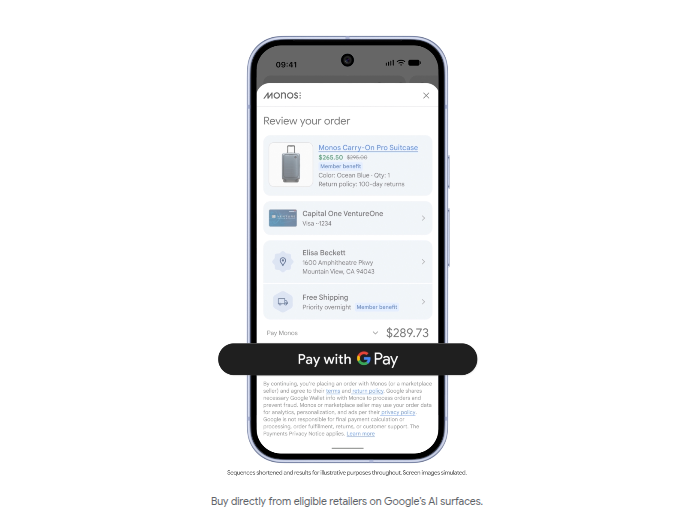
Google said UCP is designed to work with existing agentic protocols such as the Agent Payments Protocol or AP2 and the Model Context Protocol, which enable AI agents to process payments on behalf of users and leverage third-party software tools, respectively. The company plans to start using UCP for eligible product listings surfaced by AI mode in Search and in the Gemini application, so shoppers will be able to purchase them more easily. The process will involve agents using Google Pay, and later PayPal, to pay for the products and then passing on the customer’s shipping details that are stored in Google Wallet.
In addition, Google is giving retail partners access to a new, branded Business Agent that will pop up in Google Search results to answer questions about products on the behalf of the companies selling them. Merchants including Lowe’s Companies Inc., Michaels Stores Inc. and Reebok International Ltd. are among the early adopters..
Google Vice President of Ads and Commerce Vidhya Srinivasan told CNBC that the Business Agent is meant to address the fact that consumer behavior is shifting towards more conversational commerce experiences. “We want retailers to be able to connect to users on our surfaces, but using their own voice,” he explained.
Google said it’s also testing a new “Direct Offers” tool that will enable retailers to offer special discounts to users who purchase their products while using AI mode in Search. For instance, if someone tells Gemini “I’m looking for a modern, stylish rug for a high-traffic dining room. I host a lot of dinner parties, so I want something that is easy to clean,” brands will be able to set up campaigns to surface discounted products that match with the user’s description.
“Our role in the ecosystem is that of a matchmaker and one way is with ads,” Srinivasan said. “It’s a really big focus for us to innovate in the space that adds value to both retailers and buyers.”
Meanwhile, Google is also giving users new “data attributes” within its Merchant Seller tool, so brands can optimize their product listings for AI search. Finally, it announced a new Gemini Enterprise for Customer Experience suite to handle shopping and customer service for retailers and restaurants.
Shopify founder and Chief Executive Tobi Lutke told News that one of the most exciting things about AI agents is that they’re really good at finding products perfect for people with specific interests. “Like, I would never have searched for this product, but somehow it found me right on the other side,” he said. “This kind of serendipity is where the best of commerce happens.”
Agentic commerce rivalry heats up
Google’s updates underscore how retail and e-commerce is fast becoming a major battleground for AI agents, with rivals such as OpenAI Group PBC, Perplexity AI Inc. and Amazon.com Inc. all pushing to automate consumer’s shopping journeys.
OpenAI has made a number of moves in this direction, launching its Instant Checkout feature in September that lets users buy certain products directly through ChatGPT in return for a share of the transaction fee. It has also developed an Agentic Commerce Protocol in partnership with Stripe Inc., which could rival Google’s UCP due to its open-source nature.
Back in May, Perplexity revealed a partnership with PayPal Holdings Inc. that lets users purchase products, book flights and pay for concert tickets directly through its AI chat portal, without leaving the platform. Then in November, it followed up with a free agentic shopping tool for U.S. consumers.
Meanwhile, Amazon has launched its Shop Direct feature, which allows customers to browse products from third-party brands that don’t list their products on its online store. Some of those products are labeled with a “Buy for Me” button that activates an AI agent to complete purchases using the customer’s payment information held in Amazon. However, Amazon’s initiative has proven somewhat controversial, with a number of smaller brands complaining about seeing their products listed on Amazon.
It’s easy to see why retailers and AI giants are pushing so hard, though: McKinsey Co. said in a September report that agentic commerce could grow to become a $3 trillion opportunity by 2030.
Image: Google
Support our mission to keep content open and free by engaging with theCUBE community. Join theCUBE’s Alumni Trust Network, where technology leaders connect, share intelligence and create opportunities.
- 15M+ viewers of theCUBE videos, powering conversations across AI, cloud, cybersecurity and more
- 11.4k+ theCUBE alumni — Connect with more than 11,400 tech and business leaders shaping the future through a unique trusted-based network.
About News Media
Founded by tech visionaries John Furrier and Dave Vellante, News Media has built a dynamic ecosystem of industry-leading digital media brands that reach 15+ million elite tech professionals. Our new proprietary theCUBE AI Video Cloud is breaking ground in audience interaction, leveraging theCUBEai.com neural network to help technology companies make data-driven decisions and stay at the forefront of industry conversations.