If Google had a theme song, radio playlist favorite “Unstoppable” might be an appropriate choice. The company recently topped the $4 trillion market cap level — making it one of only two currently in that category. It’s ubiquitous in our daily lives, makes tons of money, and doesn’t shy away from moonshot goals.
But Google has never been one to take its lead as a given. Over the years, the company and its venture arm has been among the tech industry’s most active startup investors and highest spending acquirers, Crunchbase data shows.
Recent quarters have been particularly busy. In 2025, the company partook in the largest number of funding rounds in years. Those rounds also had the highest collective value since the market peak four years ago.
This year is also off to a brisk start with the company’s most famous spinout — Waymo — raising $16 billion this week in a new round valuing the autonomous driving company and robotaxi operator at $126 billion post-money. Google’s CapitalG and GV participated in the financing but were not lead investors. Last year, Waymo said it more than tripled its annual volume to 15 million rides.
Beyond that, Google has also been a prodigious lead investor. Last year, it led or co-led 67 known rounds valued at more than $5 billion.
Last year’s biggest rounds were a reported $1 billion financing for Anthropic and a $600 million CapitalG-led Series B for Physical Intelligence, a developer of AI software to power robots. This year, Google co-led a $300 million financing, alongside Nvidia and IVP, in AI inference startup Baseten.
Purchases are few but very expensive
In recent years, we’ve noticed that the most valuable technology companies aren’t acquiring very many venture-backed startups, even if they keep investing in them.
That said, fewer deals doesn’t always mean less spending. This is particularly true for Google, which last spring announced plans to buy cloud security provider Wiz for $32 billion in what stands to be the largest startup acquisition of all time.
That alone would have been enough for the year. But as 2025 was winding to a close, Alphabet swooped in with another jumbo M&A deal, scooping up data center energy provider Intersect Power for $4.75 billion in cash plus assumption of debt. Notably, both deals are outside Google’s core areas like search and advertising, which likely reflects desire to lessen antitrust scrutiny.
The money to do anything
It’s worth noting that when a company is valued in the trillions and has reliable profits and deep cash reserves to boot, it’s the opposite of financially restrained. Google has the ability to buy or invest in anything, at essentially any price. Given this, it’s instructive to look at what it’s not spending on, as well as where it’s directing capital.
For a tech giant, Google and Alphabet show little interest in acquiring companies with expertise in their most famous business segments. This could presumably be due to antitrust concerns or a confidence that these are areas they’ve got covered in-house. However, they are still quite aware of stress points — such as security and AI infrastructure — in which an outside company’s expertise and track record could offer big benefits.
Related reading:
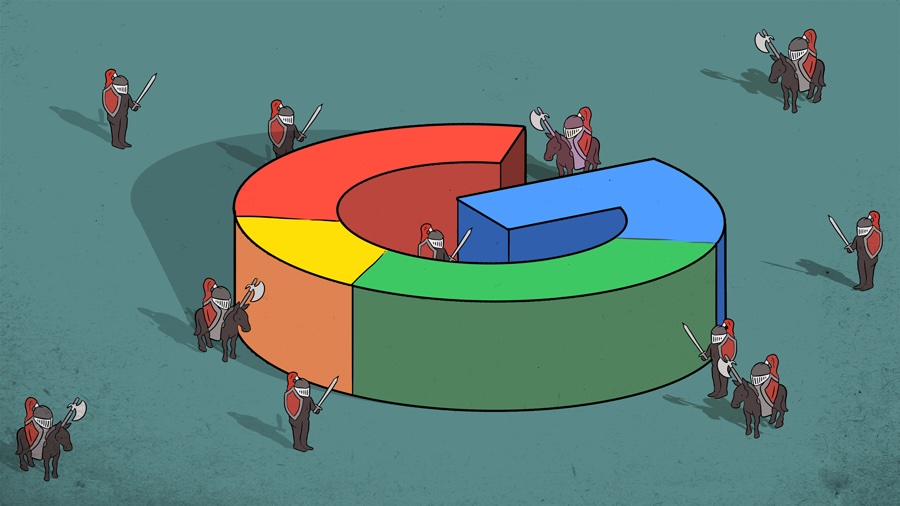
Illustration: Li-Anne Dias
Stay up to date with recent funding rounds, acquisitions, and more with the
Crunchbase Daily.