Ask most people to multiply 97 × 96 in their head, and they’ll freeze.
Ask someone who’s mastered mental math, and they’ll give you the answer in seconds: 9,312.
Here’s what they did differently:
They didn’t multiply 97 × 96 directly. They saw it as (100 – 3) × (100 – 4), which becomes 10,000 – 400 – 300 + 12 = 9,312.
The first person is trying to hold seven digits in their working memory simultaneously: 9…7…carry the 4…multiply by 9…
The person who can do mental math is not faster at raw computation. They compressed the complexity into a structure that their brain can process automatically.
This is how all mastery works.
The seventeen-step process became “it just happens.” The overwhelming project became a handful of patterns that they can see instantly.
You’re failing because you haven’t learned to compress complexity into the right structure yet.
Why Your Brain Can’t Handle Raw Complexity
You can hold about 4-7 chunks of information in your conscious attention at once.
That’s it. Four to seven chunks.
This is why 1000000000 is harder to read than 1,000,000,000. Same number, but without commas, your brain parses nine individual digits. With commas, you’re processing three chunks.
We invented commas because they match how our brains process information.
The entire history of human innovation is the history of compressing complexity into better structures.
We invented written language because spoken language disappears; you can’t hold an entire argument in your head simultaneously.
We invented algebra because solving problems with only words is cognitively overwhelming.
We invented spreadsheets because columns of numbers are easier to process than paragraphs describing the same data.
Music notation, circuit diagrams, architectural blueprints, chemical formulas—all compression tools. They restructure impossibly complex information into something your 4-7 chunk working memory can manipulate.
You simplify by finding better structures that compress more information into fewer chunks.
But beware; compressing too early can make you blind to what reality hasn’t yet revealed.
How to Think Better and Easier
Most people approach complexity in fatally flawed ways:

Shallow & Narrow: No planning. Pure chaos.
Deep & Narrow: Planning thirty moves deep for three pieces. When reality shifts to a piece they weren’t tracking, all that thinking becomes wasted effort.
Broad & Shallow: Twenty possible paths, two steps ahead on each. When a path happens, they’re trapped because they never planned what comes next.
All three fail for the same reason: trying to hold too much uncompressed information in working memory.
The solution: Think deep enough and broad enough, but only about what is worth thinking about.
The goal isn’t to track everything simultaneously. The goal is to know what to ignore.
Elon Musk doesn’t visit every department of every company every day. When Tesla was struggling with Model 3 production in 2018, he slept on the factory floor for weeks. He focused on the bottleneck while everything else was performing fine on autopilot.
You manage big projects by compressing the working parts into patterns you don’t have to think about, so you can focus your precious 4-7 chunks of working memory on the actual problems.
Making Infinite Use of Finite Means
Some complex systems have underlying grammars.
Not grammar like a language class. Grammar in the sense that Chomsky meant: a system for representing structures that makes infinite use of finite means.
We have twenty-six letters. An ancient person would assume we’d run out of words by now. The opposite happened. The finite means (26 letters) generate infinite permutations, infinite books, infinite ideas.
We have twelve musical keys. We should have run out of songs centuries ago. Instead, music is more abundant than ever.
The reason isn’t randomness. Rules constrain the permutations—a grammar that creates orderliness instead of chaos.
Not all complex systems compress this cleanly. Math has clean grammar. Music has clean grammar. Human behavior, legal systems, and many real-world problems have emergent complexity that resists neat compression.
But where grammars exist, it is inefficient to take on all the complexity. It is easier to manage when you find the finite means—the core, hard-to-vary principles—that generate the desirable outcomes.
Compression is how we create explanations that reach beyond our immediate experience.
The Neuroscience of Why This Works
When you compress complexity into patterns, you’re converting declarative knowledge (facts you consciously recall) into procedural knowledge (patterns you execute automatically).
Declarative knowledge uses working memory. Procedural knowledge doesn’t. Once you’ve practiced a pattern enough times, your brain executes it without conscious effort. The pattern itself becomes one chunk. Or less than one chunk, because it’s automatic.
Studies on skill acquisition show that expert performance relies heavily on pattern recognition stored in long-term memory, not conscious deliberation.
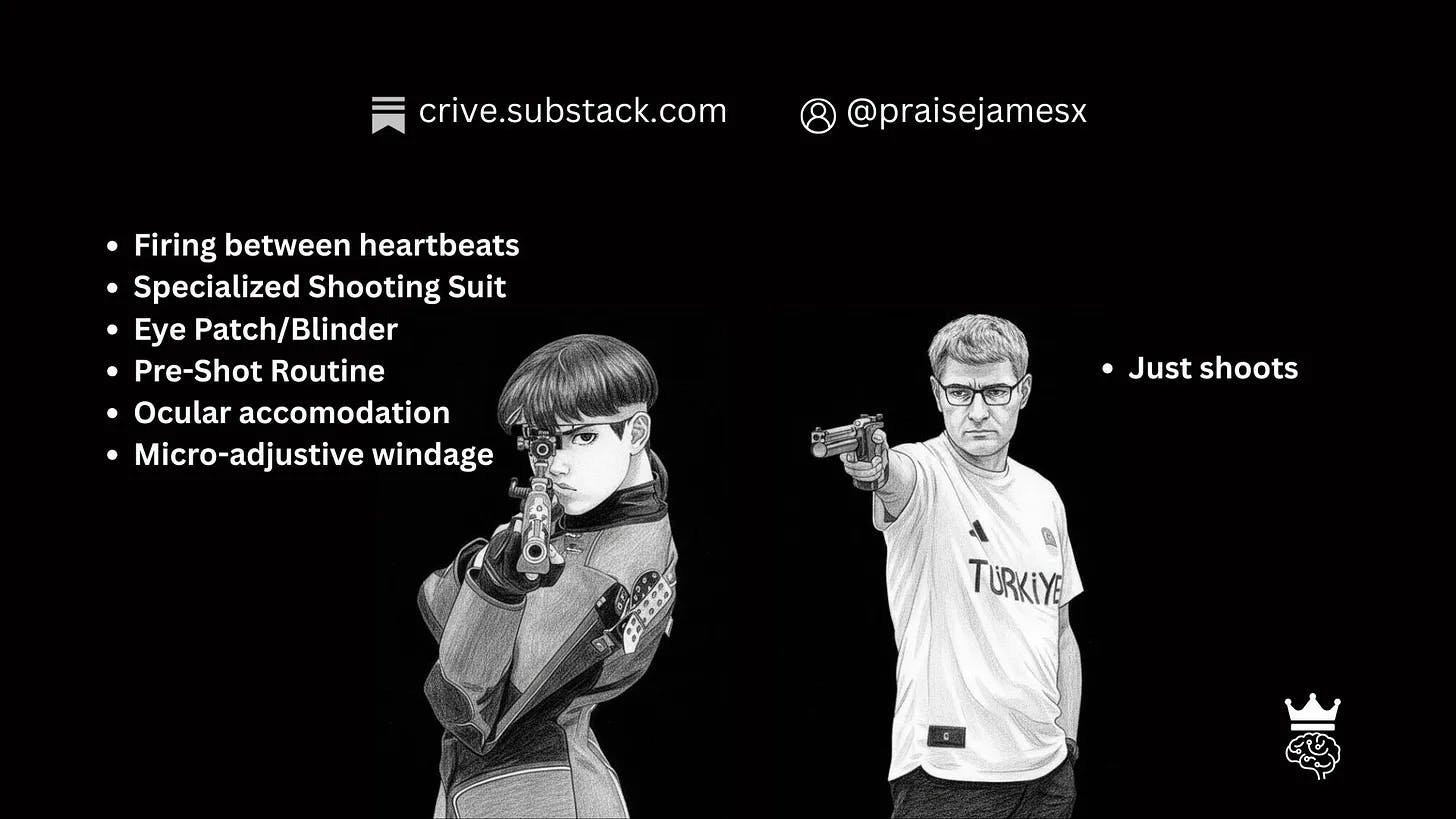
This is why Ronaldo doesn’t “just shoot.” He spent years compressing the mechanics into automatic procedural memory. During a game, “shoot” is one effortless chunk, freeing up his working memory to track defenders, angles, and timing.
How to Compress: In Three Steps
Step 1: Identify the Finite Means
Zoom out on your project. What are the 3-5 core components that, if changed, would fundamentally alter the entire structure?
These aren’t tasks. They’re the foundational variables that generate everything else.
For a software project: the data model, the user flow, and the core algorithm.
For a book: the central thesis, the narrative structure, and the types of evidence.
These are your finite means. Everything else is a permutation or combination of these core elements.
Step 2: Map the Infinite Uses
Once you have your finite means, map how they interact. What happens when you change one variable? What happens when two variables conflict?
Most people fail here. They try to plan for every specific scenario instead of understanding the generative rules.
In mental math: You don’t memorize that 97 × 96 = 9,312. You learn the rule: (a – x)(a – y) = a² – a(x + y) + xy. Now, you can solve any similar problem instantly.
In project management, you don’t plan every possible crisis. You understand the core dependencies: if component A fails, components B and C are affected, but D and E are independent. Map those relationships once, and you can respond to any failure.
Step 3: Relegate to Invisible Knowledge
Once you understand the grammar, the complexity becomes automatic. You stop thinking about the individual permutations because you’ve internalized the generative rules.
This is the final compression: from conscious execution to unconscious execution. From working memory to procedural memory.
Nothing Is Easy, Nothing Is Hard.
“Nothing is easy, nothing is hard. Only your thinking makes it so”~My friend, Mohammed Dikko
Difficulty is not a property of the task. It’s a property of your knowledge structure.
Multiplying 97 × 96 feels hard if you’re trying to hold nine digits in working memory. It feels easy if you’ve compressed it.
Building AI models for genome sequencing is “harder” than learning tic-tac-toe only because it has more prerequisites. More layers of finite means you need to compress first. But once you’ve compressed them, it stops feeling hard.
This is why knowledge creates exponential growth. Every piece of compressed complexity becomes leverage for compressing the next piece faster.
Why Discipline Gets Easier
Compression makes discipline easier.
Most people trying to force discipline without compression are white-knuckling through 47 steps when they should have found the 3 finite means that make those steps simpler.
Writing essays every week or doing 100 squats isn’t a sugary pleasure for me. It’s just way better than the consequences of not doing so.
If you’re unmotivated to do the work that gets you closer to your goals, you’re either:
- Misjudging the difficulty (it’s probably easier than you think)
- Not confident the action will bring results (which makes you execute poorly)
Your brain hates wasting energy on things that aren’t getting results. It would jump at anything better than the alternative.
Discipline is compressed knowledge executed with less friction.
Ease is earned; effort becomes elegance once understanding compounds
Why Most Advice Fails: You Can’t Copy Someone Else’s Compression
Good advice is reproducible.
If someone gives you “five steps to $10,000” and you do all five steps and make $0, one of two things is true:
- You’re missing an ingredient they didn’t mention
- It’s bullshit
Here’s the deeper problem: compression requires creative interpretation.
Someone had to discover that a² = (a + b)(a – b) + b² can be used to square large numbers mentally. It required creative insight into number relationships. Different cultures developed different mental math systems based on their unique perspectives.
What’s a “natural” chunk depends on your background, your mental models, and what patterns you’ve already internalized.
Any compression necessarily emphasizes some aspects and obscures others. The choice of what to emphasize is creative. This is why:
Great teachers don’t just know their subject; they know how to compress it for different audiences.
Great leaders don’t just see complexity, they see which compressions will help their team act effectively.
Great advice fails when it gives you someone else’s compression without helping you develop your own compression-finding ability.
The guru compressed THEIR complexity into a checklist. But their finite means aren’t your finite means. Their compression choices may not work for your mental architecture, your context, or your goals.
A cooking recipe works because you see all the ingredients and the entire process. Abstract advice fails because the missing ingredients are invisible: multivariate prerequisites, unstated skills, contextual knowledge, and most critically, the creative interpretation that made their compression work for them.
Good advice doesn’t just tell you what compressed, it teaches you how to find compressions. Bad advice gives you surface-level steps and blames you when they don’t work.
The real skill isn’t compression itself. It’s the meta-skill of choosing good compressions.
You can’t copy someone else’s compression. You have to develop your own ability to find patterns, test compressions, and know when a compression is working or failing.
This is why the mental math example works. It shows a specific, creative compression that someone discovered, not an automatic process you can blindly copy.
Find Your Finite Means
Pick one complex project you’re working on. One thing that feels overwhelming.
Ask yourself: What are the 3-5 core components that, if I understood them perfectly, would make everything else obvious?
Write them down. Map how they connect. Boxes and arrows, a diagram, anything that gets the relationships out of your head and onto a page where you can see them as one chunk.
Test your compression. Does it help you act more effectively? Does it reveal new possibilities? Does it break down when reality shifts? Adjust and iterate.
You can use my Fool-Proof AI Kit to accelerate this.
What are your finite means? Find them. Test them. Refine them.
Then build something wonderful.
Cheers,
Praise
If this essay helped you think clearly, you can explore my newsletter here.