Denver, CO – April 13th, 2026
Harper, the unified runtime for agentic engineering, today announced the release of Harper 5.0. The release makes the platform’s core fully open-source under the Apache 2.0 license, introduces RocksDB as a native storage engine (alongside LMDB), and makes Harper Pro, the enterprise offering, source-available under the Elastic License v2.
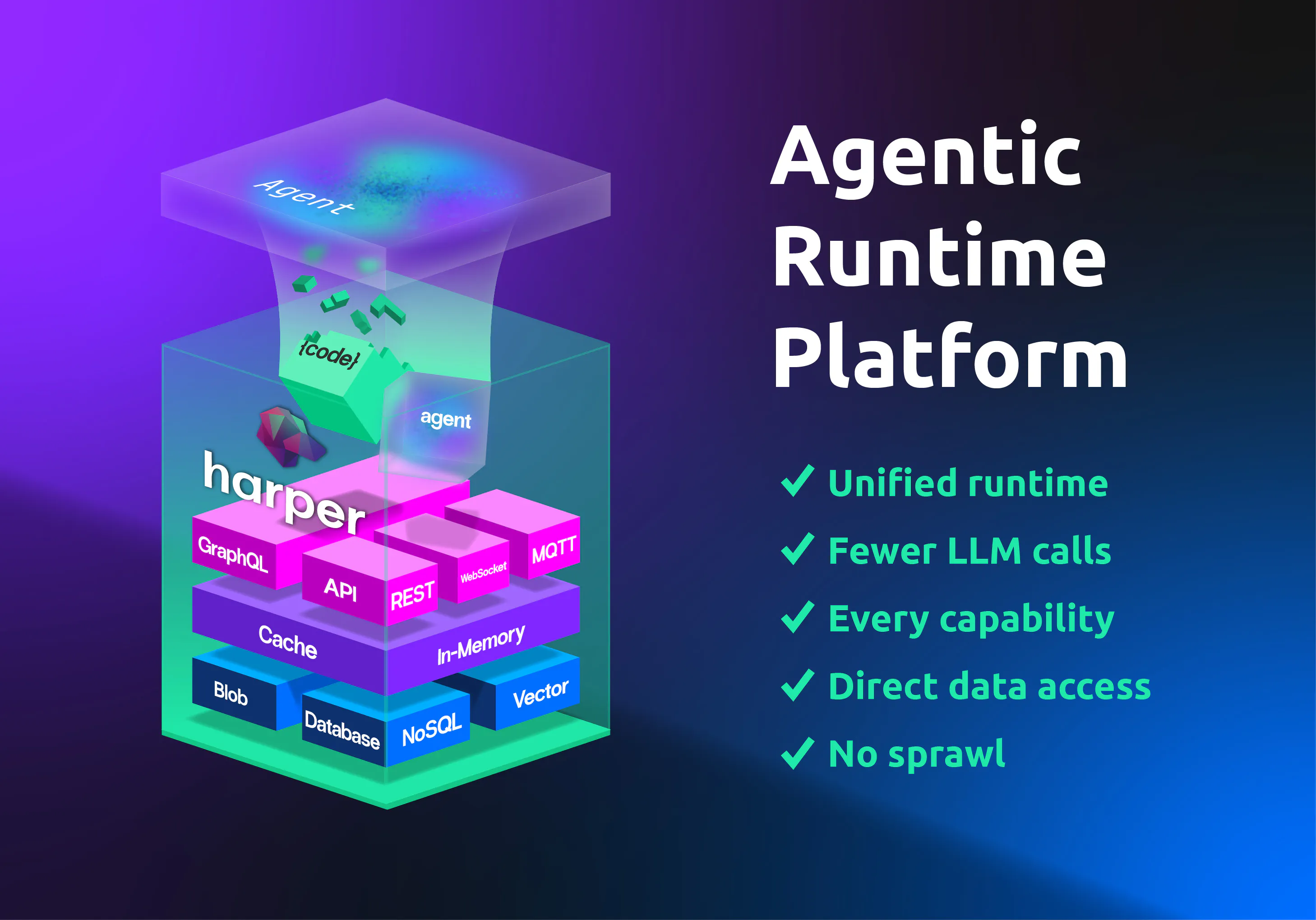
Harper combines database, cache, messaging, and application logic into a single, memory-optimized process, multi-threaded across all available cores. Rather than assembling and orchestrating separate services for each of these functions, developers build and deploy on one platform. The result is significantly reduced latency, with in-process data access measured in microseconds rather than the milliseconds typical of multi-service architectures. Additionally, native vector indexing allows agents to operate far more cost efficiently. It is a runtime built for the agentic era – giving developers and agents alike access to the full context of a deployable application both locally and globally at a fraction of the cost.
Open-Source Core, Source-Available Enterprise
The Harper core is now available under Apache 2.0 with no restrictions. Developers can use it, modify it, build commercial products on it, or contribute back to the project. Harper Pro, which adds distributed replication, clustering, and certificate management for enterprise-scale deployments, is source-available under ELv2. Developers can inspect and build the code, with the only restrictions being that it cannot be repackaged as a competing hosted service.
“Harper was founded on the principle of simplicity without sacrifice,” said Bari, Harper’s Director of Product. “By making our core open source and our enterprise package source available, we are giving the entire community the opportunity to see the value of this architecture for themselves, not just enterprise customers with the resources to evaluate it behind closed doors.”
New Storage Engine: RocksDB
Harper 5.0 introduces RocksDB as a native storage engine alongside the existing LMDB option. LMDB is known for highly optimized read performance. RocksDB, originally based on Google’s LevelDB research and maintained by Meta, adds strength in write-heavy workloads with large, variable-size records. The platform now also ships with improved transaction handling and isolation.
Existing deployments are not required to migrate. Both engines are fully supported, and migration scripts are provided for teams that choose to transition. The new RocksDB JavaScript binding is also open source and available for general use across the Node.js ecosystem.
Built for the Agentic Engineering Era
AI coding agents can generate impressive application prototypes, but a significant challenge remains in moving from prototype to production: connecting databases, caches, authentication, and deployment infrastructure across multiple systems. Harper’s single-process, multi-threaded, memory-optimized architecture gives AI agents a contained, fully integrated context to work within, reducing orchestration complexity and credential exposure. Native vector indexing and access to semantic caching at the edge allows agents to make up to 85% fewer LLM calls and lower cost exposure.
“By building on Harper, AI agents already have the full context of everything in one place,” said Kris Zyp, SVP of Engineering at Harper. “We have team members without coding experience deploying production-ready, geographically distributed applications with OAuth built in, just from a prompt.”
Developers can get started with npm create harper@latest, which scaffolds a project with native skills files for popular AI coding agents including Claude Code, OpenAI, and Cursor.
Availability
Harper 5.0 is available now. The open-source core is on GitHub at github.com/HarperFast/harper. Harper Fabric, the managed cloud platform for deploying Harper Pro, offers a free tier at fabric.harper.fast.
About Harper
Harper is a unified runtime that combines database, cache, messaging, and application logic into a single in-memory process for JavaScript and Node.js developers. Used by enterprise customers across retail, telecommunications, gaming, and aviation, Harper is a member of the OpenJS Foundation. The company is headquartered in Denver, Colorado.
Media Contact: Aleks Haugom, Senior Manager, GTM & Marketing at Harper (HarperDB, Inc.) [email protected]
Website: harper.fast
GitHub: github.com/HarperFast
Discord: discord.com/invite/VzZuaw3Xay