This story is specific to Power BI in Microsoft Fabric, and to a real architectural limitation that shaped how snapshot reporting had to be designed.
The Problem Didn’t Start as a Problem
As a Lead BI Engineer, I didn’t wake up one day and decide to create chaos.
It started innocently.
We need to preserve last year’s reports exactly as-is.
No problem.
Power BI allowed one app per workspace, so the solution seemed obvious:
- Clone the workspace.
- Clone the Semantic Model.
- Clone the Reports.
- Freeze it.
- Publish a separate app.
That was year one.
Most analytical complexity enters systems through perfectly reasonable local decisions – MIT Sloan Management Review.
At the time, this felt like discipline.
Then Year Two Happened
The next year, the same request came in.
We also need a snapshot for this year – finance & owners needs to compare and need it ASAP. Highest Priority.
So we did it again:
- New workspace.
- Same reports.
- Same semantic logic.
- Slightly different filters.
- Another app.
Still manageable. Still defensible.
Still wrong – We just didn’t know it yet.
Organizations often solve repeat problems by copying solutions rather than redesigning systems – Harvard Business Review.
This was copying, not designing.
When Workspaces Became a Time Dimension
By year three, something subtle had happened.
Workspaces were no longer environments.
They had become time containers:
- FY23 Workspace.
- FY24 Workspace.
- FY25 Workspace.
Each one contained:
- The same reports.
- The same visuals.
- Slightly different logic.
- Slightly different data cutoffs.
We weren’t versioning reports.
We were forking reality by year.
When infrastructure is used to encode business meaning, systems become brittle – DAMA International.
This was brittleness setting in.
The Workspaces Kept Growing – the Logic Didn’t
Here’s the important part.
Nothing inside those workspaces was meaningfully different.
- Same DAX
- Same dimensions
- Same measures
- Same layouts
The only difference was time.
And time was being modeled as infrastructure.
Time is the most mismanaged dimension in analytics systems – TDWI.
We felt that truth daily.
The Operational Weight Nobody Anticipated
Each new snapshot workspace meant:
- Another place to manage access.
- Another app link users could bookmark.
- Another artifact to document.
- Another explanation during onboarding.
Users didn’t say: “I need the FY24 snapshot.”
They said:
“I opened the report and the numbers look different.”
Now we had to ask:
“Which workspace did you open?”
When users must understand system internals to interpret results, the system has failed – Gartner.
That line hit uncomfortably close.
The Architecture Was Doing Too Much Work
Workspaces were never meant to answer:
- Is this mutable?
- Is this frozen?
- Is this historical?
But we forced them to.
We turned infrastructure into a proxy for governance semantics.
Governance mechanisms should be explicit, not inferred from structure – ISO (Information Governance Guidance)
Inference is fragile. Contracts are not.
The Constraint That Made This Inevitable
All of this traced back to one limitation:
One workspace could publish only one app.
That meant a workspace had to choose:
- Be current.
- Or be frozen.
There was no way to say:
Same reports. Same logic. Different guarantees.
So we encoded guarantees into duplication.
Duplication is often mistaken for control – Forrester.
We were living proof.
What Changed with Org Apps
When Org Apps became available in Microsoft Fabric, the announcement sounded small: Multiple apps per workspace.
According to Microsoft Fabric documentation, Org Apps are intended to separate how BI content is built inside workspaces from how it is consumed across the organization, enabling multiple curated app experiences to be published from the same workspace.
But architecturally, it was the missing piece.
Because now a workspace no longer had to represent time.
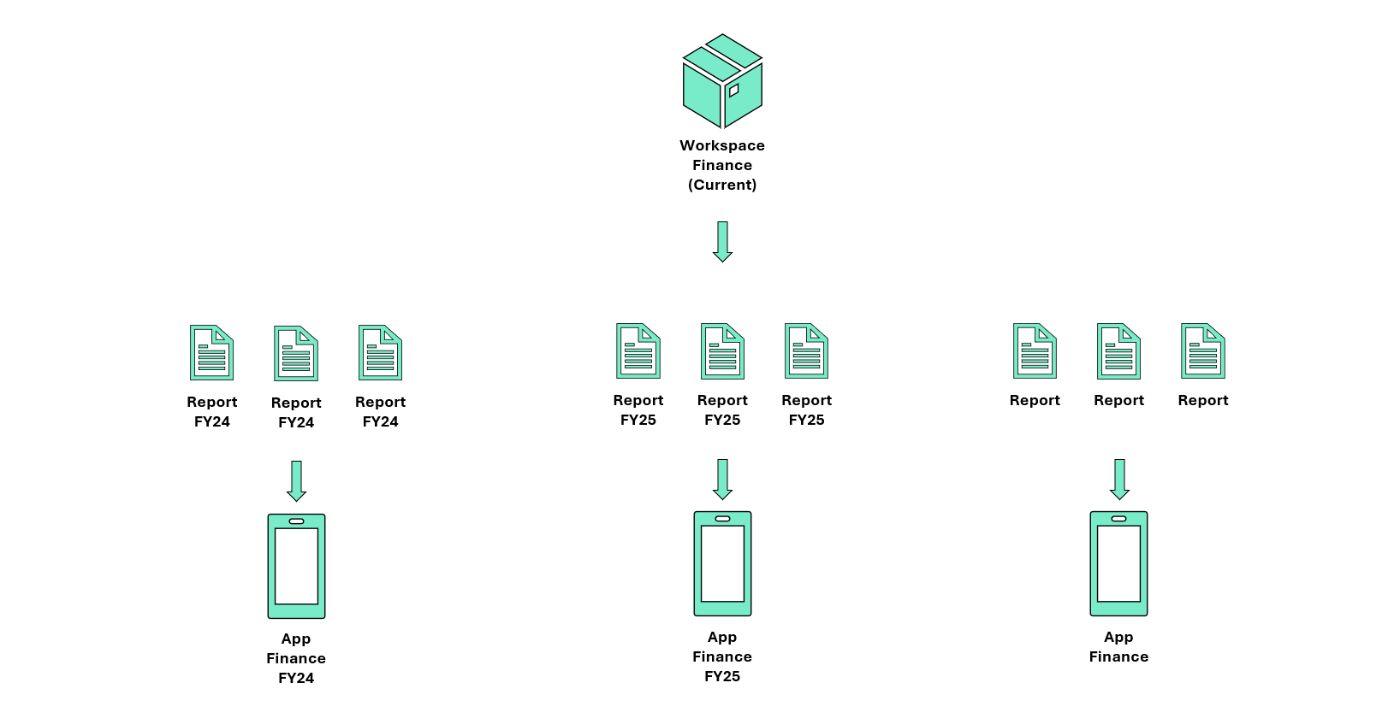
Now the model became:
- One workspace.
- Owns reports.
- Owns semantics.
- Evolves intentionally.
- Multiple Org Apps.
- FY24 Snapshot (Immutable).
- FY25 Snapshot (Immutable).
- Current View (Live).
Same reports. n Same logic. n Different contracts.
Separation of concerns is the foundation of scalable systems – Herbert Simon.
This was separation finally done right.
Why This Was the Missing Piece
Snapshots are not a reporting problem.
They are a distribution problem.
Org Apps let us express:
- What can change
- What must not
- Without duplicating infrastructure
Snapshots stopped being places. n They became explicit promises.
The Lesson This Took Years to Learn
We didn’t have a snapshot strategy problem.
We had a platform that forced: Immutability to look like duplication.
Org Apps didn’t add convenience.
They corrected a modeling error that enterprise BI teams had been compensating for quietly.
Systems eventually reflect the assumptions they are built on – Donella Meadows.
Final Thought
If you’ve never had to preserve a report exactly as it was five years ago, this may sound academic.
If you have – you already understand the relief.
Org Apps didn’t make BI easier.
They made it honest.
And once snapshots stop pretending to be infrastructure, everything else finally gets lighter.
At the time of writing, Org Apps are still evolving within Microsoft Fabric, with some capabilities in preview but the architectural direction is clear.