Previously, businesses have taken disruption lightly. Something to live with, something to respond to, something that will culminate. This closure of factories, collapse of suppliers, logistical difficulties, and system failures are all unwanted guests, and they push leaders to enter the crisis mode. The fag-end work is in teams, and decisions are fast; spending is too big, and hopefully it will be the environment, the next shock to be felt somewhere in the environment. Such a way of functioning is no longer a possibility. No longer is disruption an exception. It has been set to be the operating environment.
The change that exists is not the existence of such a risk but is the reaction of the organizations to the already practically existing risk. Reaction to anticipation and anticipation to autonomy are processes of gradual transition. This change is built in the digital twin, and then there, this is not a programmed model but an organism sensitive to the dynamics of the complex systems in the real world.
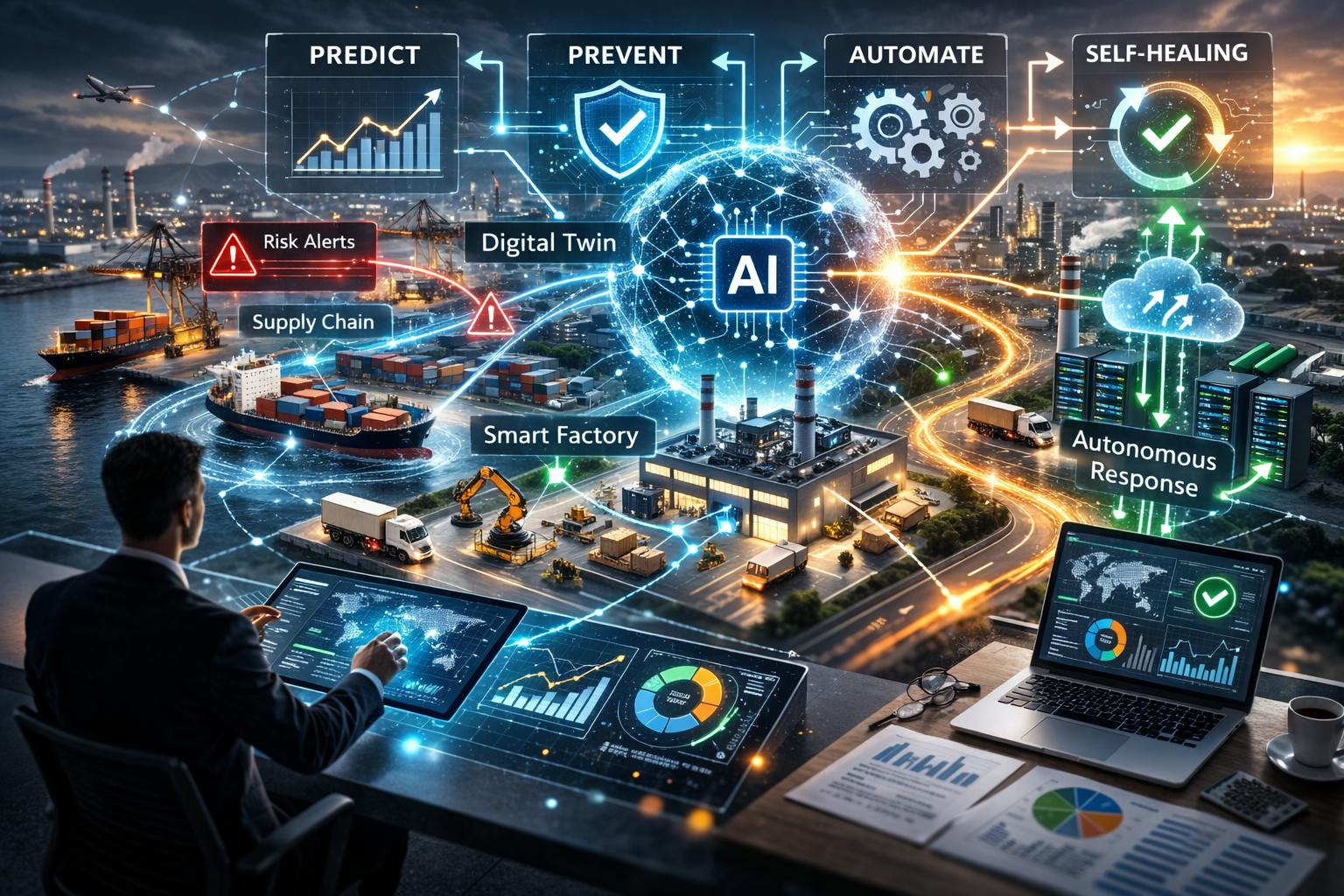
Digital twins and general-purpose AI reasoning systems can always recall the system telemetry, anticipate the wear-out of performance, and automatically undertake mitigation measures (redistribution of workload, dynamic scaling, and predictive maintenance) on vast-sized digital platforms (connected-device ecosystems, streaming platforms, and supply-chain software networks).
Digital twins as living mirrors of reality
Modern digital twins are no longer static models; they are continuously evolving representations of real-world systems. It is a continuously evolving impression of actual business, which is nourished by streams of data from machines, systems, suppliers, and working processes. It expresses contemporary reality and visions of a future eventuality. Chains of suppliers, materials, inventory flows, and logistics routes are examples of the links represented in supply chains. Machines, production lines, and environmental conditions find their expressions in factories. It includes reliability, software performance trends, and loads.
The dynamism of the twin enables leaders to experiment with ideas without having to disrupt the real world. By using a plant, the behavior of a line can be studied under conditions of stress. The effect of a disruption in levels can be observed by a supply team. A software process can also monitor the propagation of failures across systems. The reaction movement impulse starts here.
From prediction to autonomy
The anticipated issue alters the dialogue. The question of what did not happen turns into the question of what will not happen as the starting point for teams. The latter is enabled by digital twins, which replicate scenarios around the clock. They address prospective supplier closures, demand fluctuations, geopolitical disasters, equipment corrosion and wear, and system overloads prior to their actual occurrence.
The next step is autonomy. The extent of digital twins with compelling reasoning models is not limited to knowledge. They suggest actions, and under precise conditions, they implement them. The parameters of production are self-regulating. Before failure, maintenance is activated. Risks and non-habitual changes in inventory are addressed. Workloads are rerouted to software systems before performance is degraded. It is no longer entombed in alarms, but human teams remain in control. They are demoted to line managers.
Self healing systems in practice
Self-healing does not imply that systems are not destroyed. It means that they recognize stress at a very early stage and act wisely. In the manufacturing context, this can be observed in the form of equipment that adapts itself to prevent damage or trigger maintenance even before malfunctioning. The supply networks model considers it an automatic sourcing response to the supplier risk exceeding a threshold. It occurs in software ecosystems through redistribution of traffic or capacity scaling, or automatic isolation of failed parts.
This is not possible in one tool but in a closed loop. Data flows into the twin. The signal is decoded by the twin. Scenarios are evaluated. Decisions are made. Actions are taken. The result is sent back into the model. It is a system that requires time to learn via its shortcomings and evolve.
The quiet importance of governance
A government that is not in control is dangerous to the operations. The successful organizations see digital twins as a cloth of governance and not a by-product. Risk tolerance is defined. Escalation paths are clear. The decisions are limited in nature. The decisions made by the leaders are about what to automate and what people are supposed to research.
This design will make sure that digital twins are not a rogue intelligence but rather an equal force. Silos’ risk has been broken down and viewed by executives. Operations teams are not informed with noise. The real working of systems forms the basis of strategy and not spreadsheet forecasts of how systems work.
When ecosystems replace silos
To create digital twins, the starting points are not the growing assets and departments, but this is where the actual breakthrough is achieved. The supply chain cannot be called linear. Service layers, vendors, and integrations are the basis of software platforms. In a cross-cultural setting, organizational elements are not maximized, but the whole is enhanced.
Transparency suppresses information blindness. Personal fixes are substituted with integrated responses. Resilience is not a cost center but a belief center. Investors notice. Customers notice. The variation is experienced among staff members, where crisis is no longer periodic or temporary.
Leading into the autonomous era
Autonomous processes do not occur in a day, from reactive to autonomous operation. They start with the ability to see, then progress to predicting, and finally graduate to self-healing behavior with evident leadership. The possibility of such progression is based on the concept of digital twins. GenAI and intelligent reasoning algorithms are added as the means of turning wisdom into action.
The first flowing organizations are not pursuing novelty. Instead of being violent, they are opting to be non-violent. Instead of enhancing it, they are constructing shock-absorbing systems. Independence does not concern itself with replacing people in a world full of uncertainty. It is about providing them with a working system that is not contrary to them.