

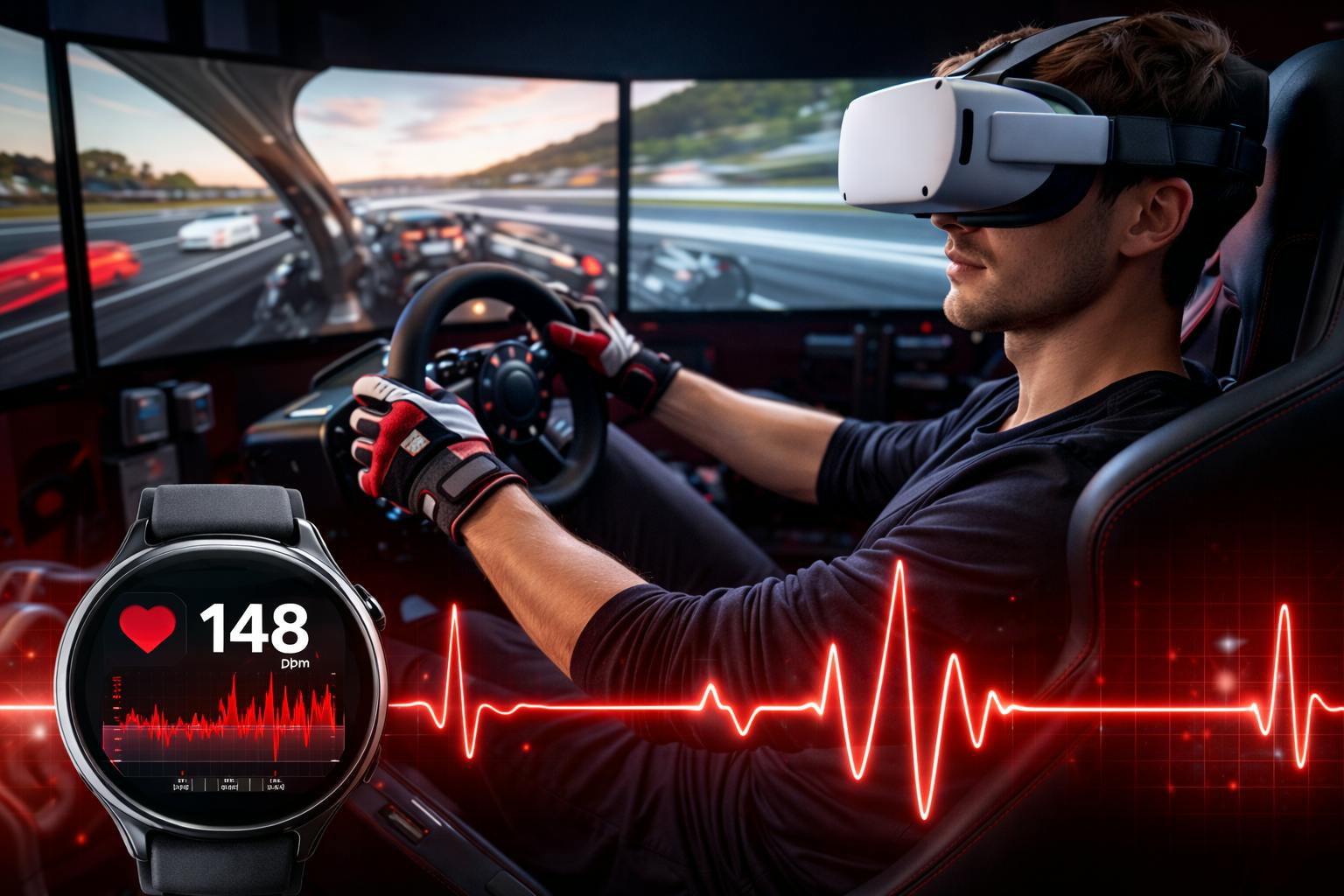
In my sim racing journey, I’m always looking for the next piece of technology that pushes immersion further, blurring the line between the real and virtual worlds. Ask any serious sim racer who’s gone all-out on a qualifying lap, and they’ll tell you it doesn’t feel like a game. Your hands sweat, your breathing quickens, and your heart rate spikes like you’re in the middle of a decent Peloton workout. That’s not imagination. It’s biology.
To paraphrase Max Verstappen’s thoughts on sim racing:
It’s exactly the same as in real life… I would say it’s like 90-95% there, but that 5% is mainly just that real touch of strapping yourself in the car and then feeling the G-forces… The cars aren’t real, the tracks aren’t real, but the racing is real.
That missing 5–10% is an opportunity. It’s the space where we layer in subtle, powerful details that push the experience even closer to reality. Every upgrade you add: force feedback, motion, VR, audio, and haptics, all add subtle levels of immersion to close that gap.
The truth is, your adrenal glands don’t know you’re sitting in the safety of your home and the difference between a digital track and a real-life race. They only know what your brain tells them. And with the right layers of immersion, your brain becomes remarkably easy to convince.
How Subtle Immersion Turns Sim Racing Into a Real Physiological Experience
Using a force feedback wheel, I can feel the wheel load up under pressure, just like trail-braking a real car through a corner. I can sense my body shift forward as the motion rig replicates deceleration. I can hear the tires scrub and gravel ping through the undercarriage with a good buttkicker, and see the flicker of sunlight through the trees in VR as I apex perfectly. Each layer works quietly in the background, but together they do something remarkable by convincing my brain that the experience is real.
And when my brain believes the danger, my body responds. Adrenaline surges on a late dive. My heart rate spikes when I lock wheels and slide toward the barrier. I feel the same focus, the same tunnel vision, the same post-race exhale of relief or triumph that real drivers describe.
That’s the magic we’re all chasing. Not perfection, but enough realism that the racing, the overtakes, the battles, the split-second decisions all feel authentic. Every transducer I bolt on, every setting I tweak, every new piece of gear is a small layer that blurs the gap towards real-life racing. The cars and tracks are virtual, but with every subtle improvement, the racing and the rush get undeniably, thrillingly real.
Your Brain Doesn’t Care That It’s a Simulator
What little I remember from my Intro to Biology class freshman year is that, from a neuroscience perspective, your brain is a pattern-recognition engine. It doesn’t ask philosophical questions like “Is this a simulation?” It asks practical ones like:
- Am I moving fast?
- Do my inputs have consequences?
- Is there risk, pressure, or uncertainty?
- Am I in control of something that could go wrong?
- Am I in danger?
When enough of those immersion boxes are checked, your brain can no longer tell the difference. It triggers the fight-or-flight response, that ancient survival mechanism where the body starts dumping stress hormones like adrenaline and cortisol into the bloodstream. Heart rate spikes, breathing quickens, blood rushes to your muscles, palms sweat, all in preparation for immediate action, giving us old wannabes that pure, electric hit of being truly alive behind the wheel again.
Layering Immersion
One of the biggest misconceptions about immersion is that it requires one massive upgrade, like a motion platform, a full cockpit, haptics, or VR. Immersion works best when it’s layered.
Each layer adds a subtle signal to your brain:
- Force feedback tells your muscles that the car has weight and weight shifts during cornering or impacts.
- Audio provides positional cues, tire sounds, and engine feedback.
- A proper seat ensures a natural driving position
- Tactile feedback adds vibration where your brain expects it.
- Haptics give you that reminder that gear shifts or track curbs create vibration
- VR increases the feeling of speed and spatial awareness by allowing you to naturally look into the apex or judging the distance to the car in front of or beside you.
None of these layers alone “fools” you. But used together, they form a coherent story your brain accepts. Once the story is believable, the body follows.
Virtual Reality
VR deserves special mention because it removes one of the brain’s biggest safety valves: peripheral reality. When using monitors, your brain always knows there’s a room around you. Ambient light, your dog moving through your field of vision, or somebody calling for your attention, VR eliminates that context. Your visual system, the dominant sense for spatial awareness, is fully committed to the simulation. There is no distraction.
The result? Stronger emotional responses, higher cognitive load, and often noticeably elevated heart rate. Many sim racers report needing breaks not because of motion sickness, but because VR racing is mentally exhausting in the same way real driving can be. That exhaustion is a clue: your brain is working hard because it thinks this matters.
How Does Measuring My Heart Rate Increase Immersion?
It doesn’t. Adding smartwatch data does nothing to increase immersion, but it adds validation. I know there is physiological stress in sim racing because my hands sweat, my breathing increases, and my muscles tense, but I cannot measure these indicators. This is where my smartwatch becomes another tool.
What We Can Measure
By monitoring heart rate during sessions, I can see exactly when immersion crosses into physiological stress:
- Grid starts
- Close wheel-to-wheel battles
- High-speed corners
- Late-race pressure laps
When sim racing, my heart rate data spikes well beyond resting or casual gaming levels. During intense moments, it resembles a light-to-moderate cardio workout (watch the video at the end of this article to see in unfold). These spikes happen without a conscious effort. Adding heart rate data onto race replays makes this even clearer. I can see the moment the pressure hits, not just in steering inputs or lap times, but in my biology.
The Value of Adding Your Heart Rate to Your Replays?
Seeing this data unlocks a deeper understanding of how I react under pressure, revealing areas where I can sharpen my driving skills. Understanding immersion isn’t just about chasing realism for its own sake; it offers practical, tangible benefits that elevate my sim racing experience.
- Training Under Pressure: When your body responds as if the danger is real, heart pounding as you brake into a tight corner or hold a slide, you can train yourself to stay composed. Real-world example: Formula 1 drivers like Lando Norris or Verstappen use sims to practice clutch moments under stress, and seeing your heart rate spike during a replay lets you replicate that high-stakes focus safely at home.
- Performance Awareness: Elevated heart rates often signal where mistakes creep in, oversteer from pushing too hard or a missed apex from tunnel vision. Pro sim racer Jarno Opmeer has noted how analyzing biofeedback helped him spot over-aggression in tight qualifying laps, turning those spikes into data to refine his lines.
- Fatigue Management: Mental exhaustion is very real in sim racing, even without physical G-forces. Watching your heart rate climb over an endurance race can teach you to pace yourself, mirroring how real drivers manage energy in long hauls. Take it from endurance sim racers who’ve learned to spot early fatigue signals to avoid costly errors.
- Appreciation of Sim Racing as a Discipline: This isn’t passive gaming, it’s an active, demanding craft you can measure and master. When you see your heart rate mirror a real driver’s after a nail-biting overtake, it’s a reminder of the skill and focus required. Think of how sim racing champions like Max Verstappen credit their simulator time for split-second decision-making, proving it’s a legitimate training ground.
Sim racing occupies a unique space where physical danger is stripped away, yet the psychological intensity remains as fierce as ever. This paradox is what fuels its excitement; every layer of immersion, from force feedback to VR, tricks your brain into treating virtual battles as real. Adding heart rate data to your replays doesn’t just enhance the thrill; it turns that intensity into a tool for growth, making every session a step toward mastery.
Watch My Demo Lap
You can provide your brain with consistent, subtle, believable signals. Once you do, the rest happens automatically. Your adrenal glands won’t ask whether it’s a simulation. Your heart won’t check if the car is virtual. Your body will respond as if it matters. Because to your brain, in that moment, it does. When it does, the experience is magical.
Check out my latest lap in Assetto Corsa Rally, complete with heart rate data as an overlay. Ignore the driving skills, I’m new to rallying.
(Disclaimer: I’m not a doctor; this is just my experience. Always check with a professional for health advice.)


