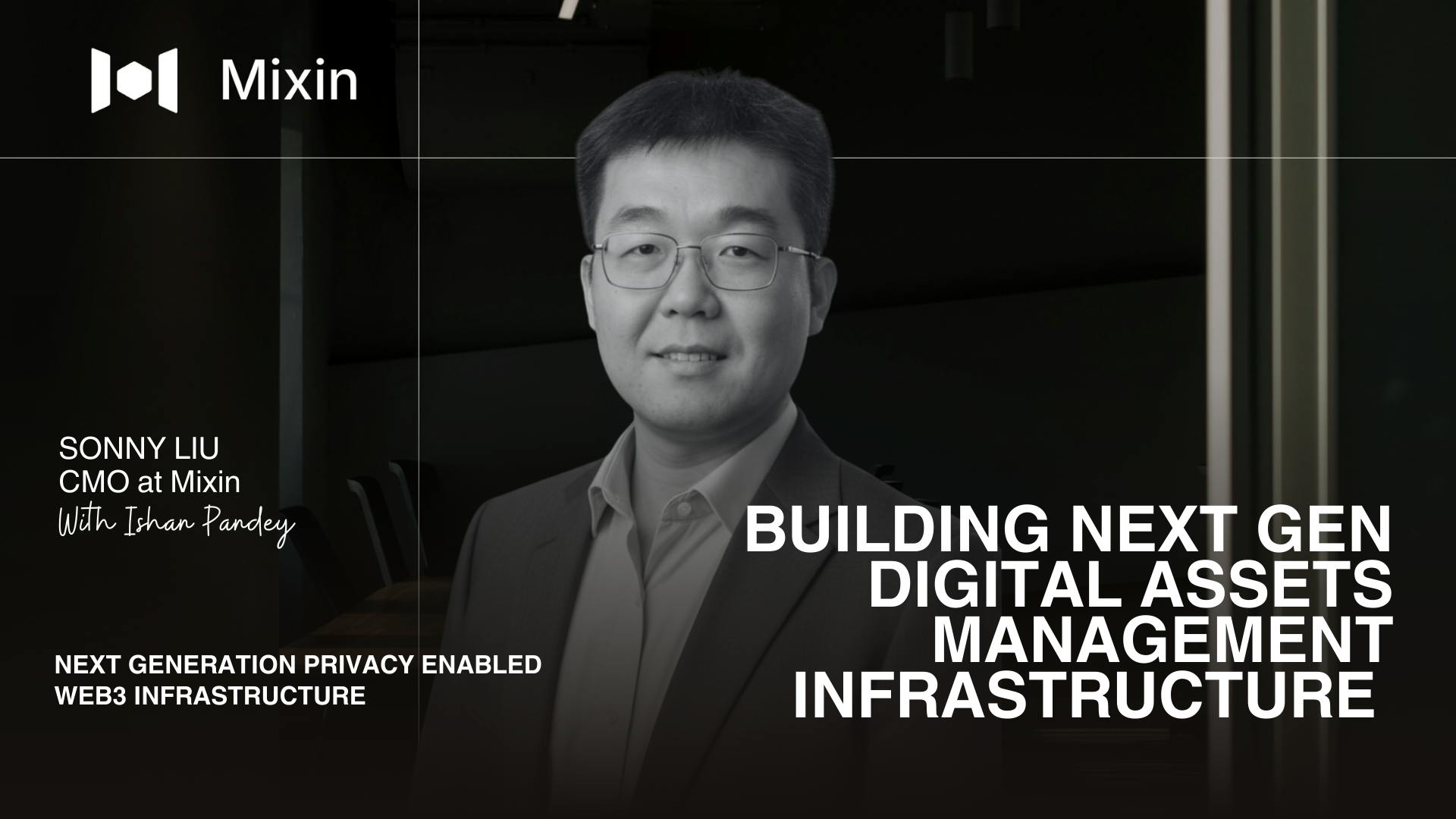
Crypto wallets often force users to choose between security, privacy, and usability. Since 2017, Mixin Messenger has been quietly building a different paradigm. With over $1 billion in assets under management and support for 2,900+ assets across 42 blockchains, the platform represents a contrarian bet: that users shouldn’t have to sacrifice self-custody for a Web2-like experience.
Today, we sit down with Sonny Liu, CMO at Mixin, to understand how they’re rethinking the relationship between social communication, asset privacy, and blockchain infrastructure.
Ishan Pandey: Hi Sonny, thank you for joining our “Behind the Startup” series. Please tell us about yourself and what drew you to Mixin’s mission of integrating privacy-first communication with multi-chain asset management?
Sonny Liu: Hi everyone, I’m Sonny from Mixin, currently responsible for product marketing. Mixin is a very forward-looking company. From the very beginning, the team has treated privacy, security, and usability as core product principles, not features you add later, but the foundation of everything we build.
In 2017, we launched our first product—Mixin, a private crypto wallet and messenger. At that time, most wallets like MetaMask, Electrum, and Trust Wallet were primarily built for asset management. They had relatively high learning curves, were better suited for users with existing blockchain knowledge, and were not very friendly to newcomers. Most of them were also designed mainly for web use. We often refer to that period as the Wallet 1.0 era.
It wasn’t until around 2025 that wallets like OKX Wallet and Phantom began integrating social features, which we describe as the Wallet 3.0 era. However, Mixin had already combined social communication with asset management back in 2017, with privacy and ease of use as first principles. That’s why we believe Mixin was ahead of its time.
As for why we deeply integrate privacy-first communication with multi-chain asset management—that’s a great question. Even outside of crypto, people generally do not want their assets or related communications to be exposed, whether it’s financial information or personal messages. While transparency is a core feature of blockchains, as crypto increasingly takes on real asset value, the demand for privacy becomes much more urgent.
The Mixin team recognized this clearly as early as 2017. Only by combining communication privacy and asset privacy can users truly protect themselves from unwanted exposure. Looking at 2026 and the strong performance of privacy coins like ZEC and XMR, it’s clear that privacy and security are becoming fundamental user needs—not nice-to-haves.
Ishan Pandey: Mixin was founded in 2017 around a problem that remains unsolved today: giving ordinary users a safe, intuitive way to manage crypto assets without sacrificing privacy or self-custody. How has the market’s understanding of this problem evolved since you started, and where do you see the biggest gaps today?
Sonny Liu: I touched on this earlier, but let me expand. You can essentially trace market demand by watching how decentralized wallets evolved. Wallet 1.0 was purely about custody, holding your assets. Wallet 2.0 improved usability and basic transfers. Wallet 3.0 added trading, market data, or social layers on top.
If you ask me what the biggest gap is today, I’d say privacy without hesitation. Almost no wallets treat privacy as a foundational design principle. Most treat it as an optional add-on or premium feature. Mixin was built with privacy at the protocol level inside a decentralized network. That’s the missing piece in the wider ecosystem.
What we’re seeing now is the market slowly catching up to what we understood in 2017: users need privacy not because they have something to hide, but because financial security and communication security are inseparable in the digital age.
Ishan Pandey: Most crypto wallets add privacy features as optional layers, and no Web3 firm provides a built-in encrypted messenger. But Mixin built privacy into the system architecture from day one. Can you explain the technical and philosophical reasoning behind this approach? What trade-offs did you have to navigate to maintain both privacy and usability?
Sonny Liu: We believe privacy is not just about financial data. Communication privacy matters just as much. In recent years, many users have accidentally leaked information that exposed their assets or personal context and suffered significant losses as a result. We live in an era of information overload, where small data leaks can quickly become public and exploited.
Privacy shouldn’t be a premium feature. It should be a default setting—something that protects users automatically, not something they need to opt into or configure.
Mixin uses end-to-end encryption based on the Signal Protocol, so no third party—not even us—can access messages. And users can transfer assets with zero fees between each other, making communication and asset usage feel seamless.
Here’s the important part: we didn’t have to compromise between usability and privacy because the entire system was designed around both from day one. That’s fundamentally different from bolting privacy onto an existing architecture. When privacy is foundational, you don’t sacrifice user experience—you enhance it by eliminating the friction and fear that comes with exposure.
Ishan Pandey: You’ve processed over $1 trillion in total transaction volume and manage over $1 billion in assets under management. Yet unlike most platforms at this scale, Mixin doesn’t monetize through custody or speculation. How does your diversified revenue model, spanning trading, wealth services, and membership, reflect your long-term philosophy?
Sonny Liu: Mixin was built to become a superapp—one that gives users access to the safest and most intuitive experience at the lowest possible cost. We generate revenue through trading, wealth services, and membership programs. But our philosophy is to pass as much economic benefit as possible back to users.
For example, in version 3.5.0 we introduced a 60 percent trading rebate program—meaning users get most of the trading fees back. And in version 3.6.0, we launched free internal transfers across imported Web3 wallets. Users can import any Web3 wallet into Mixin and transfer assets between them without fees.
This creates deep product lock-in, but not through extraction—through value. Users stay because we make their lives easier and cheaper, not because we’re trapping them or profiting from their assets under custody. That’s the foundation of long-term sustainability.
Ishan Pandey: Mixin integrates Signal Protocol-based end-to-end encryption for all communications. In most crypto products, messaging is either absent or an afterthought. Why did you make encrypted social communication a core component rather than treating it as a separate feature?
Sonny Liu: We reached this conclusion by studying actual user behavior. After transferring funds, people almost always switch to a messenger to coordinate or confirm details. It’s a very natural flow—send money, then message to say “sent” or “received.”
But in crypto, communication leaks can reveal sensitive details about wallet addresses, transaction amounts, or even personal security practices. Switching across apps increases exposure and risk every single time.
Combining encrypted communication with a wallet creates a much safer and more natural workflow. Users don’t have to think about security—they just communicate and transact in one protected environment. That’s the kind of simplicity that drives real adoption.
Ishan Pandey: Finally, what advice would you give to founders building infrastructure-focused crypto products in an industry that often rewards short-term narratives over long-term technical reliability?
Sonny Liu: Infrastructure isn’t built for headlines or market cycles. It’s built for longevity.
Trends change quickly in crypto, but fundamentals don’t. Over the past eight years, Mixin has adhered to three principles: privacy, security, and simplicity. In 2017, these principles weren’t popular and often conflicted with hype-driven growth strategies. But they are the reason infrastructure survives across market cycles.
Let me be direct about what this means:
-
Privacy should be the default, not an add-on. If you’re asking users to opt in to privacy, you’ve already failed them.
-
Security should be proven through design and time, not slogans. Anyone can claim to be secure. Proving it requires years of operation without compromise.
-
Simplicity matters because real adoption only happens when complex systems feel effortless to normal people. If your product requires a tutorial, you haven’t finished building it.
Short-term narratives attract attention, but long-term trust is earned through consistency. If you’re building infrastructure, your real audience isn’t today’s sentiment or this quarter’s metrics. It’s the users who will still rely on your system five or ten years from now.
At Mixin, that’s how we’ve been building for eight straight years. We believe it’s the only sustainable path for this industry.
Don’t forget to like and share the story!
:::tip
This author is an independent contributor publishing via our business blogging program. HackerNoon has reviewed the report for quality, but the claims herein belong to the author. #DYO
:::