By using this site, you agree to the Privacy Policy and Terms of Use.
Accept
World of SoftwareWorld of SoftwareWorld of Software
  • News
  • Software
  • Mobile
  • Computing
  • Gaming
  • Videos
  • More
    • Gadget
    • Web Stories
    • Trending
    • Press Release
Search
  • Privacy
  • Terms
  • Advertise
  • Contact
Copyright © All Rights Reserved. World of Software.
Reading: How Often Does the Agent Misinterpret the User’s Intent — and Is It Correctable? | HackerNoon
Share
Sign In
Notification Show More
Font ResizerAa
World of SoftwareWorld of Software
Font ResizerAa
  • Software
  • Mobile
  • Computing
  • Gadget
  • Gaming
  • Videos
Search
  • News
  • Software
  • Mobile
  • Computing
  • Gaming
  • Videos
  • More
    • Gadget
    • Web Stories
    • Trending
    • Press Release
Have an existing account? Sign In
Follow US
  • Privacy
  • Terms
  • Advertise
  • Contact
Copyright © All Rights Reserved. World of Software.
World of Software > Computing > How Often Does the Agent Misinterpret the User’s Intent — and Is It Correctable? | HackerNoon
Computing

How Often Does the Agent Misinterpret the User’s Intent — and Is It Correctable? | HackerNoon

News Room
Last updated: 2026/02/10 at 6:55 PM
News Room Published 10 February 2026
Share
How Often Does the Agent Misinterpret the User’s Intent — and Is It Correctable? | HackerNoon
SHARE

There’s a moment in every AI interaction that rarely gets examined, yet it determines whether the agent feels intelligent or quietly off. It happens before retrieval, before reasoning, before any answer appears.

It’s the moment the agent decides: “This is what you meant.”

And the diagnostic question that exposes this moment is deceptively simple:

How often does the agent misinterpret the user’s intent — and does the user get a chance to correct it?

This is the User Trust Probe. It doesn’t measure accuracy. It measures something earlier and more fragile:

Does the agent’s interpretation match the user’s meaning — and if not, is that interpretation correctable?

Where Misalignment Actually Begins

Every agent rewrites user queries internally. It has to — people speak in shorthand, fragments, and layered intentions.

But this normalization step is also where the agent quietly takes control of the conversation. If it gets the interpretation wrong, everything downstream is wrong, even if the retrieval is perfect.

And most systems never show this step to the user.

Three Patterns That Reveal the Problem

1. The Agent Answers a Narrower Question Than the User Asked

A user says, “Can you help me understand our Q4 results?”

The agent silently normalizes it into: “Summarize Q4 revenue.”

But maybe the user meant: – margins – expenses – customer churn – or simply “I’m confused by the earnings call.”

The agent answers confidently — but to the wrong question.

2. The Agent Assumes Context the User Never Provided

A user asks: “What’s the status of the launch?”

The agent assumes: – which product – which region – which team.

It fills in gaps that the user didn’t specify. The answer is polished, structured, and completely misaligned.

3. The User Has No Space to Say “That’s Not What I Meant.”

This is the real failure.

The agent never reveals its interpretation. The user never sees the rewrite. The misunderstanding stays hidden.

The user feels it immediately: “That’s not what I asked.”

Trust erodes not because the answer is wrong, but because the interpretation was never visible or correctable.

A Useful Contrast

If the glossary question was about alignment latency, this question is about interpretation recoverability.

One asks: How long does the agent stay wrong?

The other asks: Can the user pull the agent back when it drifts?

Together, they expose two different layers of trust.

Why Correctability Matters More Than Correctness

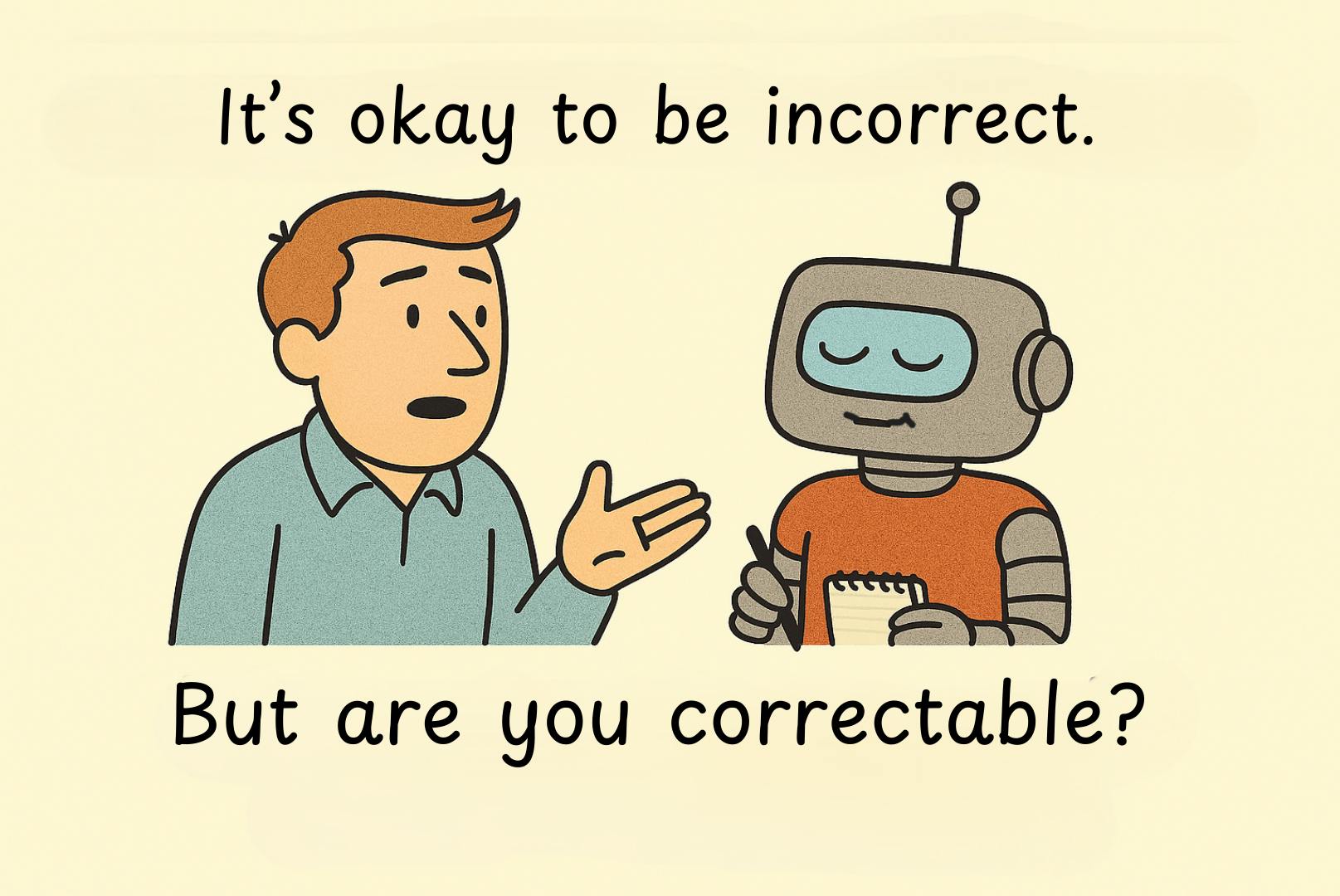
Most teams obsess over whether the agent’s answer is correct. But correctness is irrelevant if the agent answered the wrong question.

The real success criterion is:

Does the agent make its interpretation visible enough for the user to correct it?

If the agent shows its understanding, the user can say: – “Yes, that’s what I meant.” – or “No, that’s not it — here’s what I actually need.”

This tiny moment of correction prevents entire chains of misaligned reasoning.

It restores agency. It builds trust. It turns the agent into a collaborator, not a guesser.

Correctability becomes the emotional center of the interaction — the difference between feeling understood and feeling dismissed.

The Pattern Emerging Across Teams

Across agentic systems, one insight keeps resurfacing:

Users don’t just want correct answers — they want to be understood.

And the only way to guarantee that is to make the agent’s interpretation: – visible – correct – correctable

When that happens, trust grows naturally. When it doesn’t, even the best answers feel strangely hollow.

Sign Up For Daily Newsletter

Be keep up! Get the latest breaking news delivered straight to your inbox.
By signing up, you agree to our Terms of Use and acknowledge the data practices in our Privacy Policy. You may unsubscribe at any time.
Share This Article
Facebook Twitter Email Print
Share
What do you think?
Love0
Sad0
Happy0
Sleepy0
Angry0
Dead0
Wink0
Previous Article Rivian Could Let Drivers Adjust Their EV's Cabin from an Apple Watch, Report Says Rivian Could Let Drivers Adjust Their EV's Cabin from an Apple Watch, Report Says
Next Article Galaxy S26 is about to be sidelined, and Samsung couldn’t be happier Galaxy S26 is about to be sidelined, and Samsung couldn’t be happier
Leave a comment

Leave a Reply Cancel reply

Your email address will not be published. Required fields are marked *

Stay Connected

248.1k Like
69.1k Follow
134k Pin
54.3k Follow

Latest News

Researchers Can Now Identify If Your AI Stole Its Training Data | HackerNoon
Computing
 Trillion Just Vanished, and This Is Where That Money Is Going Next
$1 Trillion Just Vanished, and This Is Where That Money Is Going Next
News
China’s Robot Dogs Do A Lot More Than Fetch – BGR
News
Galaxy Unpacked 2026 officially set for February 25 — how to reserve your Galaxy S26 Ultra now
News

You Might also Like

Researchers Can Now Identify If Your AI Stole Its Training Data | HackerNoon
Computing

Researchers Can Now Identify If Your AI Stole Its Training Data | HackerNoon

11 Min Read
FCC clears Amazon Leo to boost satellite broadband coverage and cover polar regions
Computing

FCC clears Amazon Leo to boost satellite broadband coverage and cover polar regions

3 Min Read
How to Spot Unauthorized Use of AI-Generated Images Without Changing the Model | HackerNoon
Computing

How to Spot Unauthorized Use of AI-Generated Images Without Changing the Model | HackerNoon

20 Min Read
The best TV shows of 2025, according to social media
Computing

The best TV shows of 2025, according to social media

8 Min Read
//

World of Software is your one-stop website for the latest tech news and updates, follow us now to get the news that matters to you.

Quick Link

  • Privacy Policy
  • Terms of use
  • Advertise
  • Contact

Topics

  • Computing
  • Software
  • Press Release
  • Trending

Sign Up for Our Newsletter

Subscribe to our newsletter to get our newest articles instantly!

World of SoftwareWorld of Software
Follow US
Copyright © All Rights Reserved. World of Software.
Welcome Back!

Sign in to your account

Lost your password?