For decades, sportsbooks have been operating with a flawed model, of being the counterparty to the customers prediction, causing frustration that the house always wins. PRED is building something structurally different. As a peer-to-peer sports prediction exchange on Base blockchain, it takes no position against users, bans no winners, and generates revenue purely through trading fees.
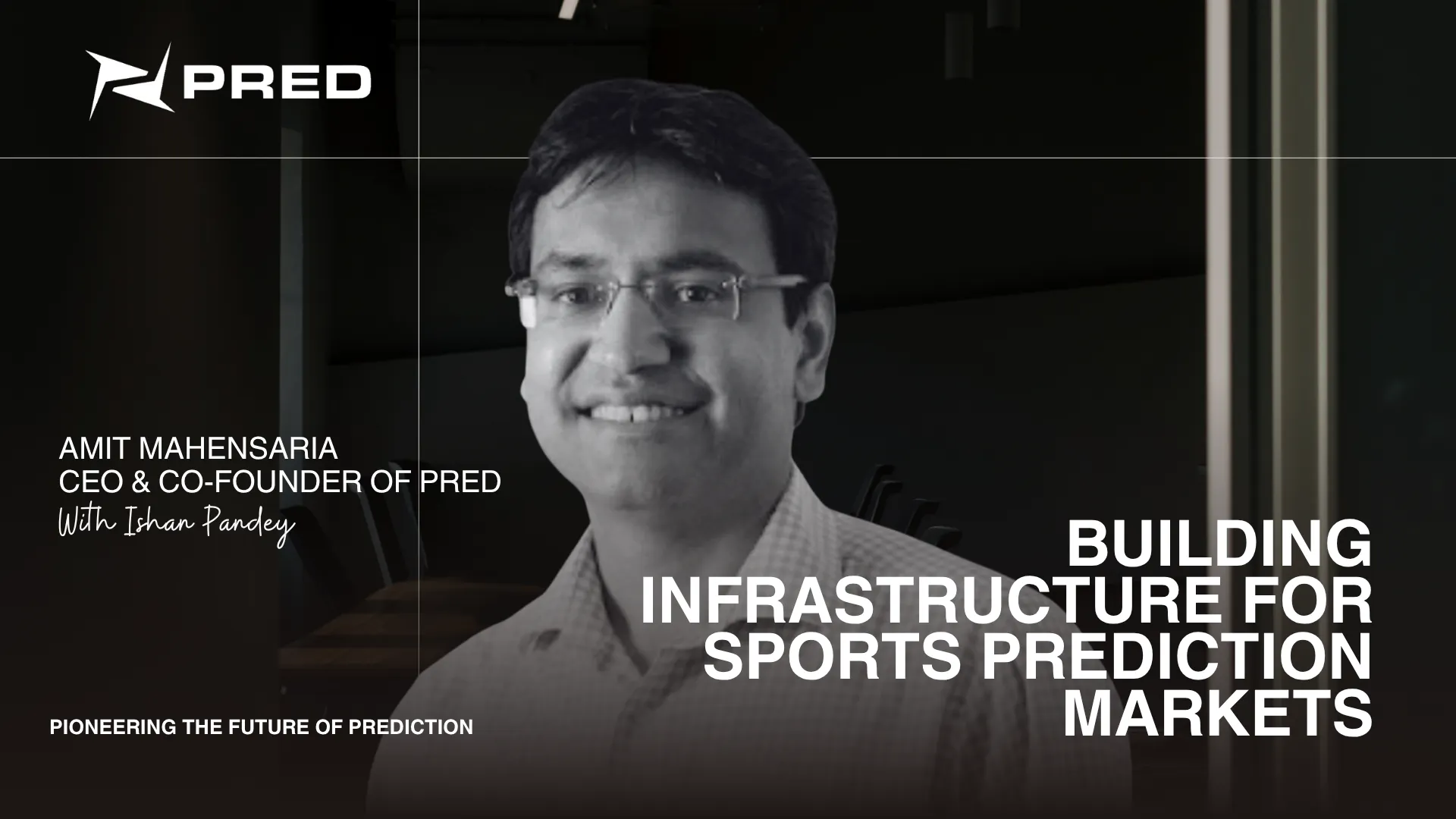
We sat down with Amit Mahensaria, CEO and co-founder of PRED, a former investment banker, and ex co-founder of Impartus (acquired by upGrad for ~$20M), to talk about why he left edtech for decentralized prediction markets, how PRED stacks up against Polymarket and Kalshi, and what the next phase of the platform looks like.
Ishan Pandey: Hi Amit, great to have you on our “Behind the Startup” series. You’ve built and exited a company in edtech, worked in investment banking and private equity, and now you’re running a decentralized sports prediction exchange. That’s a wide arc. What’s the common thread, and what pulled you into the prediction market space?
Amit Mahensaria: The common thread is building tech products that fundamentally change how a market operates, not just competing within the existing rules.
At Impartus, we built a video learning app, something that was personalised for learners and catered to their short attention span. That company was acquired by upGrad and scaled to over two million users. In investment banking and private equity before that, I spent years learning how liquidity forms, how price discovery works, and how the capital markets actually function.
But running underneath all of that, I’ve been trading sports markets for over 22 years. Not gambling, but analytically.
And in those two decades, I’ve experienced every structural flaw the traditional sportsbook model has: opaque pricing, winner discrimination, the house sitting on the other side of every position you take.
It’s an industry measured in hundreds of billions of dollars, and is built on a flawed model where company revenue = users losses. Frustrated, I started my own sports trading community around 7 years back and this sports prediction idea emanates from there.
The prediction market space gave me the opening.
Polymarket and Kalshi proved the on-chain model works and have since moved heavily into sports. But their infrastructure was originally designed for elections and macro events, and that origin shapes the product.
Sports trading has a different tempo. I wanted to build exchange infrastructure specifically for that rhythm, purpose built for sports, not adapted to a general-purpose tool.
So the pull was personal. I’ve lived with the problem as a trader for two decades. I understand how exchanges work from finance. I’ve built and scaled a venture before. PRED is where all of that converges.
Ishan Pandey: Polymarket and Kalshi have significant mindshare in the prediction market space. PRED is specifically targeting sports. Where does PRED actually beat them, technically, structurally, or in terms of user experience and where are the gaps you’re still closing?
Amit Mahensaria: Let’s be honest about the landscape. Polymarket and Kalshi have both moved aggressively into sports. Kalshi generates over 70% of its volume from sports. Polymarket has just signed an official partnership with MLS. So this isn’t a situation where we’re entering a category they’ve ignored. They’re here. The question is how we’re built differently.
Polymarket and Kalshi were designed as general-purpose prediction platforms. They started with elections, macro events, cultural outcomes, and expanded into sports as a growth lever.
Their infrastructure reflects that origin. Binary contracts, yes/no resolution, structures optimized for events that settle once and disappear.
Pred is designed as a high speed sports native exchange. That distinction shows up in the product. When a red card is shown in a Premier League match, the market reality changes in an instant.
The difference between 200ms and two seconds is the difference between capturing that price movement and watching it pass. Our matching engine was purpose-built for that tempo. Similarly, sports resolutions on PRED happen within a couple of minutes and not hours or days enabling users to celebrate their winnings and trade the next match; ask any user how important this is.
Second, spreads. We’re consistently targeting under 2% on active markets. For a trader taking multiple positions across a matchweek, tight spreads compound into real edge over time. In sports, retail users don’t market make or place limit orders in a live match, as prices can have extreme fluctuations within milliseconds when a goal happens. We’re innovating to enable protection of user’s limit orders, when high impact events happen, an industry first.
Third, more and more markets. Polymarket has 25 sub-markets in a match, whereas Stake has 500! Sports users love a variety of markets around an event. Rather than just who will win or what the score will be, sports fans want to predict and benefit from their deep insight on multiple trivia. We only think about sports day in day out, and will better innovate on markets than general purpose prediction markets.
Ishan Pandey: The core architecture of PRED is peer-to-peer order matching, not a traditional sportsbook model. Walk us through how the exchange mechanics actually work, how orders get matched, how prices are discovered, and why you believe this model produces better outcomes for users than a market-maker or AMM-based approach.
Amit Mahensaria: Think of Pred as a limit order book, similar to what you’d see on any financial exchange. If you want to take a position that Arsenal will beat Chelsea this weekend, you place an order at the price you’re willing to pay. Someone who disagrees, or who wants to trade the other side, places a counter-order. When the prices cross, the trade executes.
There’s no AMM setting the price algorithmically and no market maker sitting in the middle with an information advantage. Prices emerge from real supply and demand between traders who have done their own analysis. This is how financial exchanges work. Other prediction platforms are moving in this direction, but most of them bolted sports onto infrastructure that was built for something else. The gap shows up in execution speed and spread quality.
In an AMM model, liquidity providers take directional risk, and the pricing function is algorithmic rather than market-driven. AMMs work well for fungible token swaps where there’s continuous two-way flow. They work poorly for event-based markets where information is asymmetric and time-sensitive. You end up with impermanent loss for LPs and slippage for traders.
Settlement is on-chain on Base. Every matched position, every payout, fully auditable. You don’t need to trust us to honor results because the settlement logic is transparent.
Ishan Pandey: You claim PRED is currently the fastest exchange for sports predictions. Speed on a blockchain-based platform is a real engineering challenge. What does “fastest” mean concretely in your context, and what architectural decisions on Base enabled that?
Amit Mahensaria: Fastest means sub-200 millisecond execution from order submission to confirmation. For context, most prediction market platforms operate in the range of seconds to tens of seconds. In live sports, that latency is disqualifying. A goal can be scored, a red card can be given, and the market reality changes in an instant. If your platform can’t keep pace, your traders are trading on stale information, and that erodes trust.
The architectural decisions were deliberate. We chose Base for a reason. It gives us low gas costs and fast block times, which means we can process high-frequency order flow. But Base alone doesn’t get you to sub-200ms. We built a custom matching engine that processes the order book off-chain for speed and settles on-chain for transparency and finality.
This is the same approach that centralized crypto exchanges like Binance and Coinbase use: match fast, settle securely. The difference is that our settlement layer is public and verifiable. You can audit every trade.
We also implemented gasless onboarding, so new users aren’t blocked by the need to acquire ETH before they can start trading. That’s a UX decision more than a speed decision, but it removes a friction point that kills conversion for any blockchain-native product.
At PRED, speed is not only in trade execution, but in its DNA. We will be high speed in creation of new markets, high speed in settlement of markets and high speed in user experience.
Ishan Pandey: PRED offers 5–6% native yield on user deposits. In the current Web3 landscape that’s a meaningful differentiator, but it also raises questions around sustainability and risk. Where does that yield come from, and how do you make sure it doesn’t become a liability as the platform scales?
Amit Mahensaria: Fair to be skeptical. After the yield farming disasters of 2021 and 2022, anyone offering yield should have to explain exactly where it comes from.
On PRED, your deposited capital earns yield while it’s in your account. We’ve partnered with global institutions to generate yield via US Govt T-Bills on the underlying stablecoin deposits. Also since we don’t have huge marketing costs like deposit bonus, we are able to pass on a portion of our trading fees to the users in the form of yield. Your capital is working for you on all trades and even when you’re not actively trading.
Why did we build this into the core product? Because we think about the experience from a trader’s perspective. Serious traders think about capital efficiency all the time. On a traditional sportsbook, your deposited funds sit there earning nothing until you place a trade. On most prediction platforms, the same story. That’s an opportunity cost that adds up fast, especially for traders who maintain larger balances and are selective about their entries.
Ishan Pandey: “We never ban winners” is a strong brand promise. Traditional sportsbooks restrict or close accounts of consistently profitable bettors. What does that policy cost you operationally, and how does the P2P exchange model make it viable to actually keep that promise?
Amit Mahensaria: It costs us nothing. And that’s the entire point.
On a sportsbook, banning winners is a necessity. The house takes the other side of every position. If a trader is consistently right, the house is consistently losing money to that person. The rational business response is to limit or close their account. Every major sportsbook in the world does this. It’s not malice. It’s structural inevitability.
On an exchange, it works the other way. We don’t take the other side of your trade. When a skilled trader wins, they’re winning from another trader, not from us. Our revenue comes from commissions on completed trades, regardless of who profits on the position. Skilled traders generate the most volume. They make the markets tighter. They attract other traders. Banning them would be like a stock exchange kicking out its most active participants.
So “Winners Welcome” isn’t a marketing slogan we had to design around some operational cost. It’s a structural consequence of being an exchange. We literally could not ban winners and have it make business sense.
The real question is why anyone would trade on a platform that punishes skill. That’s the norm right now. We think it shouldn’t be.
Ishan Pandey: Accel is on your cap table. What does that partnership look like in practice beyond the cheque, and what did you learn from building and fundraising for Impartus that changed how you approached raising for PRED?
Amit Mahensaria: Accel led our $2.5 million round, with Coinbase Ventures, Reverie and prominent sports professionals. Accel has backed enough exchange and marketplace businesses that they understand the cold start problem, how liquidity networks form, and what kills them early. That’s more useful than capital alone when you’re building something where the product only works once there’s enough activity on both sides.
What I learned from Impartus about fundraising is that building a consumer product requires user obsession and patience.
The investors we brought on our cap table understand sports, understand consumer product building and are willing to back us for the long term, not only with this round but also subsequent growth rounds.
The biggest lesson from the first time around: pick investors who can argue with you, not just write cheques. Accel pushed back on our liquidity assumptions and our go-to-market sequencing.
That’s what you want from a lead investor.
Ishan Pandey: Three to four years from now, what does PRED look like at scale? Are you building toward a dominant sports prediction vertical, or is the infrastructure you’re building the foundation for something broader?
Amit Mahensaria: Three to four years from now, Pred is where serious traders go to trade sports. Not because we told them to, but because the liquidity is deep, the execution is fast, and the spreads are tight enough that professionals can operate here full-time. We want to be across every major sport and league globally, with sub-100ms execution and market data that rivals what you’d see on a Bloomberg terminal.
We’re building toward sports first and we’re building it deep. Soccer is our starting point, leading all the way to FIFA World Cup and NBA and other sports like Tennis, F1 will shortly follow because the global audiences and trading demand are already there. From there, it’s additional leagues, additional sports, player props, in-play markets, season futures. Sports alone is a massive surface area. We haven’t come close to exhausting it.
Could the infrastructure serve other event-based markets? Sure. The matching engine, settlement layer, and order book mechanics are general enough. But I’m not interested in becoming a general-purpose prediction platform. I’ve watched that playbook before.
You spread thin, you lose depth, and somebody more focused eats your lunch in every vertical.
We’re staying in sports. The more focused we are, the harder we become to replicate. That’s the strategy, and we’re not going to get bored of it halfway through.
Don’t forget to like and share the story!