We stopped moving, but we didn’t stop exploring.
The pandemic taught us that physical presence isn’t always necessary for communication. We have Zoom, Slack, and Miro. But these are 2D experiences confined to a screen. The next evolution of “Telework” isn’t a VR meeting room with legless cartoons; it is the presence in the Physical World.
Imagine sitting in London but physically exploring a Safari in Tanzania or inspecting a wind turbine in the North Sea, controlling a drone that acts as your eyes and ears. This is the concept of Virtual Mobility via Drone Avatars.
In this guide, we will architect the stack required to build a Drone Avatar System. We will move beyond simple recreational flying and look at the engineering required for Remote ID, Low-Latency Streaming, and Fleet Management.
The Concept: Decoupling Consciousness from Location
Transportation has historically meant moving your body (mass) to a location to acquire information (sight/sound). n Virtual Mobility hacks this equation. It moves the sensors (Camera/Mic) to the location and streams the data back to the user.
The Physics of the Swap:
- Physical Travel: High Energy (CO2), High Time Cost, High Risk.
- Drone Avatar: Low Energy (Battery), Instant Travel (Network Latency), Zero Physical Risk.
To make this a reality, we need to treat the drone not as a toy, but as an IoT Edge Device with a high-bandwidth uplink.
The Architecture: The Telepresence Stack
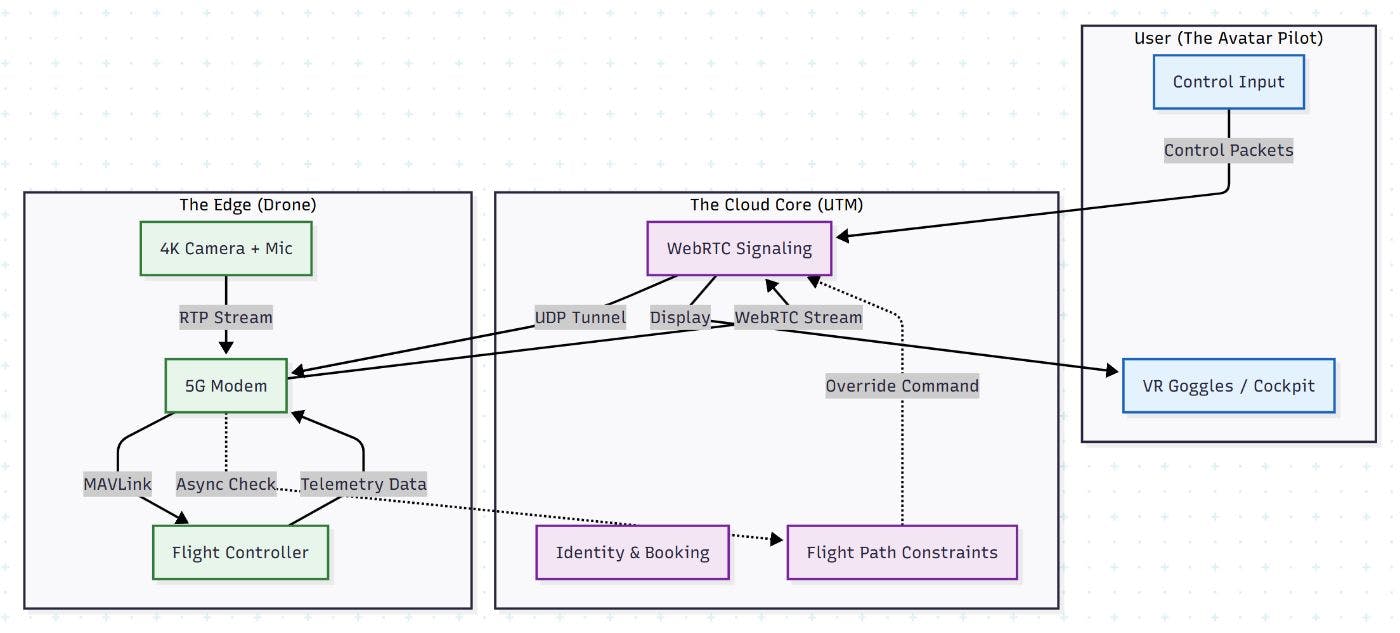
Building a drone avatar system requires three distinct layers:
-
The Edge (The Drone): Handles flight stability, collision avoidance, and video encoding.
-
The Pipe (The Network): 5G/LTE handling WebRTC streams and control signals (MAVLink).
-
The Core (UTM – UAS Traffic Management): The backend that manages flight paths, authentication, and “handing over” control between users.
Phase 1: The Edge – Telemetry & Control
We don’t need to reinvent flight physics. We use the MAVLink protocol to talk to the drone’s flight controller (usually ArduPilot or PX4).
Here is a Python script using dronekit to act as the onboard “Brain.” It connects to the flight controller and exposes a secure interface for the remote pilot.
from dronekit import connect, VehicleMode, LocationGlobalRelative
import time

# Connect to the Flight Controller (e.g., via UART or UDP)
# In production, this runs on a Raspberry Pi/Jetson onboard the drone
connection_string = '/dev/ttyACM0'
print(f"Connecting to vehicle on: {connection_string}")
vehicle = connect(connection_string, wait_ready=True)

def arm_and_takeoff(aTargetAltitude):
    print("Basic pre-arm checks")
    # Don't let the user fly if the drone has GPS issues
    while not vehicle.is_armable:
        print(" Waiting for vehicle to initialise...")
        time.sleep(1)

    print("Arming motors")
    vehicle.mode = VehicleMode("GUIDED")
    vehicle.armed = True

    while not vehicle.armed:
        print(" Waiting for arming...")
        time.sleep(1)

    print("Taking off!")
    vehicle.simple_takeoff(aTargetAltitude)

    # Wait until the vehicle reaches a safe height
    while True:
        print(f" Altitude: {vehicle.location.global_relative_frame.alt}")
        if vehicle.location.global_relative_frame.alt >= aTargetAltitude * 0.95:
            print("Reached target altitude")
            break
        time.sleep(1)

# In a real avatar scenario, these commands come from the Network Socket
# arm_and_takeoff(10)
Why this matters: The “Avatar” experience requires the drone to be semi-autonomous. The user says “Go Forward,” but the onboard code handles wind resistance and stabilization.
Phase 2: The Eyes – Low Latency Streaming
For a user to feel like they are the drone, latency must be below 200ms. Standard HLS/RTMP (used for YouTube) has 10+ seconds of lag. That causes motion sickness in VR.
We use GStreamer to pump raw H.264 video directly over UDP/SRT or WebRTC.
**The Pipeline:
Camera -> Hardware Encoder -> RTP/UDP -> 5G Network -> VR Headset
# Example GStreamer pipeline for sending low-latency video from the Drone
# This runs on the companion computer (e.g., Nvidia Jetson)

gst-launch-1.0 -v
  nvarguscamerasrc !
  'video/x-raw(memory:NVMM), width=1920, height=1080, framerate=30/1' !
  nvv4l2h264enc bitrate=5000000 insert-sps-pps=true !
  rtph264pay config-interval=1 !
  udpsink host=<USER_IP> port=5000
Phase 3: The Backend – Unmanned Traffic Management (UTM)
If we have thousands of “Drone Avatars” flying around, we can’t have chaos. We need a UTM (UAS Traffic Management) system. This is essentially “Air Traffic Control” for code.
The UTM is responsible for Remote ID (the license plate of the drone) and Geofencing. Before a user can take control, the system must validate the flight path.
The Flight Plan Schema (JSON)
Here is how we structure a flight authorization request in the backend database.
{
  "flight_id": "uuid-5501-abfe",
  "drone_id": "DRONE_AVATAR_01",
  "operator_id": "USER_778",
  "status": "APPROVED",
  "telemetry": {
    "altitude_limit": 120, // meters (legal limit)
    "geofence_polygon": [
      {"lat": 35.6895, "lon": 139.6917},
      {"lat": 35.6890, "lon": 139.6920},
      {"lat": 35.6885, "lon": 139.6910}
    ]
  },
  "emergency_failsafe": "RETURN_TO_HOME"
}
The Logic:
- User requests control.
- System checks weather (via API) and No-Fly Zones (via GeoJSON).
- System approves flight_id.
- If drone GPS leaves geofence_polygon, the system overrides the user and auto-lands.
Use Case: The Shared Economy of Sight
The most scalable implementation of this isn’t personal ownership; it’s Sharing. Just like Lime/Uber for scooters, we will see Drone-as-a-Service.
Scenario: The Virtual Safari
- Deployment: A park in Tanzania maintains a fleet of 50 drones with charging docks.
- Booking: You (in New York) pay $20 for a 30-minute slot.
- Connection: Your VR headset connects to Drone #14.
- Experience: You fly over the savannah. The drone’s microphone streams the sound of nature; the camera streams the visuals.
- Handover: When your battery hits 20%, the system auto-swaps your connection to a fresh drone, while the old one returns to charge.
The Social Impact
This technology is an equalizer.
- Accessibility: The elderly or physically disabled can “climb” mountains.
- Environment: Tourism without the jet fuel.
- Safety: Inspecting cracks in a bridge without hanging a human from a rope.
Conclusion
The technology for Drone Avatars exists today. We have the bandwidth (5G), the robotics (consumer drones), and the protocols (WebRTC).
The challenge for developers now is not “Can we fly?”, but “Can we manage?” Building the UTM layer – the secure, authenticated, and regulated backend is the key to unlocking the sky as a new medium for human experience.
Ready to build? Grab a programmable drone, install dronekit-python, and start coding your own avatar.