Moving to the cloud doesn’t automatically make your app faster. In fact, if you treat AWS like an on-premise data center, it will likely get slower.
We’ve all seen it: A team performs a “Lift and Shift,” moving their monolithic logic into containers and storage buckets, only to find that latency spikes, throughput creates bottlenecks, and costs explode. This is the difference between a Cloud Lift (copy-paste hosting) and a Cloud Shift (re-architecting for cloud-native characteristics).
In this engineering case study, we analyze a real-world high-traffic Content Management System (CMS) migration similar to those used by major news agencies that initially failed its performance requirements.
We will break down the three specific bottlenecks that killed performance: Lambda Cold Starts, S3 Access Patterns, and SQS Queue Blocking, and the exact architectural patterns used to fix them.
The Architecture: A Modern Serverless CMS
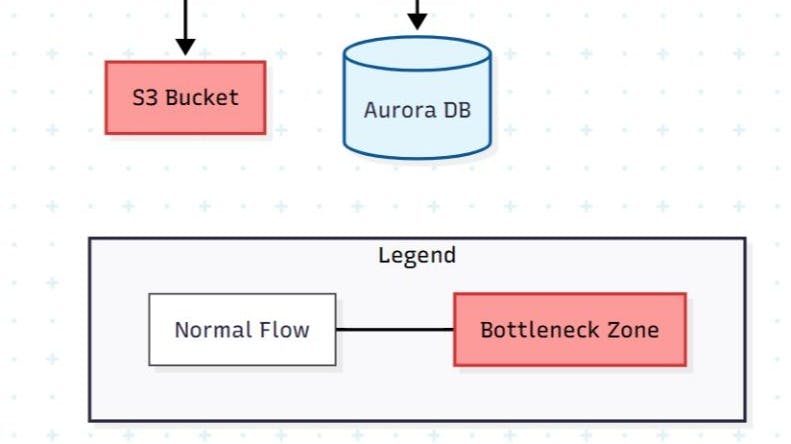
Before digging into the bugs, let’s look at the stack. The system handles article creation, image processing, and digital distribution. It relies heavily on event-driven architecture.
When load testing began, the system hit a wall. Here is how we debugged and optimized the “Big Three.”
Killer #1: The Lambda Cold Start
The Symptom:
The system required real-time responsiveness for editors saving drafts. However, intermittent requests were taking 2 to 3 seconds** longer than average.
The Root Cause:
We identified Cold Starts**. When a Lambda function hasn’t been invoked recently, or when the service scales out to handle a burst of traffic, AWS must initialize a new execution environment (download code, start runtime). For a heavy Java or Python application, this initialization lag is fatal for UX.
**The Fix: Provisioned Concurrency + Auto Scaling
We couldn’t rely on standard on-demand scaling. We needed “warm” environments ready to go.
- Provisioned Concurrency: We reserved a baseline of initialized instances to keep latency low (sub-100ms).
- Auto Scaling: We configured rules to scale the provisioned concurrency based on traffic patterns (Time-based for known peaks, metric-based for unexpected bursts).
Infrastructure as Code (Terraform)
Here is how you implement this fix in Terraform:
from aws_cdk import (
    aws_lambda as _lambda,
    aws_applicationautoscaling as appscaling,
    Stack
)
from constructs import Construct

class CmsPerformanceStack(Stack):
    def __init__(self, scope: Construct, construct_id: str, **kwargs) -> None:
        super().__init__(scope, construct_id, **kwargs)

        # 1. Define the Lambda Function
        cms_backend = _lambda.Function(self, "CmsBackend",
            runtime=_lambda.Runtime.PYTHON_3_9,
            handler="index.handler",
            code=_lambda.Code.from_asset("lambda_src"),
        )

        # 2. Create a Version (Provisioned Concurrency requires a Version or Alias)
        version = cms_backend.current_version

        # 3. Configure the Auto Scaling Target (Equivalent to aws_appautoscaling_target)
        # This automatically handles the Provisioned Concurrency Config behind the scenes
        alias = _lambda.Alias(self, "ProdAlias",
            alias_name="prod",
            version=version,
            provisioned_concurrent_executions=31 # The Baseline (Min Capacity)
        )

        # 4. Set up Auto Scaling Rules
        scaling_target = alias.add_auto_scaling(
            min_capacity=31,
            max_capacity=100
        )

        # Optional: Add Utilization Scaling (Scale up when 70% of provisioned is used)
        scaling_target.scale_on_utilization(
            utilization_target=0.70
        )
Result: Cold start frequency dropped from 15.6% to 3.5%. The trade-off? A cost increase (roughly $20 vs $300/month), but essential for business continuity.
Killer #2: S3 is Not a File System
The Symptom:
Image processing workflows were taking 0.3 to 1.0 seconds per file** just for I/O overhead. Multiply that by thousands of assets, and the pipeline stalled.
**The Root Cause:
Two anti-patterns were found:
- Bucket Copying: To handle permissions between different microservices, the system was physically copying files from IngestBucket to ProcessBucket.
- Config on S3: The application was reading environment configuration files (config.json) from S3 on every invocation.
The Fix: Pointer-Based Access & Parameter Store
- Stop Copying: We refactored the IAM roles. Instead of moving data, we granted the downstream ECS task GetObject permission to the source bucket. Data stays in place; only the pointer moves.
- Move Configs: S3 is too slow for configuration reads. We moved environment variables to AWS Systems Manager (SSM) Parameter Store and cached them in the Lambda environment variables.
The Impact
| Operation | Before (S3 Config Read) | After (Env/DB Read) |
|—-|—-|—-|
| Config Fetch | ~400ms | ~20ms |
| Image Pipeline | 6 steps (Copy/Read/Write) | 2 steps (Read/Write) |
Result: The image simulation process time dropped by 5.9 seconds per batch.
Killer #3: The FIFO Queue Trap
The Symptom:
During peak publishing hours (breaking news), the system needed to process 300 items per 10 minutes**. The system was failing to meet this throughput, causing a backlog of messages.
The Root Cause:
The architecture used SQS FIFO (First-In-First-Out)** queues for everything. n FIFO queues are strictly ordered, which means they effectively serialize processing. If Consumer A is slow processing Message 1, Consumer B cannot skip ahead to Message 2 if they belong to the same Message Group. You are artificially throttling your own concurrency.
The Fix: Standard Queues for Parallelism
We analyzed the business requirement: Did images really need to be processed in exact order? No.**
We migrated from FIFO queues to Standard SQS Queues.
- Standard Queues: Allow nearly unlimited throughput and massive parallel consumption.
- Trade-off: “At-least-once” delivery means you must handle occasional duplicate messages (idempotency), but the speed gain is massive.
import boto3

# Moving from FIFO to Standard allows parallel Lambda triggers
sqs = boto3.client('sqs')

def send_to_standard_queue(payload):
    response = sqs.send_message(
        QueueUrl="https://sqs.us-east-1.amazonaws.com/12345/cms-image-process-standard",
        MessageBody=str(payload)
        # No MessageGroupId needed here!
    )
    return response
Result: The backlog vanished. The system successfully processed daily averages of 8,700 publishing events without lag.
The “Performance-First” Workflow
The takeaway from this migration isn’t just about specific services; it’s about the lifecycle of performance testing. You cannot wait until production to test cloud limits.
We adopted a 3-stage performance model:
- Design Phase (UI/UX): Define the “Tolerance.” (e.g., “User must see the image in < 2 seconds”). If you need strict ordering (FIFO), accept the lower throughput now.
- Architecture Phase (SS): Design for the cloud. Don’t use S3 as a database. Don’t assume Lambdas are always warm.
- Tuning Phase (ST): Load test early. Calculate the Provisioned Concurrency cost vs. the Latency benefit.
Summary Checklist
- Lambda: Are you using Provisioned Concurrency for user-facing endpoints?
- S3: Are you copying files unnecessarily? Are you storing high-read configs in S3?
- SQS: Do you really need FIFO? If not, switch to Standard for parallelism.
The cloud offers infinite scale, but only if you untie the knots in your architecture first.