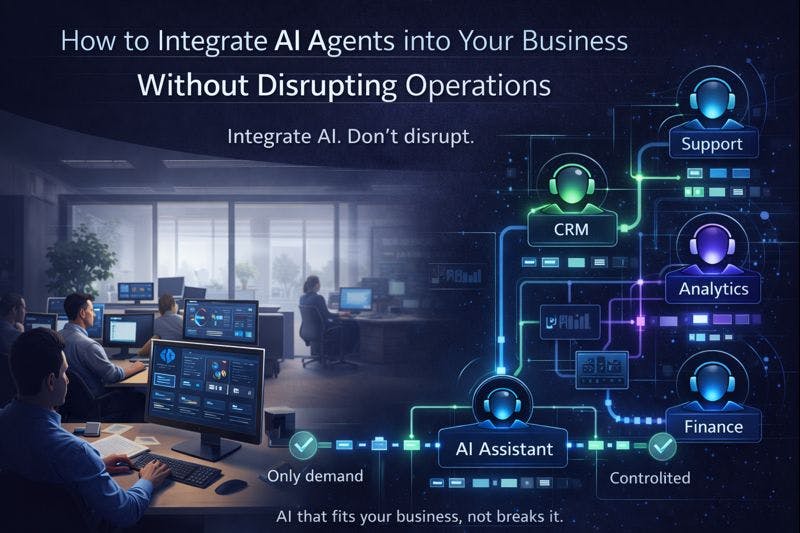
When most businesses hear “AI agents,” their first reaction is excitement. Their second reaction is fear. Excitement because AI promises speed, automation, and scalability. Fear because they imagine broken systems, confused employees, angry customers, and that one Monday morning where nothing works and everyone blames “the AI.”
Integrating AI agents into your business doesn’t have to feel like open-heart surgery. Done correctly, it feels more like hiring a very capable assistant who quietly makes things easier while your core operations continue as usual.
You won’t face any chaos, disruption or sudden “why is the CRM sending emails in Klingon?” moments.
Most integration disasters don’t happen because AI is dangerous. They happen because companies try to move too fast, automate too much, or skip the boring-but-critical preparation steps. AI is powerful, but it’s still software. It needs structure, rules, and a clear job description — just like any employee. Possibly more, because it won’t ask questions when confused. It will simply… do something.
This article will go you through all necessary steps to take while integrating AI into your system. It will be your guide to integrating AI agents in a way that:
- Feels controlled
- Protects existing workflows
- Improves efficiency without breaking trust
- Makes your team think, “Why didn’t we do this earlier?”
And yes, your accountant Karen is safe…for now.
Why Companies Fail at AI Integration
Despite all the excitement around AI, most failures aren’t caused by the technology itself — they result from organizational shortcomings. AI agents operate based on patterns, rules, and data, so if your business processes are inconsistent or unclear, the system will amplify those inefficiencies rather than solve them. One common mistake is attempting to replace humans too quickly. Employees may feel threatened, resist adoption, or override outputs, leading to errors and undermining trust in the system. Another critical factor is data quality. AI learns from the information it receives, so incomplete, outdated, or poorly structured data produces unreliable results and unpredictable behavior.
Overambitious launches are also a frequent pitfall. Companies often try to automate multiple departments at once — finance, support, sales — without giving themselves time to test, refine, and validate outputs. Finally, treating AI as magic instead of a structured tool is a recipe for disappointment. AI requires carefully designed architectures, clear permissions, defined workflows, and ongoing monitoring.
Key factors that cause AI projects to fail include:
- Unclear processes and inconsistent workflows
- Premature attempts to replace human roles
- Poor or unstructured data
- Overambitious, multi-department launches
- Treating AI as a “plug-and-play” solution
Addressing these areas upfront is essential for a successful, non-disruptive AI integration.
The Non-Disruptive Approach
A calm, incremental approach is what separates successful AI integration from projects that create stress and confusion. The core principle is simple: AI should be introduced as an assistant, not a replacement. When AI is positioned as support, it strengthens existing teams instead of competing with them. In customer support, this means AI can draft responses, categorize tickets, and flag urgent cases, while humans remain responsible for final approval. In sales, AI can clean CRM data, summarize conversations, and highlight missing follow-ups, but the human still owns the relationship and the decision-making. This keeps control where it belongs and allows trust in the system to grow naturally.
Another important element is running AI in “shadow mode.” In this phase, AI works quietly in the background, performing the same tasks as humans without influencing real operations. Its results are reviewed, compared, and corrected, but not executed automatically. Shadow mode turns AI into a learning system rather than a risk factor. Teams can see how it behaves, where it makes mistakes, and how quickly it improves, all without exposing customers or operations to potential errors.
The non-disruptive approach relies on three foundational principles:
- AI supports humans before it replaces any manual work
- AI is validated in shadow mode before becoming operational
- Responsibility is transferred gradually, not instantly
By following this structure, AI becomes a stabilizing force rather than a destabilizing one. Instead of feeling like a risky experiment, it starts to feel like a dependable colleague that quietly improves productivity.
Where to Start
Not every process is suitable for AI at the beginning. The safest entry points are areas where mistakes are visible, easy to correct, and unlikely to cause serious harm. These environments allow AI to learn while protecting the business from disruption. They also make it easier for teams to trust the technology, because any errors can be quickly identified and fixed without impacting customers, revenue, or compliance.
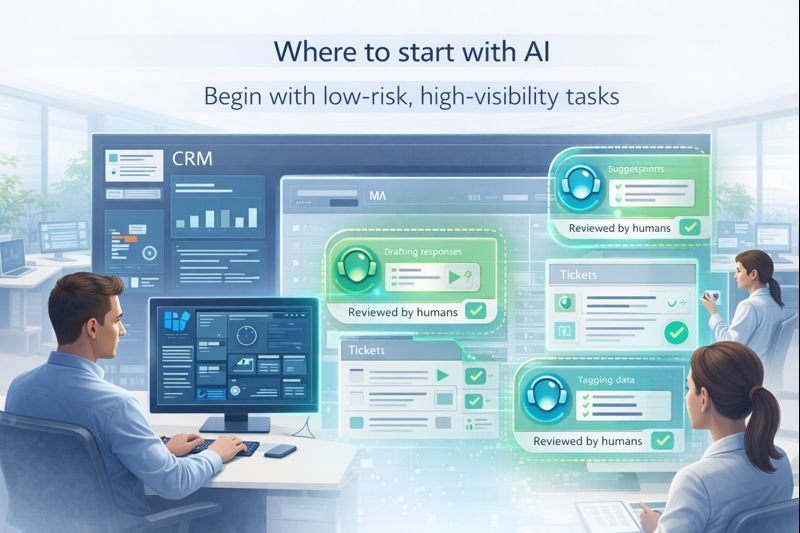
Processes that follow clear patterns are especially good candidates. AI works best when it can recognize structure and repetition, such as ticket categorization, document searches, or data summaries. When the benefits of automation are measurable even on a small scale, teams can clearly see the value AI is adding. This creates momentum and confidence, which are critical for expanding AI into more sensitive workflows later.
The best starting areas usually include:
- Customer support, where AI can draft replies and classify issues before human review
- Internal knowledge management, where AI helps employees find information and reduces dependency on key individuals
- Reporting and analytics, where AI summarizes data and highlights trends without changing decision authority
These areas provide fast, visible wins. They demonstrate AI’s usefulness without putting operations at risk and prepare both systems and teams for more advanced integrations in the future.
The Human Factor in AI Adoption
Technology alone does not guarantee success, but people make or break AI initiatives. Employees need to understand AI’s purpose, limitations, and scope before they embrace it. Open communication and transparency are critical. When staff know that AI is designed to relieve repetitive work rather than replace them, adoption becomes smoother and engagement increases. Properly managing expectations helps prevent fear-driven resistance that could undermine the integration process.
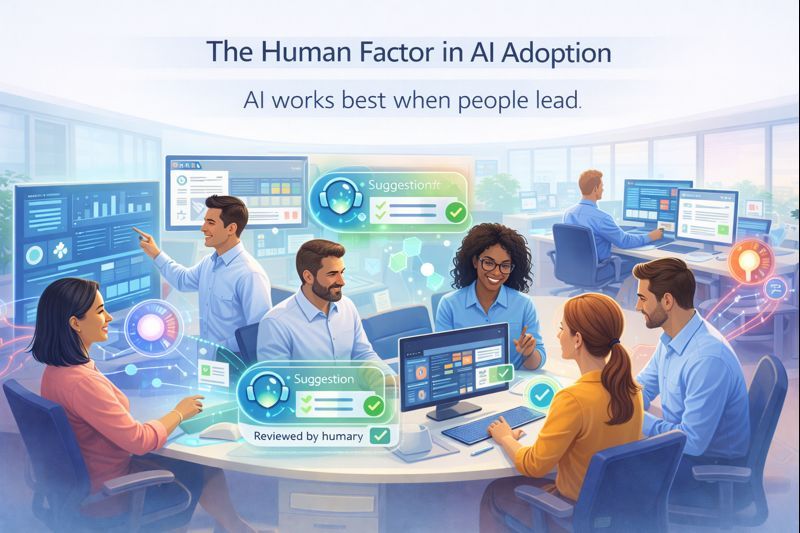
By involving employees in testing, monitoring, and feedback loops, businesses foster a sense of ownership and collaboration. This human-centered approach ensures that AI adoption is aligned with operational realities, rather than imposed as an abstract or disconnected technological experiment.
Early oversight also prevents errors from propagating. Human-in-the-loop supervision allows teams to catch mistakes, refine AI behavior, and establish standard operating procedures for continued use. Over time, this supervision diminishes as trust grows and AI agents prove reliability. Successful organizations balance technological sophistication with human judgment, creating a system that is both intelligent and resilient.
Key Takeaways
Integrating AI agents into a business doesn’t need to be dramatic or disruptive. Success requires careful planning, thoughtful process design, and attention to human factors. Starting small in low-risk areas, running shadow modes, and ensuring modular, predictable workflows allows AI to add value without creating operational chaos. Transparency, employee engagement, and gradual transfer of responsibility help cultivate trust, ensuring adoption is smooth and sustainable.
Ultimately, AI integration should feel like a productivity upgrade rather than a radical overhaul. By combining strategy, clear rules, and human oversight, businesses can achieve faster, more reliable operations while maintaining stability, employee satisfaction, and customer confidence.