
By using this site, you agree to the Privacy Policy and Terms of Use.
Accept
World of SoftwareWorld of SoftwareWorld of Software
  • News
  • Software
  • Mobile
  • Computing
  • Gaming
  • Videos
  • More
    • Gadget
    • Web Stories
    • Trending
    • Press Release
Search
  • Privacy
  • Terms
  • Advertise
  • Contact
Copyright © All Rights Reserved. World of Software.
Reading: How to use social media for ecommerce: tips and best practices
Share
Sign In
Notification Show More
Font ResizerAa
World of SoftwareWorld of Software
Font ResizerAa
  • Software
  • Mobile
  • Computing
  • Gadget
  • Gaming
  • Videos
Search
  • News
  • Software
  • Mobile
  • Computing
  • Gaming
  • Videos
  • More
    • Gadget
    • Web Stories
    • Trending
    • Press Release
Have an existing account? Sign In
Follow US
  • Privacy
  • Terms
  • Advertise
  • Contact
Copyright © All Rights Reserved. World of Software.
World of Software > Computing > How to use social media for ecommerce: tips and best practices
Computing

How to use social media for ecommerce: tips and best practices

News Room
Last updated: 2026/02/02 at 8:30 AM
News Room Published 2 February 2026
Share
How to use social media for ecommerce: tips and best practices
SHARE

5 social media post ideas for ecommerce

These post formats show up repeatedly across social media platforms because they’re easy to produce, easy to recognize, and easy for audiences to engage with. You’ll see them used by large brands and small ecommerce teams alike.

1. Product inspiration without a hard sell

Some brands use social media to inspire, not convert immediately. Posts like IKEA’s focus on ideas and aesthetics rather than individual products or prices.
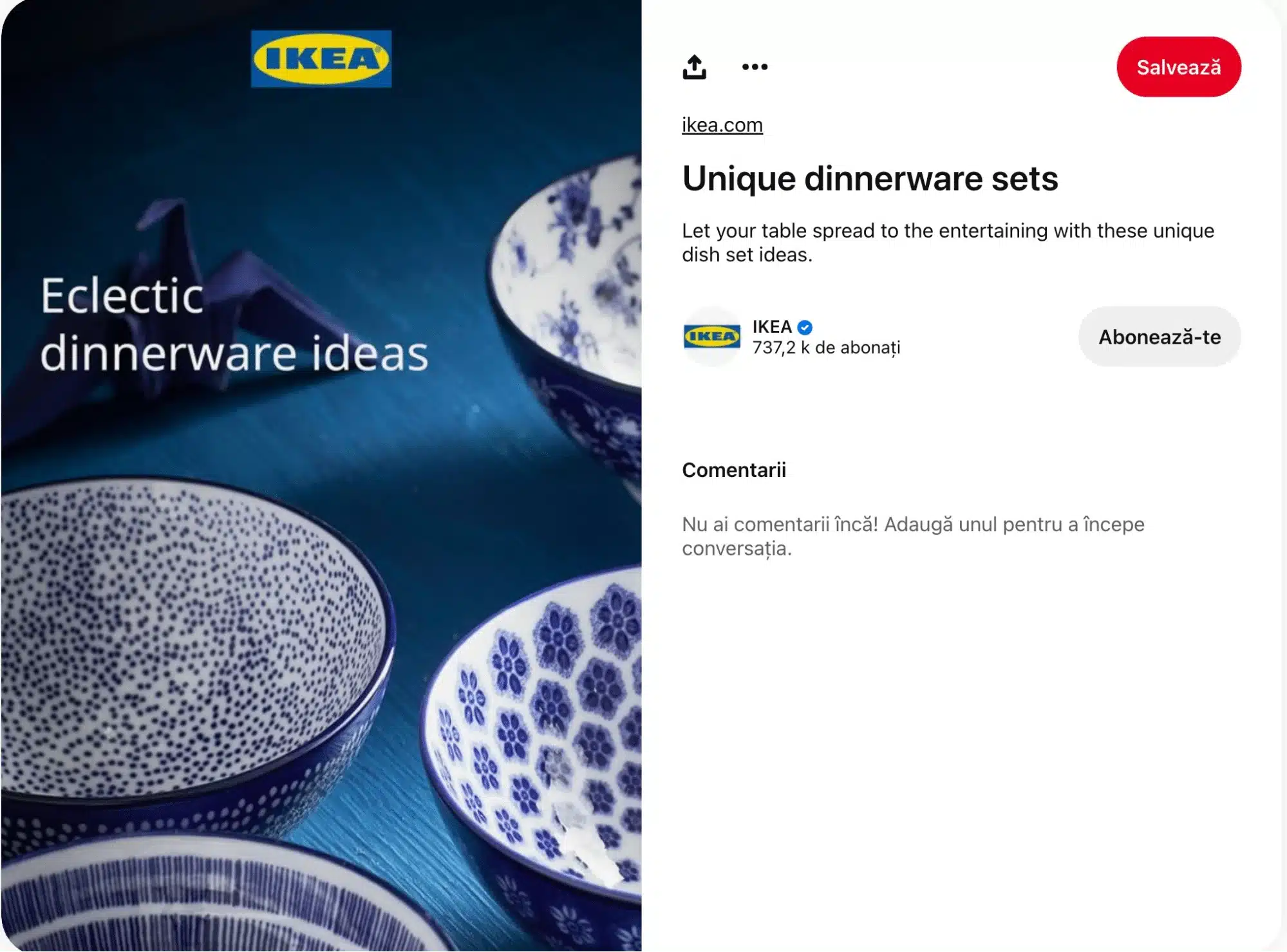
Pinterest pin from IKEA promoting unique dinnerware sets, featuring blue and white patterned bowls arranged on a dark blue table with the overlay text “Eclectic dinnerware ideas,” used to inspire creative table settings and dining decor.

This usually takes the form of:

  • A single image or carousel built around a theme
  • Minimal copy
  • A soft link back to a broader product category

It works well for early-stage browsing and saving behavior.

2. Text-led posts that rely on brand voice

Text-first posts are still common on platforms like X. Brands like Innocent use humor and tone to keep attention while still mentioning the product.

Innocent Drinks social media post showing two fruit smoothie bottles (pink and yellow) pinned to a corkboard beside a red “New year’s resolutions” note, with a small kiwi decoration, promoting healthy smoothies in a playful marketing message.Innocent Drinks social media post showing two fruit smoothie bottles (pink and yellow) pinned to a corkboard beside a red “New year’s resolutions” note, with a small kiwi decoration, promoting healthy smoothies in a playful marketing message.

These posts typically:

  • Read like native platform content, not ads
  • Mention the product briefly rather than leading with it
  • Reinforce brand personality more than features

This format supports long-term familiarity rather than immediate conversion.

3. Creator-style product mentions in short videos

Short-form videos where a creator talks directly to the camera are widely used in ecommerce, especially in beauty and fashion.

A woman in a bright studio space holds up two lip liner products toward the camera, smiling. On-screen text reads, “you need to buy that lip liner,” with a beauty brand account shown.A woman in a bright studio space holds up two lip liner products toward the camera, smiling. On-screen text reads, “you need to buy that lip liner,” with a beauty brand account shown.

These videos usually:

  • Focus on one product or comparison
  • Use informal, unscripted language
  • Let the product appear naturally in the frame

They’re commonly reused across organic posts and paid campaigns.

4. Question-led Stories that surface objections

Q&A Stories are a simple way to gather and address questions publicly. Many ecommerce brands use them before launches or during promotions.

Charlotte Tilbury speaking in a makeup studio filled with beauty products, inviting viewers to submit questions through an Instagram Q&A sticker.Charlotte Tilbury speaking in a makeup studio filled with beauty products, inviting viewers to submit questions through an Instagram Q&A sticker.

This format often includes:

  • A question sticker
  • Short follow-up answers
  • Occasional product references when relevant

It helps clarify details without turning Stories into sales slides.

5. Familiar social formats applied to product discovery

Some brands adapt familiar social interactions, like swiping or revealing content, to introduce products.

A beige Instagram graphic designed like a wrapped gift, with red and pink ribbon crossing in the center and a tag reading “FROM: PROSE TO: YOU.” Below it, bold red text says “Slide to unwrap.”A beige Instagram graphic designed like a wrapped gift, with red and pink ribbon crossing in the center and a tag reading “FROM: PROSE TO: YOU.” Below it, bold red text says “Slide to unwrap.”

This usually looks like:

  • A carousel or Story sequence
  • A delayed product reveal
  • Minimal copy guiding the interaction

The goal is to keep users engaged long enough to notice the product.

3 examples of social media ecommerce done right

1. Djerf Avenue

Djerf Avenue’s social media strategy is closely tied to its founder, Matilda Djerf, who already has a strong presence as an influencer. Instead of separating personal influence from brand promotion, the brand uses it as a foundation for visibility and trust.

Across platforms, the content follows a consistent soft, feminine aesthetic built around pastel colors, clean styling, and calm visuals. The posts rarely push individual products in isolation. Instead, they present a lifestyle that the audience can relate to and aspire to, with the clothing positioned as a natural part of that everyday look.

Instagram and TikTok are the primary drivers of product exposure. On both platforms, content focuses on outfits in motion, daily routines, and behind-the-scenes moments rather than traditional promotional posts. This makes product discovery feel organic and reduces friction in the buying process, especially for younger consumers who expect brands to blend into their feeds.
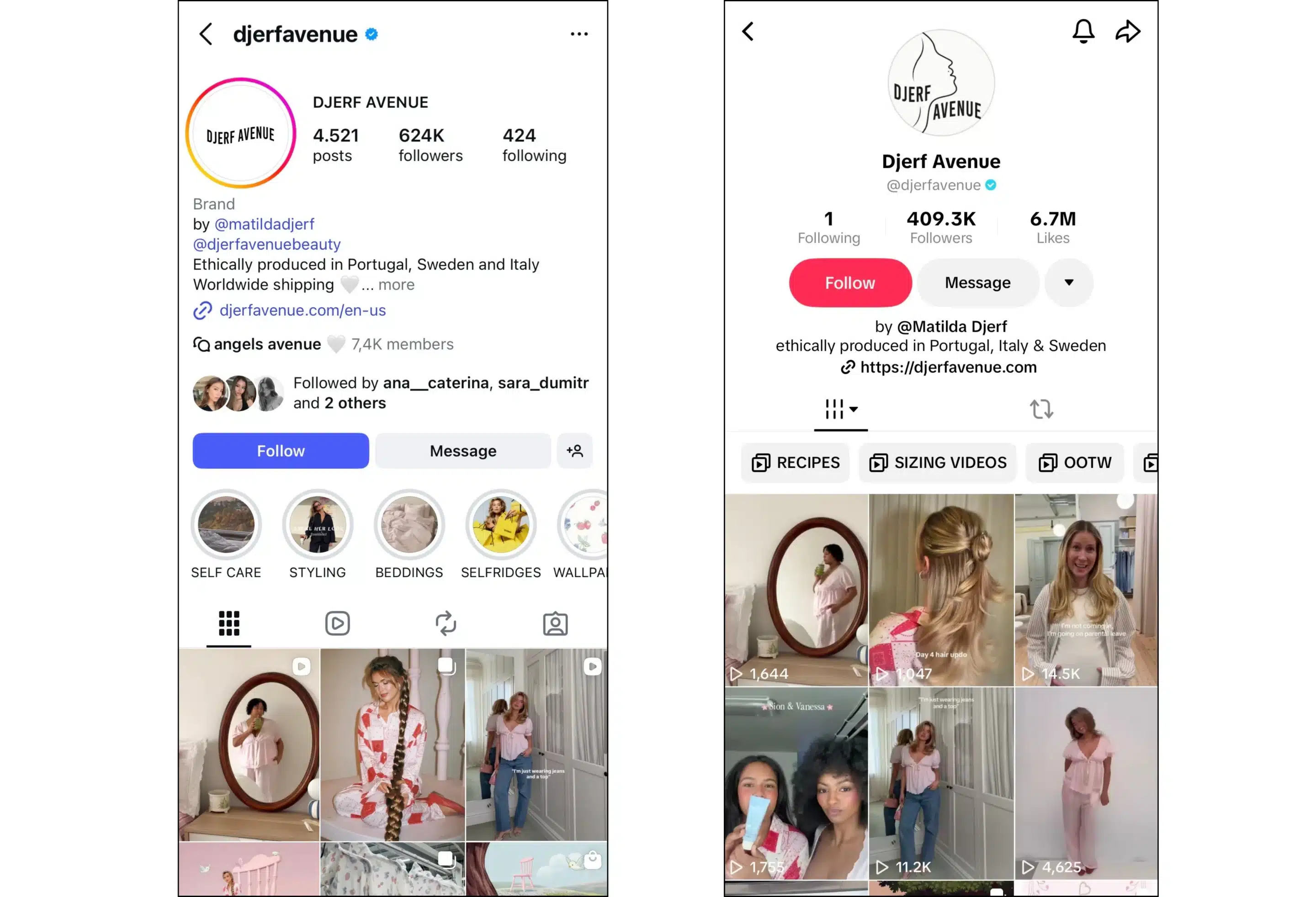
Side-by-side screenshots of Djerf Avenue’s Instagram and TikTok profiles, showing the brand bio by Matilda Djerf, follower counts, and grids of pastel-toned fashion and lifestyle videos featuring women modeling soft pink outfits and casual home styling content.Side-by-side screenshots of Djerf Avenue’s Instagram and TikTok profiles, showing the brand bio by Matilda Djerf, follower counts, and grids of pastel-toned fashion and lifestyle videos featuring women modeling soft pink outfits and casual home styling content.

Pinterest plays a supporting role. Because the brand leans heavily into inspiration, Pinterest works as a long-term discovery channel where outfits, textures, and moods live beyond a single post’s lifespan.

Pinterest “Created” grid showing soft, pastel-toned fashion and lifestyle posts, including women modeling pajamas and casual outfits, mirror selfies, hair styling clips, flat lays of floral sleepwear on white bedding, cozy coffee-in-bed scenes, and minimalist home interiors with neutral colors.Pinterest “Created” grid showing soft, pastel-toned fashion and lifestyle posts, including women modeling pajamas and casual outfits, mirror selfies, hair styling clips, flat lays of floral sleepwear on white bedding, cozy coffee-in-bed scenes, and minimalist home interiors with neutral colors.

YouTube exists mainly as an extension, with limited Shorts content, but it’s not a core traffic or sales channel for the brand.

2. Mejuri

On Instagram, Mejuri shares a mix of product-focused images and lifestyle shots featuring well-known figures. Pieces are often shown worn by actresses, athletes, or influencers such as Brittany Snow, Emma Chamberlain, or Emma Navarro. This approach adds social proof while helping potential customers imagine how the jewelry fits into different lifestyles, from casual to formal.
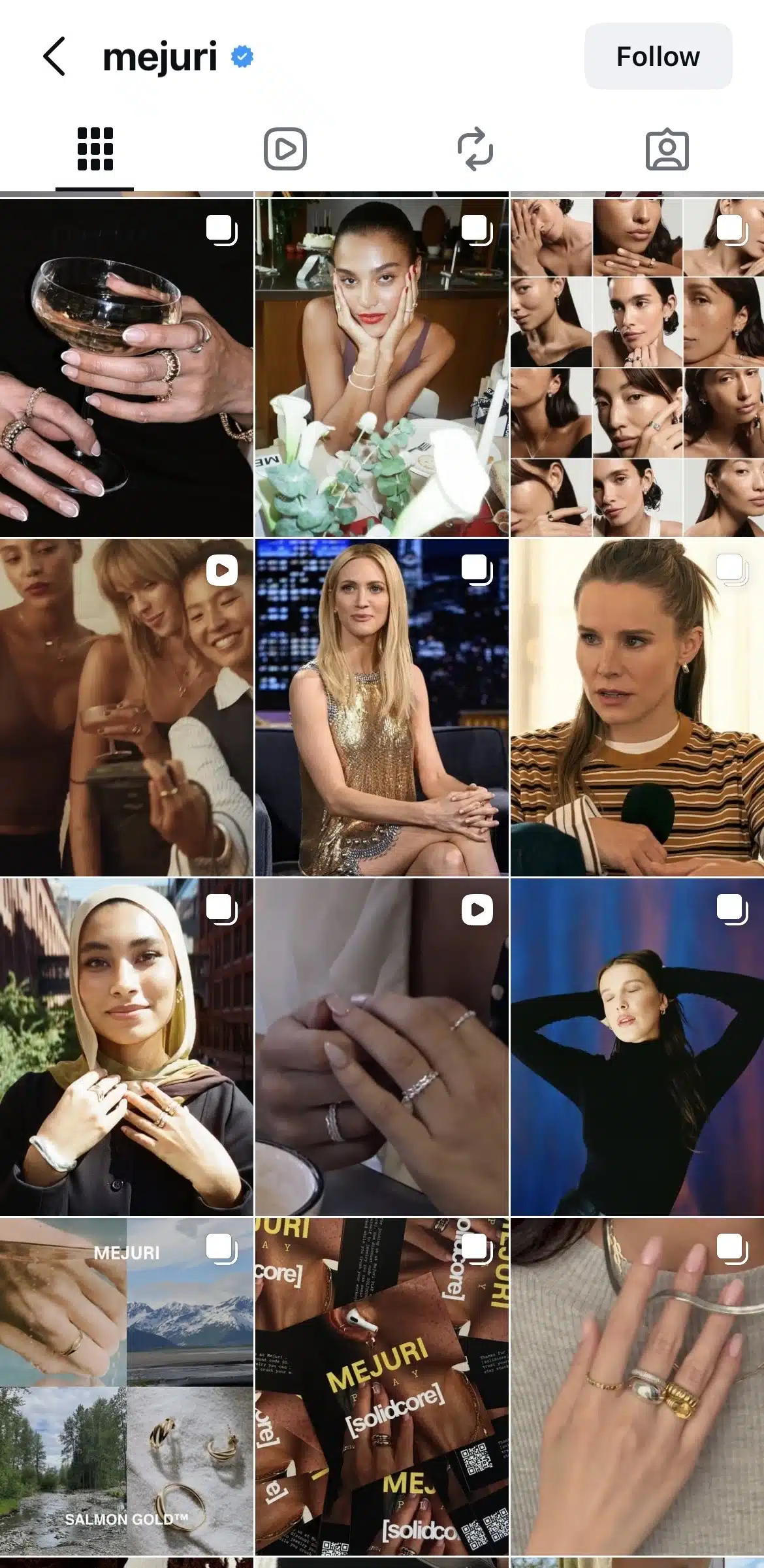
Instagram profile grid for Mejuri showing lifestyle jewelry content, including close-ups of hands wearing gold rings, models styling minimalist necklaces and earrings, skincare-style portraits, and celebrity features, presented in a clean, editorial layout that highlights Mejuri’s everyday fine jewelry aesthetic.Instagram profile grid for Mejuri showing lifestyle jewelry content, including close-ups of hands wearing gold rings, models styling minimalist necklaces and earrings, skincare-style portraits, and celebrity features, presented in a clean, editorial layout that highlights Mejuri’s everyday fine jewelry aesthetic.

Facebook plays a more informational role. The brand uses it to communicate store openings, in-person events, and brand updates rather than product discovery. This supports trust and keeps existing customers informed without duplicating Instagram content.

Facebook event post from Mejuri announcing the grand opening of its Short Hills store in New Jersey at The Mall at Short Hills, featuring a black promotional graphic with “New Jersey” in large textured lettering and event details dated April 28, 2024.Facebook event post from Mejuri announcing the grand opening of its Short Hills store in New Jersey at The Mall at Short Hills, featuring a black promotional graphic with “New Jersey” in large textured lettering and event details dated April 28, 2024.

Pinterest functions as a visual catalog. Boards are organized around different jewelry collections, making it easier for users to browse, save, and return when they’re ready to purchase. This supports longer consideration cycles, which are common for higher-value products like fine jewelry.
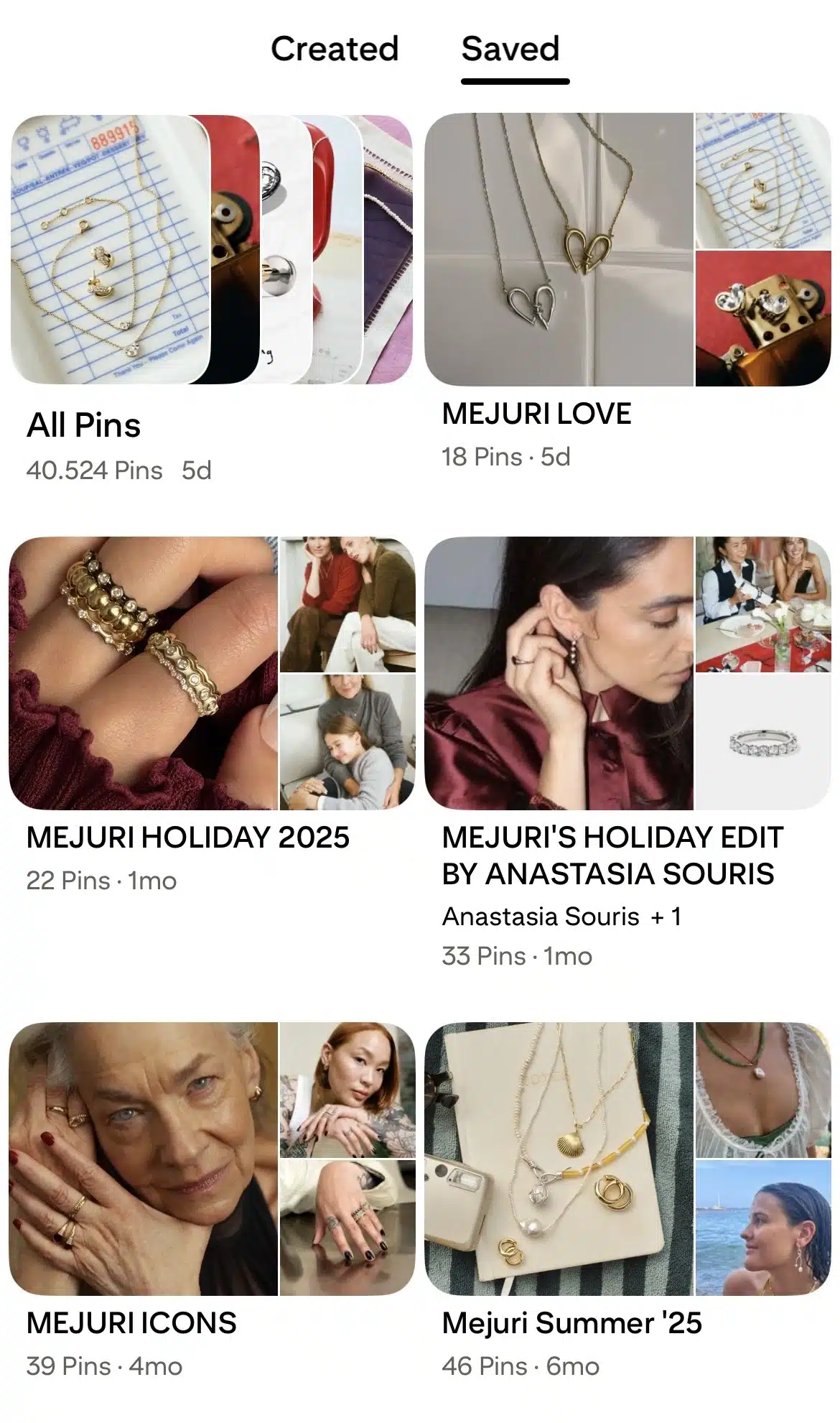
Pinterest profile view showing Mejuri’s saved boards, including “Mejuri Love,” “Mejuri Holiday 2025,” “Mejuri Icons,” and “Mejuri Summer ’25,” with preview thumbnails featuring gold and silver jewelry, rings on hands, layered necklaces, and lifestyle shots of models wearing Mejuri pieces.Pinterest profile view showing Mejuri’s saved boards, including “Mejuri Love,” “Mejuri Holiday 2025,” “Mejuri Icons,” and “Mejuri Summer ’25,” with preview thumbnails featuring gold and silver jewelry, rings on hands, layered necklaces, and lifestyle shots of models wearing Mejuri pieces.

Mejuri previously maintained a presence on X, but the account has been inactive for several years. The brand’s current strategy is clearly focused on visual platforms that support inspiration and product discovery rather than real-time conversation.

3. The Ordinary

The Ordinary takes a very different approach to social media ecommerce by removing lifestyle aspiration almost entirely. Instead, the brand focuses on clarity, consistency, and a pharmaceutical-style visual language that mirrors how its products are formulated and positioned.

Across platforms, the aesthetic is clean and restrained. Posts rely on close-ups of products, ingredient callouts, and simple demonstrations of how formulas are used. The brand frequently references scientific cues, including the periodic table of elements, to reinforce credibility and make the content feel clinical rather than cosmetic.

Instagram, Facebook, and TikTok are used to distribute this core visual system. Content across these social media platforms is highly consistent, whether it’s a short video showing texture and application or a static post highlighting a specific ingredient and its purpose. This repetition helps social media users quickly understand what each product does and who it’s for.
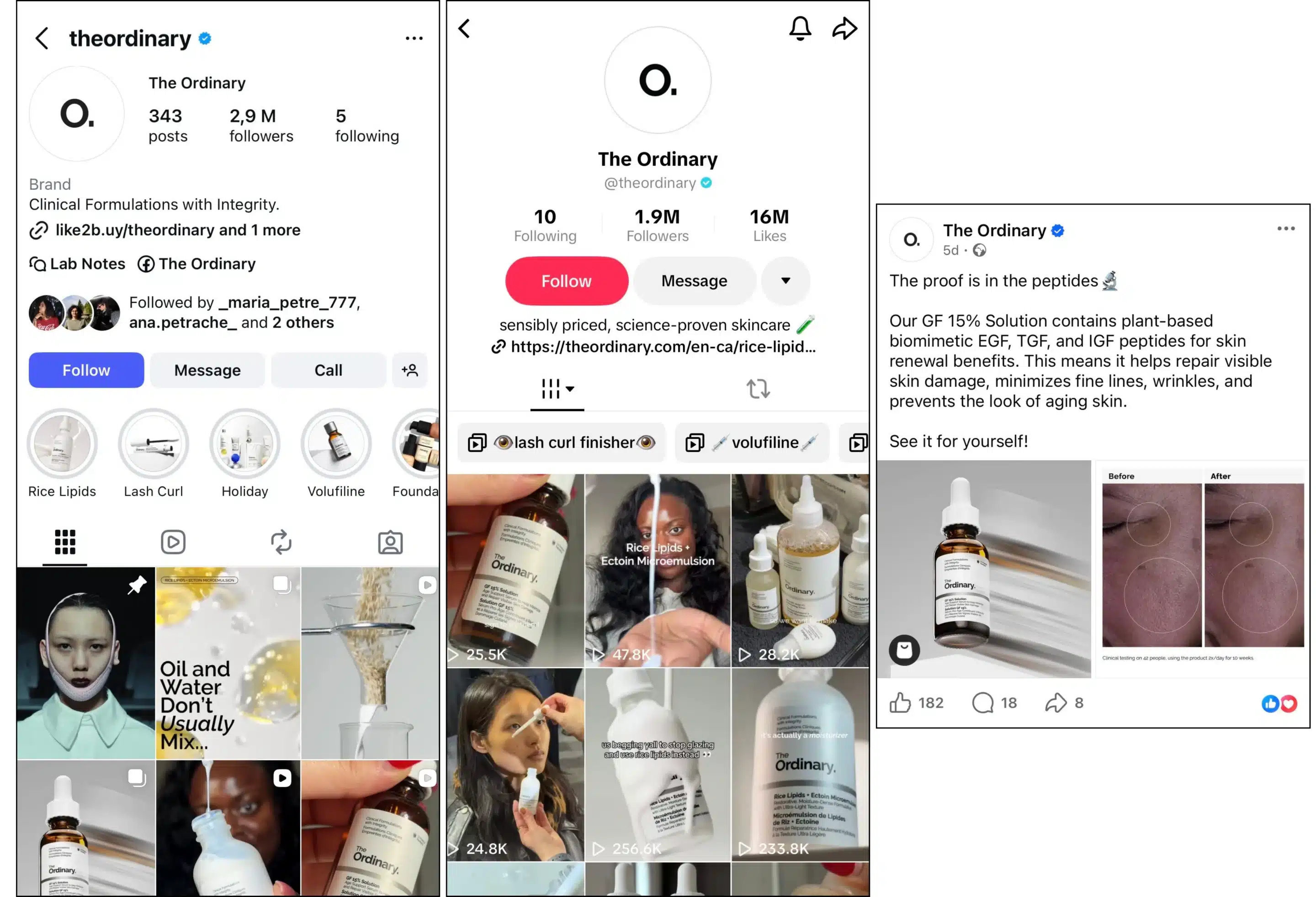
Collage showing The Ordinary across Instagram, TikTok, and Facebook, including brand profile pages, product-focused video grids, and a Facebook post about peptide skincare. Screens display serum bottles, application demos, before-and-after skin results, and captions highlighting science-backed formulations and peptide benefits.Collage showing The Ordinary across Instagram, TikTok, and Facebook, including brand profile pages, product-focused video grids, and a Facebook post about peptide skincare. Screens display serum bottles, application demos, before-and-after skin results, and captions highlighting science-backed formulations and peptide benefits.

YouTube plays a more educational role. The Ordinary uses it for product ads and longer informational videos, often featuring people in lab coats and lab-style environments. These videos reinforce the brand’s scientific positioning and support higher-consideration purchase decisions by explaining formulations in straightforward terms.

Frequently asked questions

1. How does social media influence ecommerce purchase decisions?

Social media influences ecommerce purchase decisions by shaping trust, familiarity, and product understanding before a customer visits an online store. Through creator content, reviews, comments, and repeated exposure, social media reduces uncertainty and helps people feel confident choosing one product over another. For many online shoppers, social media is where comparison and validation happen, even if the final purchase happens later.

2. Is social media ecommerce effective without paid ads?

Yes, social media ecommerce can be effective without paid ads, but it requires consistency and strong content signals. Organic content like user generated content, influencer posts, and educational videos supports product discovery and builds social proof over time. Paid campaigns can accelerate results, but organic social media efforts often play a key role in nurturing interest and supporting long-term ecommerce sales.

3. What is the difference between social media ecommerce and social commerce?

Social media ecommerce refers to using social media platforms to promote products and drive traffic to an ecommerce site, where the purchase happens off-platform. Social commerce goes a step further by enabling direct purchases within social media apps through features like shoppable posts, in-app checkout, and native product catalogs.

Improve your ecommerce social media efforts

At this point, the picture should be clear: social media for ecommerce is about choosing the platforms that matter, using content that supports real buying behavior, and paying attention to what actually moves people closer to a purchase.

Where most ecommerce teams struggle is not strategy, but follow-through. Planning posts, keeping schedules consistent, responding to customers, and checking performance across platforms takes time and attention that’s hard to maintain manually.

If managing those day-to-day tasks is what slows you down, SocialBee helps you keep everything in one place. You can plan and schedule content across social media platforms, manage comments and messages, and review performance without switching tools.

Start your 14-day free trial with SocialBee and see whether a more organized workflow makes social media easier to sustain for your ecommerce business.


Sign Up For Daily Newsletter

Be keep up! Get the latest breaking news delivered straight to your inbox.
By signing up, you agree to our Terms of Use and acknowledge the data practices in our Privacy Policy. You may unsubscribe at any time.
Share This Article
Facebook Twitter Email Print
Share
What do you think?
Love0
Sad0
Happy0
Sleepy0
Angry0
Dead0
Wink0
Previous Article I Hate How Much I Love This Hydration-Tracking Water Bottle I Hate How Much I Love This Hydration-Tracking Water Bottle
Next Article MyTerms: A New IEEE Standard Enabling Online Privacy and Aiming to Replace Cookies MyTerms: A New IEEE Standard Enabling Online Privacy and Aiming to Replace Cookies
Leave a comment

Leave a Reply Cancel reply

Your email address will not be published. Required fields are marked *

Stay Connected

248.1k Like
69.1k Follow
134k Pin
54.3k Follow

Latest News

Freeview could be turned off SOONER than expected ‘with 330k homes left behind’
News
Airtel Africa expands fibre network to 81,500km
Computing
Daggr Introduced as an Open-Source Python Library for Inspectable AI Workflows
News
AI Is Not the Bottleneck – Your Program Design Is | HackerNoon
Computing

You Might also Like

Airtel Africa expands fibre network to 81,500km
Computing

Airtel Africa expands fibre network to 81,500km

4 Min Read
AI Is Not the Bottleneck – Your Program Design Is | HackerNoon
Computing

AI Is Not the Bottleneck – Your Program Design Is | HackerNoon

10 Min Read
Experimental Linux Code For 1GB PUD-Level THPs Shows 34% Faster Memory Access Times
Computing

Experimental Linux Code For 1GB PUD-Level THPs Shows 34% Faster Memory Access Times

5 Min Read
Why Amazon can’t launch satellite internet in Nigeria just yet
Computing

Why Amazon can’t launch satellite internet in Nigeria just yet

7 Min Read
//

World of Software is your one-stop website for the latest tech news and updates, follow us now to get the news that matters to you.

Quick Link

  • Privacy Policy
  • Terms of use
  • Advertise
  • Contact

Topics

  • Computing
  • Software
  • Press Release
  • Trending

Sign Up for Our Newsletter

Subscribe to our newsletter to get our newest articles instantly!

World of SoftwareWorld of Software
Follow US
Copyright © All Rights Reserved. World of Software.
Welcome Back!

Sign in to your account

Lost your password?