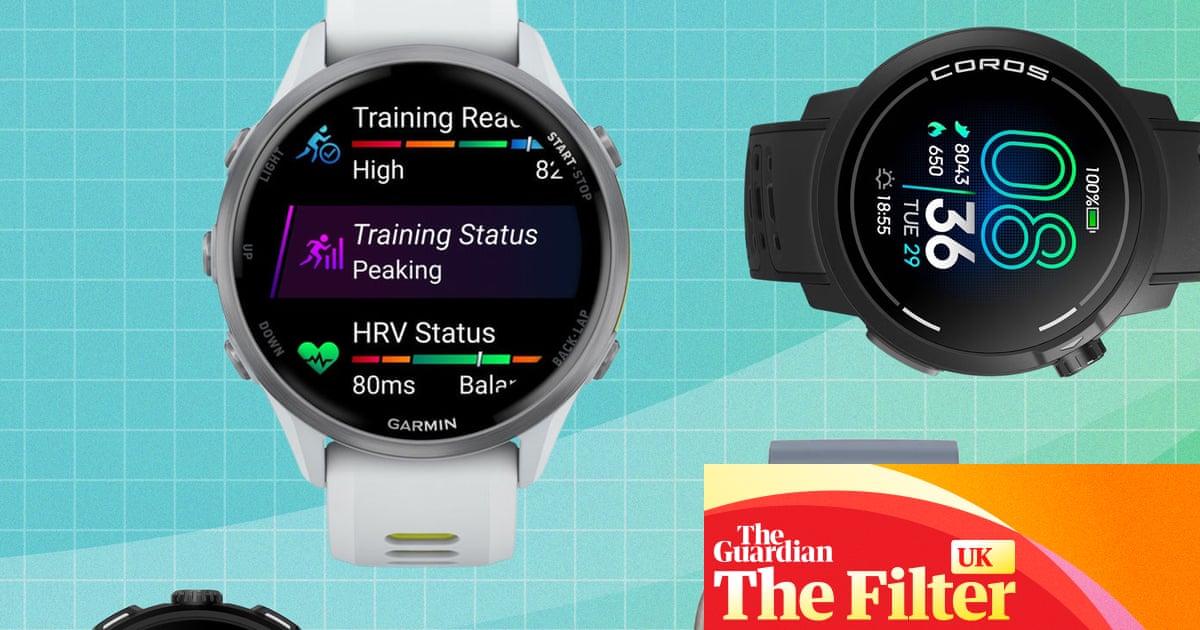
Whether you’re hitting the pavements for the first time, running with a club or racing for personal glory, the ability to track your workouts has become an essential part of any training regime. Not only can it help you improve, but you can also use it to avoid injury and share in the social experience. A running watch isn’t the only way to do this, but it is a pretty effective option.
But with the market flooded with options, offering an array of features, you might find it difficult to answer all the questions that arise. Do you need offline maps? Do you want to listen to music while you run? Which brand is best, and how much do you really need to spend?
Since a running watch is likely to last for far longer than most other bits of tech, you’ll want to make a smart investment – and I’m here to help you do just that.
I ran more than 1,000km to guide you through my tried-and-tested options, so you can pick up the best running watch for you.
At a glance
Why you should trust me
I’ve been reviewing consumer electronics for 18 years, with more than a decade spent as the Guardian’s gadget expert. In that time I’ve seen all manner of tech fads come and go, watched cutting-edge technology become mainstream commodities, used my body as a test bench for hundreds of watches, rings, glasses, goggles and other wearable devices, and covered thousands of kilometres as a keen club runner.
How I tested
To really determine whether a running watch goes beyond the basics, you have to use it for some time. I ran well over 1,000km, testing each watch on its own and in pairs, wearing the devices for short and long runs, across different urban and wooded environments. I wore them for club runs and on solo efforts, for training, workouts and races, plus during the day and night, to fully evaluate their capability to track metrics and analyse data.
I’ve poked and prodded them, updated them, tested their maps and navigation, and monitored their stamina. I’ve compared readings from the wrist-based optical heart-rate sensors to more accurate chest straps, compared pace and cadence readings, splits and total distances, routes and traces. And since GPS accuracy is so important and varies between watches, I put the top contenders through two different urban stress test routes to see which devices were reliable and which lost the plot. The first saw me weave between the tallest buildings in the City of London, while the other was around the notorious Canary Wharf loop of the London marathon, which tends to send racers’ watches wild.
Do you need a running watch?
Just starting out? Use your phone for free
If your running journey is just beginning, then it’s likely you already have a device to track your workouts. Your smartphone will be able to track your route, distance and pace; you just need the right app to do it.
If you’re an iPhone user, Apple’s built-in Fitness app can track runs and other workouts, too. Android phones usually arrive with a workout-tracking app installed; which one will depend on the brand of your phone. Samsung’s Health, Google’s Fit or Fitbit, for example, can all track the basics.
One of the most popular free, cross-platform apps is Strava. It not only tracks your workouts but also enables you to share them with friends and family through its integrated social features for support and encouragement.
Do you already own a smartwatch?
Similar to phone-based tracking, practically any smartwatch can be used for tracking runs. Even older versions of the Apple Watch, Google Pixel Watch and the Samsung Galaxy Watch will work great, with built-in GPS and heart-rate monitors, and many of them track far more than the basics.
The downside is relatively short battery life, but they should be fine for runs under marathon distances. All models should come pre-loaded with fitness-tracking apps that can record your runs, but Strava also has free apps for the Apple Watch and Google’s Wear OS.
The best running watches for 2026
Best running watch for beginners:
Garmin Forerunner 55
Garmin
Forerunner 55
from £122.49

The Forerunner 55 is the cheapest in market-leader Garmin’s running watch lineup, and covers more than the essentials.
As well as 20 hours of workout battery life, this compact watch offers solid heart-rate tracking and can monitor cadence, pace and other essential metrics. It connects to the excellent Garmin Connect app on your phone via Bluetooth or computer via USB, which can then send the data to Strava and other third-party apps.
Using Garmin’s Coach feature, you can leave the watch to automatically create a training plan for you, or load your own structured workouts such as intervals. Sleep tracking and recovery tools help you figure out whether you should step up a gear or if you should be taking it easy. Plus, it has race-time predictions and a race planner, so you can pre-program the route and see what’s coming up around the bend.
What sets the Forerunner 55 apart from the competition at this price, however, is the speed and accuracy of its GPS tracking. Despite lacking the more advanced dual-band GPS of pricier models, it proved surprisingly reliable during testing, even in the most built-up areas of central London.
However, the Forerunner 55 is now a fairly old watch with a tiny low-res LCD screen and button-only functionality. It also lacks offline maps, music, contactless payments and many of the more advanced metrics that have become increasingly useful training aids on more modern and expensive watches.
Screen: 1.04in LCD
Weight: 37g
Water resistance: 5 ATM

Garmin
Forerunner 55
from £122.49
Best budget running watch:
Suunto Run


The Run is a surprise budget hit from longtime Finnish GPS-maker Suunto, which takes the best bits of its pricey models and condenses them into a super-light, bright running watch for under £200.
The good-size 1.3in OLED touchscreen is crisp and looks great, while the body of the watch is neat and slim on the wrist. It arrives with two lengths of a quick-release nylon band, but is also compatible with standard 22mm straps, should you prefer a silicone one.
Heart-rate monitoring is solid, and the dual-band GPS achieves a lock quickly, outclassing many of its rivals for accuracy in our urban stress tests. The Run records most of the advanced metrics you’d need, including the usual pace, heart-rate zones, cadence, running power and dynamics, plus it has solid VO2 max, training load and recovery tracking viewable on the watch or in the decent Suunto phone app.
The Run lasts a good 20 hours of tracking at its highest accuracy level, and has profiles for workouts on outdoor running tracks, multisport for triathlons and many other modes. It also supports structured workouts and interval training when things get a bit more serious.
While the screen is bright enough to see in direct sunlight, some of the dim grey fonts were a struggle to read at a glance. Some of the metrics looked a little too similar when four were on the screen at the same time, too. But the two buttons and crown make navigating, starting and pausing the watch easy, and it’s useful to be able to disable the touchscreen during workouts to prevent accidental presses.
The Suunto app, whether on an Android or iPhone, is fairly simple, displaying decent maps and graphs, plus daily health and sleep tracking. But the Run lacks offline maps, restricted to simple breadcrumb navigation – a line with no underlying map tiles – if you sync routes from your phone beforehand. It supports offline music via Bluetooth headphones, but only with MP3s; there’s no support for Spotify or other streaming services. The USB-C charging puck is a bit flimsy with weak magnets, too, so you have to be careful to keep the watch charging.
Screen: 1.3in OLED touchscreen
Weight: 36g
Water resistance: 5 ATM
Alternative:
Coros Pace 3


Coros’s Pace 3 is a popular budget running watch for good reason: it packs a lot in for the price. But for GPS accuracy, it was beaten by the Suunto Run in our urban stress tests. Its battery life is shorter, too, and it has an older-style LCD screen. It has similar limitations with offline music and no maps.
A great option if the Suunto Run isn’t for you.
Screen: 1.2in LCD
Weight: 30g (nylon band)
Water resistance: 5 ATM
Best mid-range running watch:
Coros Pace Pro


With highly capable budget watches champing at their heels, mid-range running watches essentially add one thing: offline maps.
One of the best in a crowded pack is the Coros Pace Pro, which offers a lot while costing less than rivals. It has a bright and crisp OLED touchscreen, a button and crown on the side for control, as well as decent haptics and beeps to let you know what’s happening.
The interface is fairly basic but responsive, with the watch tracking a wide array of sports, including a triathlon. Its heart-rate tracking is solid, and the dual-band GPS got a lock quickly and performed well in our urban stress tests. Battery life is up to 31 hours in its highest accuracy mode, which is very good. It even ships with a natty little keyring charging adapter that you plug into your own USB-C cable and then into the back of the watch.
The Coros tracks all the metrics you probably want, too, with a decent set of training and analysis tools. However, I did find its recovery metrics a little optimistic – and, bizarrely, its training load tools reset every Monday rather than using a seven-day rolling average, which make them a bit useless.
Nevertheless, there are plenty of workout configuration options, with up to eight metrics on display per screen. They’re only accessible from the Coros app on your phone, though. That app is a little basic, but it gets the job done, displaying your data, routes and maps well.
This app is also where you plan and send routes to your watch – you can’t create routes directly on the device. Browsing a map on the watch is fast and responsive via touch, as is zooming into road names using the crown. But if you do happen to veer off course, the watch can’t automatically re-route you back to the correct path.
The Coros offers support for offline music, but it’s only of the MP3 variety, which is less useful when you use streaming services. It lacks contactless payment support, and while the Pace Pro is light and comfortable, it doesn’t look or feel as premium as some more expensive rivals.
Screen: 1.3in OLED touchscreen
Weight: 37g (nylon band)
Water resistance: 5 ATM
Best-looking mid-range running watch:
Suunto Race 2


The Suunto Race 2 just misses out on being the top mid-range pick: it’s significantly more expensive than the Coros Pace Pro, yet didn’t perform quite as well in our urban GPS stress tests.
This watch has plenty going for it, though. It’s good-looking, with a solid, premium feel, while the large, crisp 1.5in OLED touchscreen is bright and covered in super scratch-resistant sapphire crystal. The crown and two buttons make it easy to control the device during workouts, and the excellent rubber straps give a secure fit.
The Race 2 tracks more than 110 different sports, including multisport and triathlons, and the collection of free apps in the SuuntoPlus store can add extra elements to each sport profile, such as a cadence coach or a climb app. It tracks every running metric you’re likely to need, with a new decent heart-rate sensor and dual-band GPS traces, support for structured workouts and external sensors such as footpods. It also has a decent set of training and analysis tools, some of which are from leading training firm TrainingPeaks.
Battery life is impressive, with an outstanding 55 hours of tracking at the highest accuracy levels. That figure drops if you turn on the always-on screen option, though. Its offline maps look great on the big touchscreen, but like the Coros Pace Pro and other non-Garmin watches, you have to set routes on your phone first or rely on manual navigation.
The companion app on your phone is a little basic-looking but has decent maps, stats, data and graphs, plus daily health and sleep tracking. Compared with a Coros or Garmin, the watch is a little short on different faces and customisations, but the ones included look good. It doesn’t have contactless payments or offline music, either.
Screen: 1.5in OLED touchscreen
Weight: 76g (steel); 65g (titanium)
Water resistance: 10 ATM
The best running watch money can buy:
Garmin Forerunner 970

Garmin
Forerunner 970
from £579

If you want the very best running watch there is, there’s one clear winner: the Garmin Forerunner 970. It tracks every metric and statistic you could possibly want, both on the run and after the fact, and looks the business doing it.
Alongside a compact and comfortable fit, the watch has a large and crisp OLED touchscreen, protected by super-hard sapphire crystal. There are five buttons for when you don’t want to use the touchscreen; contactless payments; and a built-in speaker and microphone for calls, voice commands and accessing your phone’s voice assistant. The Forerunner 970 even has an extremely useful built-in torch, which can be used as a strobe light for running or for just illuminating your way at night.
On a run, the watch can clearly show up to eight different metrics onscreen at once and has excellent, highly detailed built-in offline maps. Unlike competitors, Garmin’s maps are routable, which means you can plan routes on the watch itself, and it can re-route you like a car’s GPS if you veer off course. It also supports offline music from various streaming services, including Spotify, Amazon and YouTube Music, or your own MP3s.
Garmin’s dual-band GPS with best-in-class tracking accuracy did very well in our urban stress tests. Plus, its battery lasts a solid 23 hours of tracking – or more, if you turn down the screen’s brightness, or switch to less power-hungry GPS modes. The heart-rate sensor remains consistent even in difficult conditions and takes ECGs for monitoring arrhythmia, similar to the best health-tracking watches.
The Forerunner 970 comes with the full suite of Garmin’s industry-leading fitness tracking, training and recovery tools. That includes the new impact load and running tolerance metrics that help you avoid injury by more accurately measuring the strain each run puts on your body, while keeping a rolling seven-day log of distance and impact, so you don’t overdo it.
If you want to track more than running, the watch is fully triathlon-ready and tracks 30-plus sports of all guises. It’s great at general health and activity tracking, too, with various coaches for sleep, training and recovery. Garmin’s excellent automatic workout plans can be tailored to upcoming races or can be replaced by your own or third-party plans just as easily.
The Garmin Connect app is the best in the business, with every stat, analyses and metric you’re likely to want to deep dive into; solid route planning and built-in social features, including options to share the data to Strava or other platforms; plus a good website for big-screen interrogation.
Read our full Garmin Forerunner 970 review: the new benchmark for running watches
Screen: 1.4in OLED touchscreen
Weight: 56g
Water resistance: 5 ATM
Garmin
Forerunner 970
from £579
Alternative:
Garmin Fenix 8


If you like the sound of the Forerunner 970 but want a watch that looks more like a traditional timepiece, the Fenix 8 has all the same features and more. It comes in three sizes, with a great OLED screen, longer battery life and the same level of tracking accuracy across the board; but it is heavier, a bit thicker and costs more.
Read our full Garmin Fenix 8 review: best adventure watch becomes smarter
Screen: 1.3in OLED touchscreen (43 and 47mm); 1.4in OLED touchscreen (51mm); weight: steel: 66g (43mm), 80g (47mm), 102g (51mm); titanium: 60g (43mm), 73g (47mm), 92g (51mm); water resistance: 10 ATM
Best running watch for battery life:
Garmin Enduro 3

Garmin
Enduro 3
from £615.99

Most good running watches will last at least a marathon while tracking all metrics, but if you need to go further, then there are watches built for ultramarathoners that provide super-long battery life.
The Garmin Enduro 3 is the best there is, lasting up to 60 hours of tracking at its highest GPS accuracy level – or even longer if you’re running in bright conditions, thanks to the built-in solar charging. And if you really have to go the distance, switch to a special “expedition GPS mode” and it will manage up to 77 days.
This level of stamina does come with a few drawbacks, though. The first is its sheer size: the Enduro 3 is massive all round, and uses a low-power LCD screen rather than the fancy OLEDs equipped to Garmin’s other watches.
Otherwise, it has most of the same features and high accuracy levels as the Forerunner 970 and Fenix 8, including offline maps and a torch.
Screen: 1.4in LCD
Weight: 63g
Water resistance: 10 ATM
Garmin
Enduro 3
from £615.99
Best running watch with LTE/satellite:
Garmin Fenix 8 Pro

Garmin
Fenix 8 Pro
from £875.49

All running watches have at least a guide or a map to help you out in tricky situations, but a new breed of devices has recently upped the game by adding cellular and satellite connectivity – which could help save your life in an emergency.
At the top of the game is the Garmin Fenix 8 Pro, which takes the excellent regular Fenix 8 and adds LTE and satellite connectivity. If it has mobile signal, it can keep you in contact and share your location with loved ones without you having to carry a phone. More importantly, you can contact the emergency services via satellite if you find yourself without reception in Europe and North America.
Coupled with its full offline mapping, including re-routing on the watch, and the fact it tracks every metric under the sun, it’s a killer go-anywhere, do-anything device.
However, for all this functionality, you’ll need to part with the big bucks. In addition to the cost of the watch, you’ll have to subscribe to Garmin inReach for the phone-free communications features, which costs from £7.99 a month.
Read our full Garmin Fenix 8 Pro review: built-in LTE and satellite for phone-free messaging
Screen: 1.4in OLED touchscreen
Weight: 77g (47mm); 90g (51mm)
Water resistance: 10 ATM
Garmin
Fenix 8 Pro
from £875.49
Alternative:
Apple Watch Ultra 3

Apple
Watch Ultra 3
from £719

It may not be a dedicated running watch, but the Apple Watch Ultra 3 ticks almost every box for running if you’re an iPhone user, including a dual-band GPS that was one of the most accurate in our urban stress tests.
The latest model adds emergency satellite communications to its existing cellular connectivity, so like the Fenix 8 Pro, it can help you seek rescue if you find yourself in a sticky situation off-grid.
Elsewhere, it tracks almost every running metric you could need, has a big and bright screen, an accurate heart-rate monitor and a durable body made of titanium and sapphire. Battery life isn’t quite as long as proper running watches when tracking, but it will manage a marathon or two. And it comes with all the trappings of a true smartwatch, including offline maps, music, Apple Pay, notifications and Siri.
The Apple Watch only works with an iPhone, and while the satellite SOS feature is free, using 4G or 5G requires a compatible plan with your phone provider.
Read our full Apple Watch Ultra 3 review: the biggest and best smartwatch for an iPhone
Screen: 1.93in OLED touchscreen; weight: 61.6g (natural titanium strap); water resistance: WR100
Apple
Watch Ultra 3
from £719
Others worth considering
Garmin Forerunner 570 – a really great running watch that’s just a little too expensive for what it offers, in particular, the lack of offline maps. A great option at a discounted price, though.
Suunto Race – software updates see the predecessor to the great Race 2 gain most of the new features of recent models. It’s a smart buy at a good discount.
Garmin Forerunner 165 – Garmin’s entry-level OLED running watch is great, but it costs a bit too much to be a budget pick and lacks dual-band GPS. Look for a deal.
Garmin Forerunner 265 – the older-generation mid-range Garmin was one of the best with dual-band GPS, an OLED screen and multiple sizes, but was quite expensive at launch without maps and has since been phased out.
Garmin Forerunner 965 – Garmin’s previous top-of-the-line Forerunner remains extremely capable, missing only a few of the Forerunner 970’s features. A good buy at a steep discount.
How I picked
Go to the effort of buying a dedicated running watch and you want the device on your wrist to at least work as hard as you are, pounding the pavements. So while practically any watch with a GPS will get the job done to some extent, it’s the features below that I considered alongside when selecting models for this test:
Screen – it has to be bright, crisp and clear enough to view and understand at a glance during the run.
Fit and profile – it has to sit on the wrist comfortably and securely, neither moving about during vigorous exercise, nor being too tight as you become warm due to activity.
Strap replacement – straps become sweaty, smelly and wear out, so being able to replace them easily is essential, either with a like for like, or with different options for different occasions.
Ease of use on the run – do the buttons work, can you lock the touchscreen, are the haptics strong enough, and can you hear the beeps and chimes while pushing for that next PB?
Heart-rate accuracy – accurate and consistent heart-rate tracking is essential for using heart-rate zones for training, as well as evaluating effort, fitness and recovery.
GPS accuracy – how long does the watch’s GPS take to get a lock and how well does it hold on to it in difficult forested or urban conditions? This is vital for accurate traces, distances, paces and various other metrics.
Battery life – will it last long enough for all your weekly runs, and how often will you have to charge the device?
Water resistance and durability – a running watch should be able to take some punishment and survive rain, wind, mud, snow, sleet, swims, freezing temperatures and baking summer days – anything you can cope with, it should do too.
Companion app and data export – a good cross-platform app is essential, offering reliable syncing, plenty of stats, graphs and maps, as well as the ability to send your data to Strava, other services, or export it to industry-standard files such as GPX or FIT for use elsewhere.
Training and analysis – how good is the data analysis of your training, fitness and recovery? Is it representative and will it adapt to your progress?
Software support – a running watch isn’t a huge target for cybercriminals, but since it and the connected service contain a lot of sensitive data, it should be secure and kept up to date for an extended period.
For more:
The best running shoes for men and women
The best treadmills, tested
The best fitness tech and gadgets, according to experts
Samuel Gibbs is the Guardian’s consumer technology editor