The New Career Moat Isn’t Depth. It’s Composition
For decades, the career advice was clean:
Pick a lane. Go deep. Become the expert.
That strategy still works—sometimes. But AI changed the payoff curve.
When models can draft, analyze, code, summarize, design, and debug at near-zero marginal cost, “being good at one isolated thing” stops being rare. It becomes a commodity input you can rent.
What stays rare is the person (or team) who can combine:
- domain understanding,
- tool leverage,
- taste and judgment,
- execution under constraints,
- and iteration discipline,
…into outcomes that actually ship.
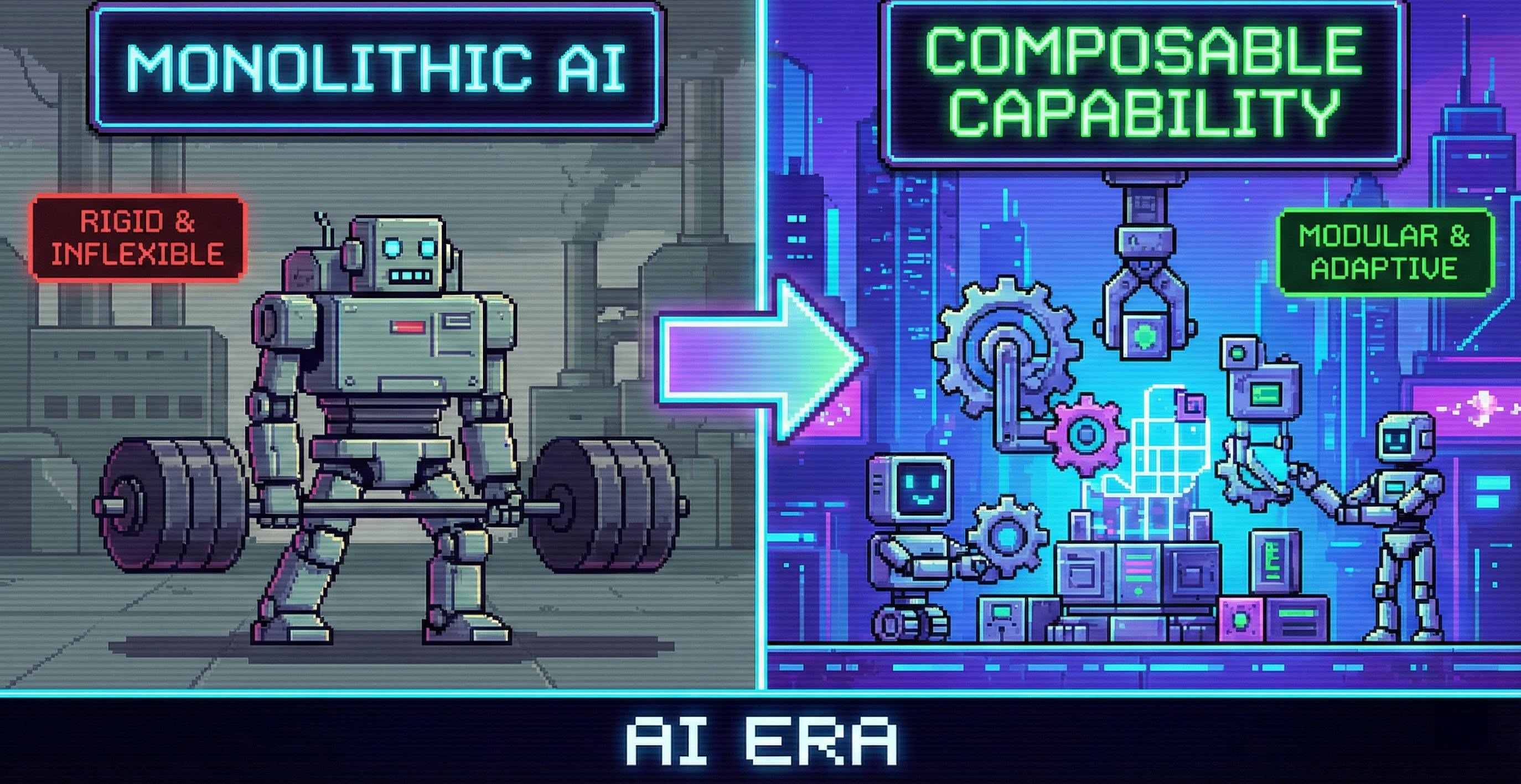
In other words: composable capability beats single-point expertise.
This is Principle #7 in one sentence.
Now let’s make it practical.
1) Composable Capability: A Strategic Lens, Not a Motivational Poster
A “skill stack” is not a random list of competencies.
It’s a system:
- modules,
- interfaces,
- orchestration,
- and feedback loops.
If that sounds like software design, good. That’s the point.
Single-skill mindset (legacy)
- “I’m a backend Java engineer.”
- “I’m a data scientist.”
- “I’m a designer.”
Capability mindset (AI era)
- “I can turn messy requirements into shipped systems.”
- “I can quantify trade-offs and make decisions defensible.”
- “I can integrate AI into workflows without creating new risk.”
The second form is harder to replace because it’s not one skill. It’s a composition.
2) The Engineering Model: Modularize Abilities Like You Modularize Software
Let’s steal a useful abstraction from engineering:
A capability is a module with inputs, outputs, and quality constraints.
If your “skills” can’t be described with I/O, they’re not composable—they’re vibes.
2.1 Module design: break complex ability into Lego bricks
Instead of “I’m good at product,” define modules like:
- Problem framing: convert fuzzy goals into measurable outcomes
- Data sense: identify what matters, what’s noisy, what’s missing
- Tooling: use AI + automation to reduce time-to-first-draft
- Decision craft: weigh options, quantify uncertainty, choose
- Delivery: write, ship, monitor, iterate
Each module can improve independently.
That’s the real advantage: you can upgrade a component without rewriting your whole identity.
2.2 Interface design: how modules talk to each other
Modules only compose when interfaces are explicit.
In practice, your “interfaces” look like:
- templates,
- checklists,
- specs,
- contracts,
- and shared vocabulary.
Example: if your “analysis module” outputs a 6-page essay, nobody can integrate it. If it outputs a decision-ready artifact, it composes.
A useful interface: Decision Memo (1 page)
- context + goal
- options + trade-offs
- recommendation + rationale
- risks + mitigations
- next actions
That format turns thinking into an API.
3) The Real Advantage: Reconfigurability Under Uncertainty
AI-era work is volatile. Requirements change. Tools change. Markets change.
Composable capability survives because it is reconfigurable:
- new domain? swap in a domain module (learn the primitives)
- new tools? swap in tool module (learn the workflow)
- new constraints? modify the orchestration layer (how you decide and ship)
This is why “depth-only” careers are fragile: they assume stability.
4) The Skill Stack That Wins (A Practical Blueprint)
If you want a high-leverage stack that composes well in most knowledge work, build around four pillars:
4.1 Domain primitives (not trivia)
Learn the core invariants of your domain:
- what “good” means,
- what breaks systems,
- what metrics matter,
- what regulations constrain you,
- what users actually value.
You don’t need encyclopedic coverage. You need decision relevance.
4.2 AI leverage (tools as muscle)
Use AI for what it is best at:
- drafting,
- summarizing,
- brainstorming,
- pattern extraction,
- code scaffolding,
- test generation,
- documentation.
But never confuse speed with truth.
Tool leverage is not “I can prompt.” It’s:
- “I can integrate AI into a pipeline and control failure modes.”
4.3 Judgment (the anti-automation layer)
Judgment is where most “AI-native” workers still fail.
Judgment is:
- recognizing uncertainty,
- spotting missing constraints,
- refusing false confidence,
- choosing what not to do.
This is the human edge that compounds.
4.4 Shipping (feedback loops)
The market only pays for shipped outcomes.
Shipping is:
- execution cadence,
- instrumentation,
- learning loops,
- and stakeholder alignment.
If you can ship, you can convert any new skill into value quickly.
5) Organizations: Stop Hiring for Roles. Start Staffing for Capability Graphs.
Traditional org design is role-centric:
- fixed jobs,
- fixed responsibilities,
- fixed ladders.
AI pushes orgs toward capability platforms:
- small teams,
- modular responsibilities,
- rapid recombination per project.
What changes in practice
- Teams become “pods” assembled around outcomes
- AI tools become shared infrastructure
- Internal interfaces become critical (docs, schemas, standards)
- The best managers optimize for composition, not headcount
Why this works
Because in a fast-changing environment, the ability to rewire beats the ability to optimize a stable structure.
6) The Anti-Patterns (How People Lose in the AI Era)
- Anti-pattern 1: “Depth only, no orchestration”
You’re brilliant, but you can’t translate expertise into decisions others can execute.
- Anti-pattern 2: “Tools only, no domain”
You can generate outputs fast, but you can’t tell if they matter or if they’re wrong.
- Anti-pattern 3: “Output only, no feedback”
You produce artifacts, but you don’t close the loop with metrics, users, or reality.
- Anti-pattern 4: “Role identity lock-in”
You cling to a title instead of building a platform.
7) A Tiny Framework: The Capability Composer
Here’s a compact way to operationalize composable capability.
Step 1: Define your modules
Write 6–10 modules you want in your stack:
- Domain: payments, logistics, healthcare, fintech risk…
- Tech: data pipelines, backend systems, LLM toolchains…
- Human: negotiation, writing, leadership, product thinking…
Step 2: Define each module’s interface (I/O)
For each module, write:
- input: what it needs
- output: what it produces
- quality bar: what “good” looks like
- failure modes: how it breaks
Step 3: Build 3 default compositions
Because you don’t want to reinvent orchestration every time.
Example compositions:
- Rapid discovery: user pain → hypothesis → evidence → recommendation
- Delivery sprint: requirements → design → build → test → deploy
- Incident recovery: detect → triage → mitigate → postmortem
Step 4: Instrument your stack
Track:
- cycle time (idea → shipped)
- error rate (rework, incidents)
- learning velocity (how fast you upgrade modules)
- leverage ratio (output per hour with AI)
That’s how you turn “career advice” into a measurable system.
8) A Lightweight Code Analogy
Here’s a toy way to model composable capability as modules + interfaces.
from dataclasses import dataclass
from typing import Callable, Dict, Any, List
@dataclass
class Module:
name: str
run: Callable[[Dict[str, Any]], Dict[str, Any]] # input -> output
quality_check: Callable[[Dict[str, Any]], bool]
def compose(pipeline: List[Module], context: Dict[str, Any]) -> Dict[str, Any]:
state = dict(context)
for m in pipeline:
out = m.run(state)
if not m.quality_check(out):
raise ValueError(f"Module failed quality bar: {m.name}")
state.update(out)
return state
# Example modules (simplified)
def frame_problem(ctx):
return {"problem": f"Define success metrics for: {ctx['goal']}", "metric": "time-to-value"}
def qc_frame(out): # cheap check
return "problem" in out and "metric" in out
def ai_draft(ctx):
return {"draft": f"AI-generated first pass for {ctx['problem']} (needs verification)"}
def qc_draft(out):
return "draft" in out and "verification" not in out.get("draft", "").lower()
pipeline = [
Module("Framing", frame_problem, qc_frame),
Module("Drafting", ai_draft, qc_draft),
]
result = compose(pipeline, {"goal": "reduce checkout drop-off"})
print(result["metric"], "=>", result["draft"])
The point isn’t the code. The point is the design pattern:
- modules are replaceable,
- interfaces are explicit,
- quality gates prevent garbage from propagating,
- the pipeline can change without breaking the whole system.
That’s what a resilient career (or org) looks like in 2026.
Conclusion: Build Platforms, Not Titles
AI is turning many individual skills into cheap, rentable components.
Your advantage is not being one component.
Your advantage is being the composer:
- the one who builds a capability graph,
- selects the right modules,
- connects them with clean interfaces,
- and ships outcomes with tight feedback loops.
Depth still matters—but only as a module.
In the AI era, the winners aren’t the specialists.
They’re the architects.