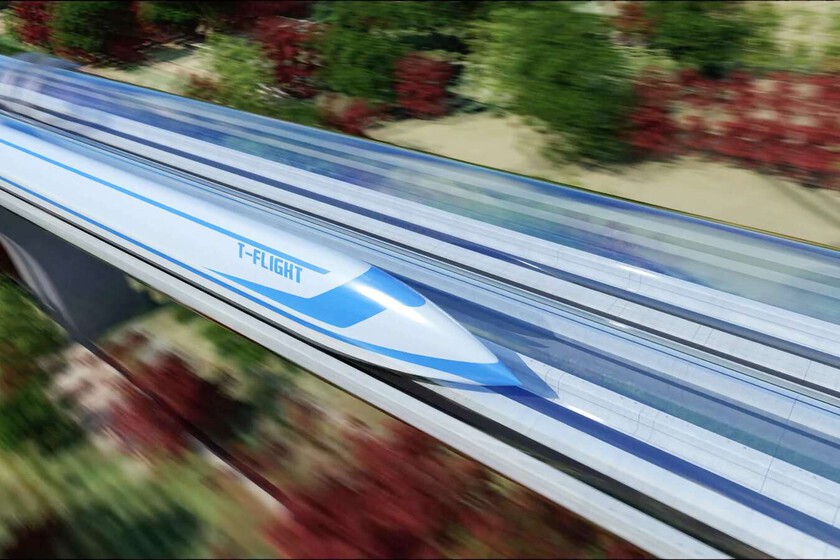
China’s conquest of the high-speed train field is impressive. At the 2008 Beijing Olympics, the country had just 120 kilometers of high-speed rail between Beijing and Tianjin. 17 years later, they manage more high-speed kilometers than any other country, a far cry from Spain or Japan. They are not only building kilometers to unite the entire country: they are developing technologies so that the plane is no longer necessary. As? With Maglev trains at speeds of 1,000 km/h.
And a specific model, the T-Flight, which dreams of 4,000 km/h.
Maglev + Hyperloop. China is one of the countries, along with Japan, that is investing a lot of money in the development of magnetic levitation trains, or Maglev. This technology allows trains not to rest their wheels on the rails, but rather to float thanks to a series of powerful magnets and an electromagnetic field. This allows us to exceed the 250 km/h that has been set as a standard for high speed and, for example, China has the fastest Maglev in the world, one that reaches 431 km/h.
It is already operational between Beijing and Shanghai, but in Japan they are testing one that will exceed 600 km/h. It’s a speed that will seem slow compared to what CASIC is preparing. It stands for “China Aerospace Science and Industry Corporation,” a state-owned tactical missile company that announced the T-Flight project in August 2017. The idea? Combine magnetic levitation trains with Hyperloop-style vacuum tubes.
T-Flight. In short, it is putting a Maglev in a vacuum tube, eliminating air pressure and resistance as much as possible, but there is much more. For example, CASIC’s idea is that magnetic levitation is enhanced thanks to superconductors that will raise the train up to 100 mm above the rail. Conventional Maglevs are raised by about 10 mm, and the idea is that the higher the train is, the more stability it will have at extreme speeds.
On the other hand, the tube itself, with a system that extracts air from it to create a low pressure environment, reducing aerodynamic resistance to the maximum. This partial vacuum and levitation that eliminates the physical resistance of the wheel and track is what will allow unprecedented speeds to be achieved.
Achievements. In 2024 they already achieved a first test validated as a world record by reaching 623 km/h, but in the summer of this year, in a low pressure environment, the train reached 650 km/h in seven seconds in its laboratory. They were strange tests, since the track was a kilometer long when the usual thing is much longer, but that also gives us a clue of how brutal both the acceleration and braking of the train is.
That is, think that, in seven seconds and in just one kilometer, the train accelerated to 650 km/h and stopped. The team’s idea is to reach 800 km/h as the top speed this year, but the ambition goes much further.
Ambition. Currently, the team is in Phase 1, which is the one that aims for that speed of 1,000 km/h. To do this, and to validate the speed in real conditions, they want to extend the test track to 60 kilometers. However, the thing does not stop there and, when the project was born, it was already said that Phase 2 and Phase 3 would target 2,000 km/h (almost double the cruising speed of a traditional commercial airplane) and 4,000 km/h, supersonic speeds that would compete with the fastest airplanes in the world.
This would allow large urban centers in China to be linked in a few minutes, leaving aside the need to take planes to cover long distances. In fact, this high speed is already showing in Europe that short flights do not make sense if we combine the waiting time at the airport with the flight itself and compare it with the comfort of access to the train.
A major challenge. Now, the goal will not be easy. Maglev technology works and is proven, but what they want to achieve with this T-Flight not only complicates things because, in addition to a track, a tube must be built. And, of course, maintain it.
Extending this partial vacuum over hundreds of kilometers of tube represents an enormous technical challenge because it implies that the joints must be perfectly sealed, without the cold and heat dilating them so that there are no leaks. It is estimated that a 600 km pipe requires an expansion joint every 100 meters, and each one of them represents a potential point of failure. Furthermore, at 300 km/h vibrations can be seen in the seats.
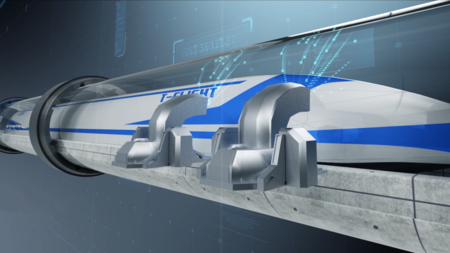
Air system to reduce pressure inside the tubes
Furthermore, any decompression would be catastrophic and perhaps most importantly: there is no certification standard or safety protocols for something like this. In any case, T-Flight continues to take steps at a good pace and, although it seems difficult to see it working in the short term, if a country can achieve it right now… it is China.
Images | Geely
In WorldOfSoftware | After 20 years, the definitive one arrives: Brazil prepares the first high-speed train in South America