
Successful influencer marketing in 2026 isn’t about throwing budget at a big name and hoping it lands. It’s about strategy, authenticity, and knowing exactly how to measure impact.
Here’s the playbook for making it work.
Key takeaways
- Influencer marketing is a rapidly growing market. Influencer ad spend has nearly doubled from 2021 to 2025, and it’s not slowing down.
- Don’t just chase big names. Nano- and micro-influencers often drive higher engagement and trust than massive accounts.
- Let creators create. If a campaign feels scripted, forced, or out of touch, audiences will call it out.
- Think long-term. Ongoing influencer partnerships beat single sponsored posts when it comes to real impact.
- Build a real strategy. Clear goals, the right influencers, and proper tracking are what separate good campaigns from wasted spend.
What is influencer marketing?
Influencer marketing is a social media strategy where brands partner with content creators to promote their products or services to their engaged audience.
Think of it as digital word-of-mouth marketing — instead of your neighbor raving about their new air fryer over the fence, it’s someone with 20,000 TikTok followers influencing your next purchasing decision.
Celebrity endorsements were the original form of influencer marketing. But today, social content creators with niche audiences can be even more powerful marketing tools.
These influencers often have stronger relationships with their followers, making their recommendations more impactful.
Why is influencer marketing growing so fast?
Influencer marketing is growing because brands are shifting toward authentic, trust-based engagement over traditional advertising.
There’s been a 21% year-over-year increase in organizations working with influencers, according to Hootsuite’s latest Social Media Trends survey. That’s an impressive leap for a strategy that began with bloggers reviewing free samples.
Source: Grand View Research
And the growth isn’t slowing down. Between 2021 and 2025, the global influencer marketing industry nearly doubled in size, and is projected to reach $97.55 billion by 2030.
The same trend is playing out at the regional level. In Canada, influencer ad spend is expected to top $1 billion by 2030 — a 375% jump in spending from 2020. And in the UK, it’s projected to reach £1,442.78 million.
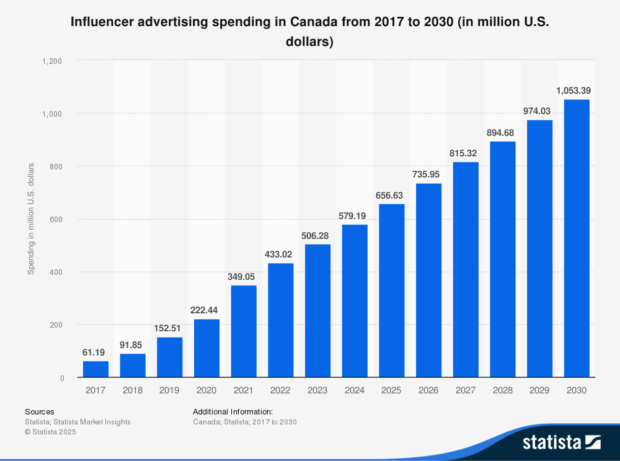
While influencer marketing continues to grow, it looks different every year.
“When influencer marketing was first starting out, it was all about one-off sponsored posts. Since then, we’ve seen a lot of brands get creative with PR boxes, brand trips, IRL activations, and more,” says Eileen Kwok, Social Media & Influencer Marketing Strategist at Hootsuite.
Today, influencer marketing is shifting toward more integrated campaigns, with brands experimenting across platforms — from TikTok and Instagram to LinkedIn and YouTube.
“As influencer marketing evolves, we’ll start to see brands create these ecosystems of influence online, and continue to discover ways they can have many touch points and collaborations with thought leaders,” Kwok adds.
In other words, there’s no one-size-fits-all approach to making influencer marketing work. With the right planning and research, just about every brand’s message can benefit from a little influencer amplification.
Types of influencers
The main types of influencers are nano-, micro-, macro-, and mega-influencers, along with emerging influencer types.
Here’s a quick overview of how they compare:
| Influencer type | Follower range | Best for | Average cost per post |
| Nano-influencers | 1K–10K | Local businesses, niche products, testing campaigns | $25–$315 |
| Micro-influencers | 10K–100K | Growing brands, targeted campaigns | $160–$1,800 |
| Macro-influencers | 100K–1M | National campaigns, product launches | $5,000–$10,000 |
| Mega-influencers | 1M+ | Global campaigns, major launches | $1,200–$25,000+ |
Before investing in influencer collaborations, it’s important to understand how audience size and platform influence campaign success. While celebrities offer massive reach, smaller creators often deliver higher engagement and more targeted audiences.
Different creators also perform better on different platforms, so choosing the right influencer depends on your audience and where they spend time online.
Let’s take a closer look at each influencer type below.
Nano-influencers (1K – 10K followers)
A nano-influencer is a creator with a small but highly engaged audience, typically between 1,000 and 10,000 followers.
These creators often have strong personal connections with their followers, which can lead to higher engagement rates. For example, nano-influencers see the highest engagement rates on Instagram, according to eMarketer.
Average cost per post: $25 to $500 (It varies wildly by platform and niche. Read more about average rates for influencer marketing here)
Why choose them: Hyper-engaged audiences, authentic connections, budget-friendly
Best for: Local businesses, niche products, testing campaigns
Example: @sustainable_sarahb (8.1K followers on TikTok) showcases her eco-friendly lifestyle with posts on thrift shopping, her switch to veganism, and news about climate developments. She’d be a great partner for an eco-friendly brand looking to connect with an audience of people trying to live a greener life.

Source: @sustainable_sarahb
Micro-influencers (10K – 100K followers)
A micro-influencer is a creator with a moderately sized audience and strong niche authority.
They’re essentially the sweet spot of influence. Big enough to grow reach, but still close enough to their audience to feel authentic.
Average cost per post: $160 to $5,000
Why choose them: Strong niche authority, high engagement, reasonable rates
Best for: Growing brands, specific market penetration
Example: @jmillydg (10.6K followers on Instagram) is obsessed with disc golf. Any disc golf brands out there looking for a passionate partner in the field? Here’s your guy.

Source: @jmillydg
Macro-influencers (100K – 1M followers)
A macro-influencer is a high-reach creator with a large, established audience. At this stage, we’re entering celebrity territory — well, internet celebrity at least.
These creators have turned content creation into a full-time career, complete with managers and media kits. They can deliver polished content and the scale needed for larger campaigns.
Average cost per post: $5,000 to $25,000
Why choose them: Major reach, professional content quality
Best for: National campaigns, product launches
Example: @yourgirlneens (182K followers on YouTube) built a following with her diary-style posts and creates videos about fashion, travel, food, and life with her partner and two young kids.

Mega-influencers (1M+ followers)
A mega-influencer is a creator with over 1 million followers. These creators — whether they’re Instagram influencers, TikTok creators, or making waves on LinkedIn — can make products sell out faster than concert tickets, but they come with a price tag to match.
Average cost per post: $1,200 to $50,000+
Why choose them: Massive reach, instant credibility
Perfect for: Global brands, major launches
Example: Mega-influencers can include OG social media stars like Addison Rae, as well as @carlarockmore (1.3M followers on TikTok), who are probably slightly more financially accessible to brands. Fans of the fashionable 50-something @carlarockmore call her the “real-life Carrie Bradshaw.”

Source: Carla Rockmore
Emerging influencer types
Here are three up-and-coming types of influencers to keep your eye on.
Employee influencers
Employee influencers are employees who promote their company by sharing content on their own social accounts or appearing in branded content.
Just take a note from companies like Microsoft and IBM, who regularly feature employees in their social posts to add a more human, behind-the-scenes perspective.

Source: lifeatibm
“Employee advocacy is already the third-most popular way organizations use social media. Employee-generated content is on the rise and for a good reason,” says Kwok.
Employee advocacy helps build trust, since people trust other people more than brands. It’s also cost-effective, since you don’t have to rely entirely on paid media. Plus, advocacy boosts your brand’s reputation. When employees speak up, it comes across as more genuine.
B2B influencers
B2B influencers are industry experts who influence business decisions, usually on platforms like LinkedIn.
For instance, Dave Gerhardt is one of LinkedIn’s stars, with a following of more than 177,000.

Source: Dave Gerhardt
LinkedIn is becoming the new Instagram for the business crowd. Twenty percent of marketers surveyed in a recent Hootsuite study said they work with influencers on LinkedIn.
“LinkedIn provides a fresh way to partner with credible industry leaders, business owners, and educators that are seen as true experts in niche industries,” Kwok says. “If you’re looking to roll out conversion ads and speak directly to decision makers, LinkedIn is the best platform to do so.”
Virtual/AI influencers
Virtual influencers are computer-generated characters, designed to engage with real people (like you!) on social media platforms. A whopping 52% of U.S. social media users follow a virtual influencer, and that percentage is higher globally.
These virtual influencers have realistic, human-like appearances and personalities. Maybe you’re following one (any Lil Miquela fans in the house?) and you don’t even know it.

Source: Lil Miquela
What are the benefits of influencer marketing?
The main benefits of influencer marketing are building trust, reaching the right audiences, and increasing brand visibility.
Here’s how it delivers:
Builds trust and authenticity
60% of consumers now trust what a creator says about a brand more than what the brand says about itself.
Why? Because when people watch a creator for months (or years), their recommendations feel more like advice from a friend than a brand message. Call it the friend factor.
But this only works when the content feels genuine.
For example, prebiotic soda brand Poppi faced significant backlash after sending vending machines to 32 high-profile influencers like Alix Earle and Jake Shane for its Super Bowl campaign.
Critics called the move extravagant and out of touch, arguing that gifting such lavish items to already affluent creators alienated the brand’s community

While some people argued that the online chatter made the campaign a success, as Rachel Karten says, “Good marketing doesn’t exist in the context of bad sentiment.”
Key takeaway: This misstep shows that effective influencer marketing isn’t just about disclosure. It’s about aligning campaigns with your audience’s values and ensuring inclusivity in your approach.
Reach highly targeted audiences
Influencer partnerships allow brands to connect directly with niche communities. Traditional advertising, on the other hand, is like using a megaphone as you walk around downtown. Sure, you’re reaching a lot of people, but are they your people?
Take a vegan skincare brand partnering with plant-based creators. This helps them reach people who’ve already shown interest in similar values and lifestyle choices. That’s marketing gold.

Source: veganzinga
Added brand exposure
Influencers help your brand show up in conversations you wouldn’t normally be part of – and that can do wonders for visibility (and ROI).
59% of marketers Hootsuite surveyed are confident that working with influencers has delivered positive ROI for their organizations.
“With so much chatter online, influencers are one of the best ways to break the noise and capture the attention of your audience,” says Kwok.
How to create an influencer marketing strategy
To create an effective influencer marketing strategy, follow these steps:
- Define your goals and budget
- Identify your target audience
- Understand platform rules and regulations
- Find the right influencers
- Research and vet creators
- Reach out and build relationships
- Collaborate on campaign content
- Measure results and optimize
Step 1: Define your goals and budget
Before you slide into any influencer’s DMs, start by defining the overall goals of your influencer marketing strategy.
Are you:
- Launching a new product?
- Trying to reach a new audience?
- Building brand awareness?
- Driving direct sales?
Your goals will determine everything — from the influencers you choose to the content you create. (We’ve got a whole blog post on goal-setting strategies to get you started.)
And please set a realistic budget. If you’re working with a limited budget, focus on smaller creators who can deliver strong engagement
Step 2: Identify your target audience
At the end of the day, you’re not just looking for any influencer — you’re looking for the right influencer for your specific audience.
Developing audience personas is a great way to make sure you understand who you’re trying to reach, whether it’s your existing audience or a new segment. The right influencer should already have an audience that overlaps with your target market.
Step 3: Understand rules and regulations
Before you dive into influencer marketing, it’s essential to read up on different rules and regulations.
In the United States, those rules come from the Federal Trade Commission. Similar rules also exist globally.
Disclosure is one of the most important requirements. Social media influencers must identify sponsored posts. However, they don’t always do it, or it’s too subtle that the disclosure is effectively hidden or incomprehensible.
In the UK, the Competition and Markets Authority (CMA) investigated “hidden advertising” on Instagram and pressed parent company Facebook to commit to changes that make disclosure easier and more clear.
While rules vary slightly by country, the core principle is the same: be clear and upfront so audiences know when content is sponsored.
Step 4: Find the right influencer
When finding influencers, look at a variety of factors beyond follower count (especially since followers can be bought!). Think about relevance, engagement, and audience alignment.
Here’s what to look for:
- Audience demographics. Are they actually reaching your target market?
- Content quality and style. Does it align with your brand?
- Engagement rate. Likes, comments, shares compared to follower count.
- Past partnerships. Have they worked with your competitors?
At the end of the day, you’re looking for someone who aligns with your brand values, matches your target market, and can drive real engagement.
There are a couple of ways to find creators. You could use an influencer marketing tool to search for creators. Or, you could use a social listening tool to find creators who are already talking about your brand or industry.
In fact, 60% of organizations that work with influencers already use social listening tools, and Kwok expects that number to climb even higher in 2026.
She adds that social listening is incredibly valuable for finding niche creators who may not surface in traditional searches.
“Social listening helps brands monitor real-time conversations and sentiment, but what many don’t realize is that it’s one of the best ways to identify high-impact influencers — especially in niche industries. If you’re able to partner with an influential creator, they can help bump your mentions, sentiment, and overall social share of voice.”

Not sure where to start? We’ve got a roundup of our top social listening tools here.
Step 5: Research and vet creators
Before diving into influencer outreach, take a minute to do your homework. Look at their recent posts. How often are they sharing sponsored content? How does their audience respond?
If they’re already bombarding followers with paid posts, their engagement rate may not last. Nobody wants a never-ending sales pitch in their feed.
What you’re really looking for is balance. Creators who mix sponsored and organic content tend to feel more authentic, and that shows in their performance.
This also matters when you’re planning your ask. If you expect too many posts in a short window, even a big marketing budget might not land. The best creators get a lot of offers, and they’re selective about what they take on.
That’s right: an influencer might just say no! The most in-demand influencers get lots of offers. It’s a sign of respect to take a minute to learn what they do, what they’re all about, and who their audience is.
For example, @shawnjohnson on Instagram isn’t just a “momfluencer” with millions of followers, she’s also an Olympian and author. Knowing that context changes how you approach the collaboration.

Source: @shawnjohnson
Step 6: Reach out and build relationships
When you reach out, keep it personal and to the point. Explain who you are, what your brand does, and what you’re hoping to collaborate on.
Before you send that message, warm things up. Engage organically with their posts. “Like” their content and leave thoughtful comments to build rapport before reaching out via DM or email with your partnership pitch.
Generic outreach rarely works. Sure, a tailored message takes more time, but it shows you’re serious and gives you a much better shot at getting a response.
Be clear about what you’re offering and what you’re asking for. Outline your campaign goals, and make sure the value goes beyond just payment. The best partnerships feel like a fit, not a transaction.
Pro tip 💡: You may not actually want to use the word “influencer” when reaching out to potential partners. Content creators prefer to be called just that — creators — and may view “influencer” as a bit of an insult that belittles their work.
Step 7: Collaborate on campaign content
Next, work with influencers to co-create content. This isn’t about controlling every detail.
Think of influencer campaigns as group projects. Influencers are content creation experts, so you’ll get the best value from their work by allowing them to showcase those skills.
Of course, it’s a good idea to offer some guidelines on messaging and deliverables. Find the sweet spot between zero direction (“just make it cool!”) and scripting every breath.
A strong creative brief includes:
- Key messaging points
- Must-have elements (product features, hashtags)
- No-go zones (things to avoid)
- Examples of content you love
- Technical requirements (video length, image ratio)
Tools matter here, too. With Upfluence integrated directly into Hootsuite, teams can manage influencer content alongside their regular social posts — making it easier to collaborate, approve content, and schedule everything in one place.
And when you’re ready to kick off your next campaign, you can also research and vet creators directly within Hootsuite.

Just remember: don’t over-direct. Comedian @heyfreesamples weaves product placements into her skits. Asking her to do a straight-to-camera product review would feel off-brand — and her audience would notice.

Source: @heyfreesamples
The bottom line: creators know their audience, and overly scripted content rarely performs well.
As Kwok puts it, “Followers are smart — they can sniff out an off-brand ad buy right away. Forming long-term relationships and building trust with your partners is the key to winning the hearts of your audience.”
Step 8: Measure results and optimize
When you launch your influencer campaign, it’s easy to get distracted by vanity metrics like likes and comments, especially if your influencer’s following dwarfs your own.
However, the true measure of a campaign’s success lies in its return on investment. To accurately assess your campaign’s performance, ensure you have the right tools in place to:
- Set up unique tracking links
- Create campaign-specific discount codes
- Establish your baseline metrics
- Define your KPIs (and no, “going viral” isn’t a KPI)
- Track deeper engagement metrics
Strong tracking is what enables accurate attribution. Without it, you’re guessing. With it, you can clearly connect influencer activity to conversions, revenue, and overall campaign performance.
You can also request detailed reports from the influencer on the reach and engagement levels of their posts.
Pro tip 💡: Measuring your results is only half the picture. You also need to understand how those results stack up. Compare your campaign performance against industry benchmarks to determine whether your results are strong, average, or underperforming.
#1 Analytics Tool for Growth
Beautiful reports. Clear data. Actionable insights to help you grow faster.
Start your free trial
Best practices when working with influencers
The best practices for working with influencers include respecting their expertise, building long-term relationships, and keeping communication lines open.
Let’s dive in:
Respect the influencer’s expertise
Influencers know their audience best. When you’re approaching a content creator about a partnership, be prepared to find a balance between your objectives and their creative freedom.
“Present your brief to your creator and see if there are any tweaks they would make to make the partnership more authentic on both ends,” says Kwok.
That might look like letting an influencer who doesn’t ski make a cheeky video about how they love your products best for creating an apres-ski look.

Source: Vicki Duong
Think beyond a single post
“One-off sponsored posts don’t do it anymore,” says Kwok. Work with your influencer to build an ongoing campaign, maybe even one that moves offline. Kwok suggests considering an in-person event or teaming up with a whole group of influencers to really achieve reach.
“It’s important to take notice of what other brands are doing, but I encourage brands to write their own rules,” says Kwok.
“Discover the types of partnerships that break the mold of a traditional sponsored post and create the kind of content your target audiences would want to engage with.”
Perhaps a curated collection of products from your influencer partner, available in-store?

Source: @omgheysam
Keep the DMs open
Nothing should be left as a surprise, so open and ongoing communication is important for both parties to feel supported.
“It also ensures the outcome of the post is executed in an effective and timely manner,” says Kwok, who recommends all parties set clear expectations right from the beginning — including where they can best be reached, how many business days are reasonable between responses, or any upcoming vacations.
What brands often get wrong
Look, we’ve all made mistakes. However, some influencer marketing mistakes are more expensive than others.
Over-scripting content
You wouldn’t tell Picasso exactly how to paint, would you? When brands try to control every aspect of influencer content, it’s rarely a masterpiece.
Choosing influencers based on aesthetics alone
Sure, that influencer’s feed looks like it was curated by the Instagram gods themselves. But if their audience is primarily teenage boys and you’re selling anti-aging cream, well, you do the math.
Ignoring red flags
If a content creator is posting edgy content or getting into online fights, beware. Their bad behavior could have you brushing up on your crisis management skills.
How to fix these mistakes
Work together on briefs
Instead of dropping a 20-page PDF in their inbox, try having an actual conversation with your influencer. Ask them:
- What types of content perform best with their audience?
- Their ideas for featuring your product or service
- Previous campaign experiences (good and bad)
Run test campaigns
Before you commit your entire yearly budget to one mega-influencer, try running smaller campaigns with multiple creators.
Advanced influencer marketing best practices
Whitelisting influencer content
When influencer content performs well organically, you can run it as an ad from their account. It’s like getting the best of both worlds: influencer authenticity with paid reach precision.
Think of this as the marketing equivalent of a greatest hits album.
Leveraging affiliate marketing
Setting up affiliate programs gives influencers incentive to keep promoting your product long after the initial campaign ends.
Just make sure your commission structure makes sense for both parties — nobody wants to push products for pennies.
Always-on campaigns
The “one and done” approach to influencer marketing is about as effective as trying to get fit by going to the gym once.
Successful brands are building long-term relationships with creators, creating consistent content that feels natural and authentic.
Measuring success
Ultimately, the success of your influencer campaign hinges on proving ROI, not just accumulating viral moments or polished content. Here’s how to evaluate your influencer marketing efforts effectively:
Pro tip 💡: Look beyond the raw numbers to understand their significance. A 5% engagement rate on a TikTok post might seem low until you realize it’s two times the industry average.
The influencer marketing landscape is always evolving (think: AI influencers), but the core principles remain unchanged: prioritize authenticity, focus on strategy, and always track your results. Start building those influencer relationships today — just ensure your budget aligns with your ambitions.
FAQ: Influencer marketing
What is influencer marketing and how does it work for businesses?
Influencer marketing is a strategy where brands partner with content creators to promote products or services to their audience. It works by tapping into the trust creators have already built — turning their recommendations into a form of digital word-of-mouth that drives awareness, engagement, and sales.
How do brands build a successful influencer marketing strategy?
Brands build successful influencer marketing strategies by setting clear goals, defining their target audience, choosing the right influencers, and measuring results. It’s also important to follow a structured process — from setting budgets and vetting influencers to collaborating on content and optimizing performance over time.
What types of influencers should brands work with for marketing campaigns?
The types of influencers brands should work with depend on their goals, budget, and target audience. Nano- and micro-influencers offer high engagement and niche reach, while macro- and mega-influencers provide scale and visibility for larger campaigns.
How do companies measure ROI from influencer marketing?
Companies measure influencer marketing ROI by tracking metrics tied to business outcomes, not just vanity metrics. This includes conversions, click-through rates, cost per acquisition, engagement rates, and brand sentiment. Using tools like tracking links and discount codes can connect influencer activity to revenue.
What are the most effective influencer marketing best practices for brands?
The most effective influencer marketing best practices are to give influencers creative freedom, communicate consistently throughout the campaign, and build long-term relationships. Brands should avoid over-scripting, collaborate closely on content, and think beyond one-off posts.
Manage your social media marketing with Hootsuite. Schedule influencer posts, research and engage with creators in your industry, and measure the success of your digital marketing campaigns. Try it free today.