Key Takeaways
- AI on the JVM accelerates: New frameworks like Embabel, Koog, Spring AI, and LangChain4j drive rapid adoption of AI-native and AI-assisted development in Java.
- Java 25 anchors a modern baseline: The new LTS improves readability, concurrency, and performance, while frameworks standardize on Java 17+.
- Modernization surges: Organizations prioritize updating legacy apps and outdated Java versions, with OpenRewrite emerging as the dominant automation tool.
- Enterprise Java advances: Jakarta EE 11 stabilizes with broad adoption, and early work on Jakarta EE 12, especially Jakarta Query, pushes the platform forward.
- Community and deployment shifts: Java community engagement is growing, while enterprises increasingly explore hybrid, regional, or on-prem deployment strategies.
This report summarizes the InfoQ Java editorial team’s current perspective on the adoption of technology and emerging trends within the Java space. We focus on Java, the language, as well as related languages such as Kotlin and Scala, the Java Virtual Machine (JVM), and Java-based frameworks and utilities. We discuss trends in core Java, including the adoption of new Java versions, as well as the evolution of frameworks such as the Spring Framework, Jakarta EE, Quarkus, Micronaut, Helidon, and MicroProfile.
This report has two main goals:
- To assist technical leaders in making mid- to long-term technology investment decisions.
- To help individual developers choose where to invest their valuable time and resources for learning and skill development.
This is our seventh published Java trends report. However, this topic has received ample news coverage as we have internally tracked Java and JVM trends since 2006.
To help navigate current and future trends at InfoQ and QCon, we use the “crossing the chasm” mental model for technology success, pioneered by Geoffrey Moore in his book of the same name. We try to identify ideas that fit what Moore called the early market: “The customer base is made up of technology enthusiasts and visionaries who are looking to get ahead of either an opportunity or a looming problem“.
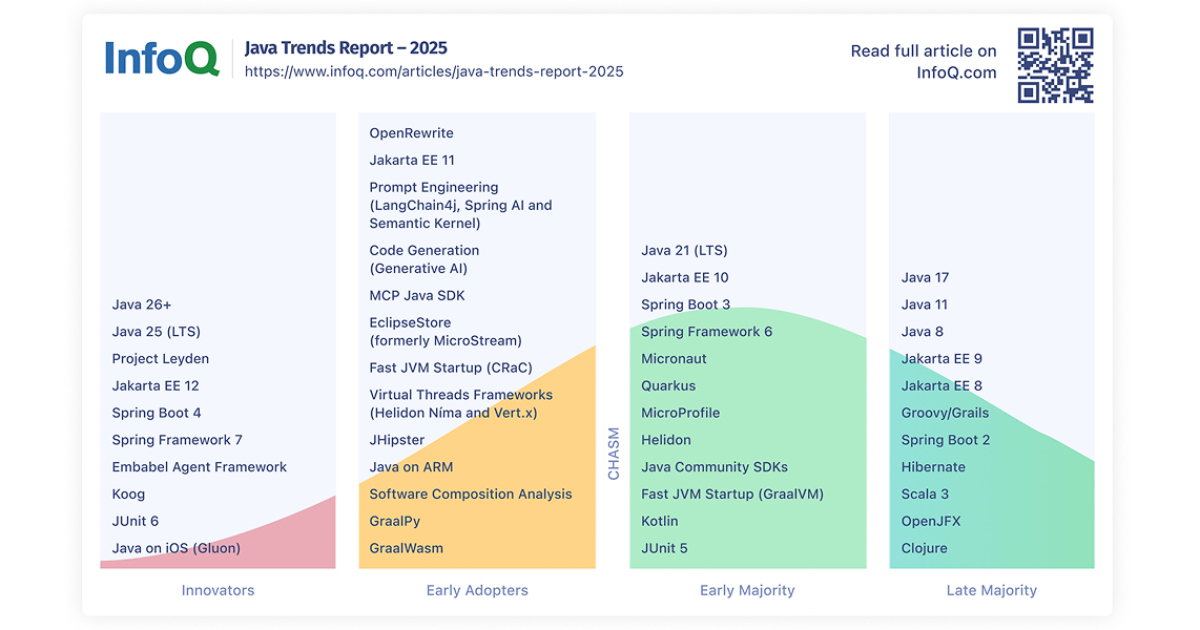
As we have done for the 2024, 2023, 2022, 2021, 2020, and 2019 Java trend reports, we present the internal topic graph for 2025:

For context, this was our internal topic graph for 2024:

Innovators
The Embabel Agent Framework and Koog, created by Rod Johnson and JetBrains, respectively, are new open-source agent platforms for the JVM introduced to the Java community during the second quarter of 2025. These frameworks were designed for developers to build and run AI agents.
The first three features under the auspices of Project Leyden have been delivered in 2025 with the releases of Java 24 and Java 25. A fourth feature will be part of the upcoming Java 26 feature set.
The much-anticipated GA releases of Spring Boot 4.0 and Spring Framework 7.0, released in November 2025, deliver API versioning, resilience and null-safe annotations from JSpecify.
Work for Jakarta EE 12 commenced in early 2025, well before the final release of Jakarta EE 11, included creation and plan reviews for 24 specifications. Four new specifications have been added to the ecosystem. One of these, Jakarta Query, has already been accepted to be part of the Platform and Web Profile. The anticipated release of Jakarta EE 12 is July 2026.
Early Adopters
Jakarta EE 11 moves up to this category as many Java projects, including Open Liberty, WildFly, Payara and GlassFish, have been certified as compatible implementations.
OpenRewrite makes its debut in this category as many projects have been modernized using this technology. Notable uses of OpenRewrite include the javax to jakarta namespace migration and the upgrade of the outdated Jakarta EE Technology Compatibility Kit (TCK).
GraalPy and GraalWasm have moved into this category as they were officially characterized as stable and suitable for production workloads with the release of GraalVM for JDK 23. These projects, previously experimental features under the auspices of GraalVM, made their debut in the Innovators category in 2024.
Introduced in December 2024, the MCP Java SDK makes its debut in this category as it enables Java applications to interact with AI models and tools through a standardized interface that supports both synchronous and asynchronous communication patterns.
Spring AI 1.0, delivered in May 2025, joins the list of other Generative AI technologies. Spring AI features include a ChatClient interface that supports twenty AI models with multi-modal inputs and an output with a structured response, an Advisors API that serves as an interceptor chain for developers to modify incoming prompts by injecting retrieval data and conversation memory, and full support for the Model Context Protocol (MCP).
What follows is a lightly edited summary of the corresponding discussion on various topics among several InfoQ Java Queue editors and Java Champions:
- Michael Redlich, Java Champion | Director at Garden State Java User Group | Contract Developer Advocate and Technical Writer at Payara | Java Queue Lead Editor at InfoQ | Retired Senior Research Technician at ExxonMobil Technology & Engineering Company
- Erik Coslow, Senior Director of Product Management at Azul | Java Queue Editor at InfoQ
- Karsten Silz, Senior Full-Stack Java Developer | Java Queue Editor at InfoQ
- Trisha Gee, Java Champion | Head of Developer Advocacy at Gradle
- Marit van Dijk, Java Champion | Developer Advocate at JetBrains
- Richard Fichtner, Java Champion | CEO at XDEV Software | Founder of JUG Oberpfalz | Co-Organizer of JCON
- Bert Jan Schrijver, Java Champion | CTO at OpenValue | JUG leader at NLJUG
Their biographies are listed at the end of this report.
We also acknowledge the Java Queue editors who provided input on updating our “crossing the chasm” model for 2025:
- Daniel Bryant, Java Champion | Platform Engineering & Product Marketing at Syntasso | News Manager at InfoQ
- Olimpiu Pop, Technology Consultant | Java Queue Editor at InfoQ
This summary provides additional context for our recommended positioning of certain technologies on the internal topic graph.
Java and Artificial Intelligence
Van Dijk: There is an increasing focus on using Java for AI, and new tools are emerging. Langchain4j continues to evolve. This year, we also saw the introduction of Embabel, a new agent platform for the JVM, created by Rod Johnson of Spring Framework fame. Another addition is Koog, a Kotlin-based framework designed to build and run AI agents entirely in idiomatic Kotlin. It’s great to see the number of options for using AI on the JVM growing.
With the use of AI tools for software development, we seem to be (re)discovering software engineering practices. With the trend of spec-driven development, we are integrating good software development practices into the use of AI for software development.
As more code is being generated by AI, rather than written by developers, readability continues to be important. That’s why it is good to see that the Java language and tools continue to evolve in ways to make code easier to read and understand.
Fichtner: AI is no longer just a buzzword, it has become a practical reality, and we see two very distinct ways it’s being used.
On one side, you have AI-powered development tools. These don’t replace developers, but in the hands of skilled professionals they accelerate coding, improve quality, and make teams far more productive.
On the other side, there is AI built into applications. This use is where Java shines. For years, people assumed AI required Python. But when it comes to running business-critical, large-scale applications, more and more teams are turning to Java. They value its strong typing, reliability, and the maturity of its ecosystem. When it’s time to deploy, integrate, and scale, Java frameworks like LangChain4j, Spring AI, and others make it possible to bring AI into production with confidence.
In short, Python may start the story, but Java is where many of these AI applications truly come to life.
Silz: For forty years, I wrote code by hand. I don’t anymore because AI codes for me. AI also explains unknown projects, writes specs and documentation, fixes broken builds, and tunes production systems. Even with all of AI’s mistakes, I’m still more productive than without AI.
My working assumption is that AI can make all developers more productive, which raises two questions. The first concerns automation over the next two to three years: Will fewer developers produce the same amount of code, will the same number of developers create more code, or will more developers write significantly more code? The second is a principal question: What happens when AI gets good enough that it’s not developers telling the AI what to do, but business analysts?
Java 25 and Beyond
Gee: Java 25 came out in September 2025, which is now the current long-term support release. I love that the six-month release cadence is now so normal, and that we, as a Java community, are used to getting high-quality releases on predictable dates, and that each one has interesting features in it.
Van Dijk: The release of Java 25, the latest LTS, brings a lot of improvements to the language. Changes like Compact Source Files and Instance Main Methods make it easier not only to learn Java as a beginner, but also to help experienced programmers by allowing them to quickly prototype ideas. In each case, code can be expanded as knowledge and needs grow.
Other changes are making the language more expressive, making Java easier to write and read. For example, Structured Concurrency (still in preview) makes it easier to work with concurrent code and easier to understand what is going on. Improvements in pattern matching, such as Primitive Types in Patterns, instanceof, and switch (also still in preview), make it easier to quickly understand code.
In addition to language features, performance and performance insights have also improved in Java 25. Updating your JDK will give you benefits out of the box, even if you don’t update your code to use the latest language features. I would recommend you do, so you can get the benefits of new language features as well.
It’s great to see that frameworks and libraries are moving to support or even require newer Java versions. Java 17 seems to be a new baseline, because Spring, JUnit, Gradle 9, and the upcoming Maven 4 require Java 17 or higher to run. The Spring team now also recommends the use of Virtual Threads, introduced in Java 21. And it’s nice to see the adoption of JSpecify annotations by projects like Spring and JUnit. It’s great to see the language and ecosystem evolve together.
Schrijver: Well, JDK 24 and 25 were released, Stream Gatherers were finalized, Scoped Values were introduced, pattern matching can now handle primitive types in
switchandinstanceofstatements, and Compact Source Files and Instance Main Methods were introduced.
Redlich: After a slow start, Project Leyden has finally delivered features that aim to improve startup time, time-to-peak performance, and footprint of Java programs. The very first feature, Ahead-of-Time Class Loading & Linking, was delivered with the release of Java 24. This feature seemed to have opened the proverbial floodgates as two features, Ahead-of-Time Method Profiling and Ahead-of-Time Command-Line Ergonomics, were delivered in Java 25, and one feature so far, Ahead-of-Time Object Caching with Any GC, has been targeted for JDK 26. A fifth feature, Ahead-of-Time Code Compilation, is currently still in draft status.
Modernization of Legacy Java Applications
Fichtner: We’re seeing a clear rise in demand for Java application modernization. Many teams are moving older applications, – Swing-based apps for example, – into the web browser using modern frameworks like Vaadin. Others are dealing with years of accumulated technical debt. Framework updates have become more complex, and with today’s heightened focus on supply chain security, organizations are paying close attention to vulnerabilities in their software stacks.
Another major driver is Java version modernization. Too many teams are still running on versions prior to Java 8. They want to move forward, but they need a realistic, reliable path to do so.
This aspect of modernization is where tools like OpenRewrite really shine. They make upgrades deterministic, not just for moving to newer Java versions, but also for keeping frameworks like Spring Boot, Quarkus, Micronaut, and others up-to-date.
That combination, addressing technical debt, strengthening security, and modernizing platforms, has become a major trend over the last year, and it’s accelerating.
Costlow: I don’t want to talk about specific technical libraries, the change that I feel is more in the pace of Java and major libraries. Everyone is pushing forward to be more current: current with the JDK and current with libraries. It’s to the point that major libraries are actually requiring relatively current tech.
Jakarta EE
Redlich: The much-anticipated release of Jakarta EE 11 has finally arrived! The original roadmap had a release date of July 2024, but it was decided to upgrade the outdated Technology Compatibility Kit (TCK), which featured migrations from Ant to Maven and Test Harness to Arquillian using OpenRewrite.
This upgrade resulted in a staggered release process with the Core Profile in December 2024, the Web Profile in April 2025, and the Platform in June 2025. This effort should make a more efficient release process for Jakarta EE 12 and beyond.
What Developers are Saying in the Java Community
Our participants provided insight into what other developers in the Java community might be saying about the state of Java.
Gee: Of course, what everyone is talking about is AI, and in the Java community, there was concern in past years about how Java can remain relevant when people automatically think of languages like Python when it comes to AI. However, this year I’ve been seeing the use of many more libraries and frameworks that make it really easy to use AI functionality within Java programs in a way that’s idiomatic and useful to Java developers. Since the vast majority of us will be writing enterprise applications that include AI features, this approach is extremely useful to us.
Van Dijk: We continue to hear about how AI can help developers and what this assistance means for development practices. Of course, people talk about how the language and the ecosystem continue to evolve. JUnit 6 was released recently. Spring Boot 4 / Spring Framework 7 were released in November. And it looks like Maven 4 might be released this year, after years of work.
It’s great to see both the Java language and the ecosystem continue to evolve to make software development easier, and it’s great to hear people sharing their favorite tools and practices.
Fichtner: When I listen to the Java community right now, one of the biggest shifts I notice is around the cloud conversation.
A few years ago, everything was about moving to the cloud and cloud native. But the winds have definitely changed, if you’ll forgive the pun. These days, I hear a lot more about companies moving back on-premises, or choosing European cloud providers and data centers instead of relying solely on the big global platforms.
This shift isn’t just about technology, it’s also about sovereignty and compliance, especially here in Europe. Data privacy, regulatory requirements, and control over infrastructure are driving real change in how teams deploy and run their Java workloads.
So, one of the strongest talking points I hear in the community right now is exactly that: rethinking cloud strategies and putting more emphasis on on-prem and regional solutions.
Schrijver: I hear others mostly talking about Java finding its way into the AI world with frameworks like Langchain4j, but also with the application of Java in RAG tools and MCP servers. Rod Johnson at Devoxx Belgium explained why he feels that we all should be building AI agents on the JVM, and how frameworks like Embabel show that Java is actually well suited to build agentic AI solutions. Although languages like Python currently have a head start compared to Java in the AI space, I think we’re not far off from Java becoming a serious competitor here, given all the current developments around building AI solutions with Java. Exciting!
Costlow: I have selective hearing and attention for modernization. A lot of what I hear is about companies deciding how they’re working to manage applications: running them, building them, maintaining them, and retiring them. Ultimately, a lot of this management boils back down into business concepts of time to market, return on investment, and cost management. These conversations don’t start in the Java community; they’re the type of conversations where people need to continually decide that Java is the right choice. Here, the conversations often start on the topic that, with Java, you can continually leverage and grow the investment that you made in Java over a decade ago, and then you’ll be able to do the same thing years from now.
What is New and Exciting That We Didn’t Expect?
Our participants were asked about things in the Java ecosystem that were delightfully unexpected.
Gee: I’ve played with Compact Source Files and Instance Main Methods. It’s really nice to see how “Hello World” has a lot less boilerplate, although it doesn’t affect professional developers much in their day jobs, it does help newbies get started with the language, because it removes a lot of the noise they just don’t need to know. I don’t know if it’s “exciting” so much as long-overdue! But I also like that this feature has been added in a way that doesn’t feel unnatural to experienced developers, and I expect, given Java’s commitment to backwards compatibility, that the addition doesn’t change any existing functionality.
Schrijver: I didn’t expect to be able to write a Java source file with just
void main() { IO.println("hi!"); }and run it withjava test.javaanytime soon, and yet here it is!
Although this enhancement seems small and not super relevant if you’re in the enterprise Java web applications space like me, I still think this addition is a great development that makes it easier to get into Java for beginners, and for the use of Java in education.
Costlow: I’ve been seeing really old applications being essentially resurrected. By old, I mean like people upgrading from Java 7 because they’re making replace/retire decisions and choosing to carry Java apps forward.
Silz: Software development has product-market fit for generative AI: plenty of training material, good checks to ensure the AI is correct (code compiles, linters pass, tests pass), and expensive developers as the incentive for automation. For now, we developers benefit from increased productivity. We may not in the long term.
Redlich: I didn’t expect that we would see a small open-source project focus on carbon-aware job processing. This addition was the highlight of the JobRunr 8.0 release in July 2025. JobRunr provides an optimized carbon footprint for developers when scheduling jobs using data from ENTSO-E, an energy provider for the European Union. Carbon-aware job processing is not yet available in the United States.
What’s Getting You, Personally, Really Excited in the Java Space?
We asked our participants to describe what gets them personally excited about the current state of affairs in the Java ecosystem.
Gee: I haven’t had much time to write Java code this year, but I am keen to work with the various features around Project Loom and structured concurrency. Having features that help us write concurrent and/or parallel code in a way that is easier to reason about is fundamental to writing safe and scalable applications.
Van Dijk: Personally, I am excited about all of the changes that make the Java language easier to learn and easier to use, and tools that can help with understanding code. These additions will make code easier to maintain and less prone to bugs, all of which will make developers’ lives easier. With more code being generated than ever before, there will be more code to maintain.
With the evolving language and ecosystem, there are always new things to learn, which is exciting, if sometimes also overwhelming. The most exciting thing for me personally is to be part of the wider community and be able to share knowledge, at conferences and in other ways. It is more fun to learn together, and it is truly amazing to be part of this community.
Fichtner: What really excites me in the Java space right now is the community. It feels more alive than ever.
Here in Germany, we’re coaching and supporting new JUGs. It is inspiring to see so many people eager to start local groups, meet offline again, and connect face-to-face after the pandemic. That kind of real human interaction is at the heart of what makes Java special.
I’m also really energized by JCON Europe, the community conference we host in Cologne. It’s always amazing to spend time with the Java community, exchange ideas, and just hang out with people who share the same passion.
This year, for the very first time, we took JCON to the USA. In October 2025, we partnered with IBM to highlight their fantastic contributions to the Java ecosystem and we even ran a special edition of JCON at IBM TechXchange.
For me, that combination of local JUG energy and global collaboration is what makes the Java community so exciting right now.
Schrijver: I keep getting impressed by the amazing possibilities that GraalVM brings. At Devoxx Belgium, Fabio Niephaus showed me how he was running a Spring Boot application in a web browser (!) by using GraalVM to compile a Java application to WebAssembly. If you don’t believe me, have a look for yourself at this Spring Shell for WebAssembly web application.
Costlow: Automated modernization tools are really exciting. Previously, the role of upgrading Java, upgrading major frameworks and libraries, was drudgery. Boring work took time away from intelligent people to change code, test everything, and effectively come out of a multi-month project with something that was functionally the same as before. Now those good engineers can automate almost all of that work and stay focused on the cool aspects of development for building new things. In terms of Java, it lets developers keep working on older applications as though they were current, modern-day works in progress.
This modernization is especially exciting for new developers because they know today’s technology; they didn’t go to college and learn Spring 1.x. Modernization makes everything more pleasant for existing developers but is especially welcoming to junior developers.
Silz: Nothing. Java, it’s not you, it’s me: new versions of languages or frameworks will make me maybe ten percent more productive at best. AI can increase my productivity by at least fifty percent. So, I invest my time in AI, not in languages or frameworks.
Redlich: I’m excited to learn more about the new Jakarta EE specification, Jakarta Query, that passed its creation and plan review in early 2025 and has been voted into the Jakarta EE 12 Platform and Web Profile. Having this specification in the Platform serves as a unification of all the data-related specifications. The Jakarta Persistence Query Language and the newer Jakarta Data Query Language will now be under the auspices of Jakarta Query.
Conclusion
Please note that the viewpoints of our contributors only tell part of the story. Different groups, segments, and locales of the Java ecosystem may have different experiences. Our report for 2025 should be considered as a starting point for debate rather than a definitive statement and an invitation to an open discussion about the direction the industry is taking.