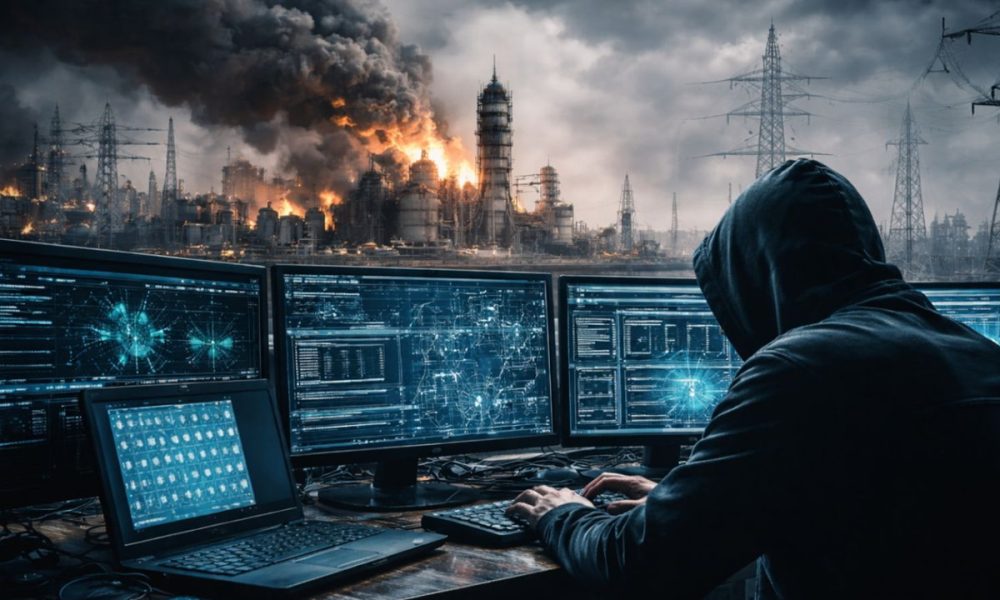
The Islamic Revolutionary Guard Corps (IRGC), the elite branch of Iran’s armed forces, has directly threatened US technology companies with interests in West Asia. He accuses them of «collaborate» and act like “spies” in the attacks by the United States and Israel against infrastructure, and in the assassinations of the country’s leaders and officials.
Although the IRGC had already warned foreign technology and defense companies with a presence in the Middle East and had attacked data centers in the region, such as those of AWS in Bahrain and the United Arab Emirates, it is the first time that it has put a specific date and list for the attacks. Includes 18 companies considered “legitimate objectives”the technology companies OpenAI, Antrhropic, Cisco, HP, Intel, Oracle, Microsoft, Apple, Google, Meta, IBM, Dell or NVIDIA, as well as defense companies such as Palantir, Boeing and Tesla, and financial companies such as JPMorgan.
“These companies must expect the destruction of their units for each terrorist act in Iran, starting at 8 p.m. Tehran time on Wednesday”declared the Islamic Revolutionary Guard in a message published on the Telegram messaging application, where also warns employees of these organizations and urges them to “Leave your jobs immediately to save your lives”. Likewise, it alerts residents around these companies in all countries in the region to leave their homes within a one kilometer radius and go to a safe place.
“Given that the main element in the design and monitoring of terrorist targets are American information and communication technology (ICT) and artificial intelligence (AI) companies, in response to this terrorist operation, from now on the main institutions participating in them will be our legitimate targets”declared the IRGC
Now American technology companies
The war in Iran escalates, as expected. The victims (mostly civilians) number in the thousands; The displaced number in the millions; the material damage is incalculable; Overcoming the footprint in the region will take decades, if it is ever achieved; The consequences spread throughout the world and the destruction of the rules-based international order is a fact. It is the result of Trump’s “adventure” to Netanyahu’s diktat that has put the world on the brink of chaos. And the worst thing is that there seems to be no way out, other than increasing the destruction at all levels.
Getting into what concerns us. The war against Iran was already affecting the technology market. With the barrel of oil at maximum levels and rising, any economic activity is affected and, in addition, the technology industry, immersed in a serious semiconductor crisis due to the hoarding of AI infrastructure, has its own problems and other additional problems such as those related to the lack of Helium.
In the IRGC statement, they highlight that American information technology and artificial intelligence companies “they are playing a fundamental role in the planning and execution of operations against Iran” and hence they mark them as objectives.
The United States used Anthropic AI in its initial airstrikes against Iran at the start of the war in late February and Israel has been using a new proprietary AI platform to track the movements of Iranian officials. In fact, Iran is considered to be the first large-scale test of AI-assisted warfare. Therefore, even in the West, the responsibility of business giants when it comes to providing their technology for war has come to the fore.
Iran’s new warnings represent a significant threat to US technology companies and raise questions about how facilities and personnel will be protected in the event of attacks with missiles and drones, when we have already seen that some of them are unstoppable and technology facilities do not have the defense systems of military bases. On the other hand, the debate arises again about the responsibility of business giants when it comes to contributing their technology in this type of conflict.
AI infrastructure and data centers in general are no longer a purely commercial asset due to their importance in communications, logistics and decision-making in conflicts.