The mood in Moscow was strikingly subdued in late February as the country marked four years since the start of Russia’s full-scale invasion of Ukraine. Kremlin officials made little mention of the anniversary, while the heavily censored Russian media offered only minimal coverage. With no end in sight to the increasingly costly war, this lack of fanfare is easy to understand. However, events currently unfolding in the Middle East may yet rescue Vladimir Putin’s faltering invasion.
When Putin first announced the full-scale invasion of Ukraine on February 24, 2022, he vowed to “demilitarize” and “denazify” Ukraine. He has also sought to justify the war as a campaign against NATO expansion and crusade to revive Russia’s great power status. By almost any measure, Putin has failed to achieve these goals.
The Russian leader’s inability to demilitarize Ukraine has been perhaps his most glaring failure. Indeed, few countries have ever looked less demilitarized than today’s Ukraine. As the war with Russia enters a fifth year, Ukraine possesses Europe’s largest army and is a world leader in drone warfare. From NATO members to Gulf petrostates, countries are now queuing up to access Ukraine’s unrivalled expertise. Meanwhile, a consensus is emerging in European capitals that Ukraine has an indispensable role to play in the future security of the continent.
Likewise, Putin’s bid to “denazify” Ukraine has proved spectacularly counterproductive. The entire concept of “denazification” is Kremlin code for the eradication of Ukrainian national identity, but Putin’s invasion has sparked an unprecedented surge in patriotism among the Ukrainian population along with a deep distrust of all things Russian. As a result, it is now virtually impossible to imagine the emergence of a pro-Russian government in Kyiv, unless permanently propped up by Kremlin bayonets.
Putin has gone to great lengths to blame the war on NATO’s post-1991 eastward expansion beyond the old Iron Curtain. Far from arresting or reversing this process, Russia’s actions have sparked a new and highly significant wave of enlargement. In response to the invasion of Ukraine, both Finland and Sweden opted to abandon decades of neutrality and join NATO. This has more than doubled Russia’s shared border with the alliance, while also transforming the Baltic Sea into a NATO lake.
On the global stage, the invasion of Ukraine has left Russia unable to project strength or justify its claims to great power status. With the vast majority of his military forces deployed in Ukraine, Putin has proved unable to aid a series of international allies during moments of crisis. Syria, Venezuela, and Iran have all learned the hard way that Putin’s promises of partnership are empty.
Russian prestige has taken a further pounding on the battlefields of Ukraine. Like many others in Moscow and elsewhere, Putin fully expected to secure a quick and complete victory in Ukraine. Instead, his armies have been unable to achieve any decisive breakthroughs despite suffering catastrophic losses. More than four years on, they remain bogged down in brutal attritional warfare.
Putin has tried to distract from this underwhelming military performance by projecting confidence in eventual success, but his boasts of relentless Russian advances now ring increasingly hollow. In February 2026, Ukraine actually liberated more territory than the Russian army was able to seize, making a mockery of Kremlin efforts to portray Russian victory as inevitable.
Eurasia Center events
With Russia’s prospects in Ukraine looking increasingly grim, the joint US-Israeli operation against Iran could hardly have come at a better time for Putin. While Russia’s inability to assist a key ally is undoubtedly embarrassing, the Kremlin could potentially emerge as a major beneficiary of the escalating conflict in the Middle East.
The scope for economic gains is obvious. With the Strait of Hormuz under threat and key energy export routes out of the Middle East facing major disruption, Russia stands to benefit more than most from rising oil and gas prices. This could reinvigorate Putin’s war economy at a time when it was beginning to show signs of serious strain.
The US focus on Iran may also distract the Trump administration from diplomatic efforts to broker a peace deal between Russia and Ukraine. While these US-led peace talks had not resulted in any tangible progress toward a sustainable settlement, they represent a diplomatic challenge to the Kremlin. Putin will now likely be able to breathe a little easier, at least while the United States remains preoccupied with Iran.
Crucially, escalating hostilities in the Middle East may force Washington to limit the supply of weapons to Ukraine. The US, Israel, and the Gulf states are all reportedly struggling to cope with Iranian drones and are already in danger of running low on air defense ammunition.
In particular, the first days of the conflict have reportedly seen unprecedented use of Patriot air defense missiles, which are in limited supply and desperately needed by the Ukrainians to intercept Russian ballistic missiles. If Kyiv finds itself without these missiles in the coming months, Russia will be able to strike critical infrastructure targets across Ukraine with impunity. This could leave large parts of Ukraine unlivable and have a major impact on the country’s ability to maintain the war effort.
None of this is inevitable. If US-Israeli forces succeed in curtailing Iran’s ability to strike back and can conclude their campaign within a matter of weeks, Putin will have little to cheer. However, if the current air offensive escalates into a protracted military conflict, this will likely strengthen Russia economically while weakening Ukraine’s ability to defend itself and prolonging Europe’s largest invasion since World War II.
Peter Dickinson is editor of the ’s UkraineAlert service.
The views expressed in UkraineAlert are solely those of the authors and do not necessarily reflect the views of the , its staff, or its supporters.

The Eurasia Center’s mission is to enhance transatlantic cooperation in promoting stability, democratic values, and prosperity in Eurasia, from Eastern Europe and Turkey in the West to the Caucasus, Russia, and Central Asia in the East.
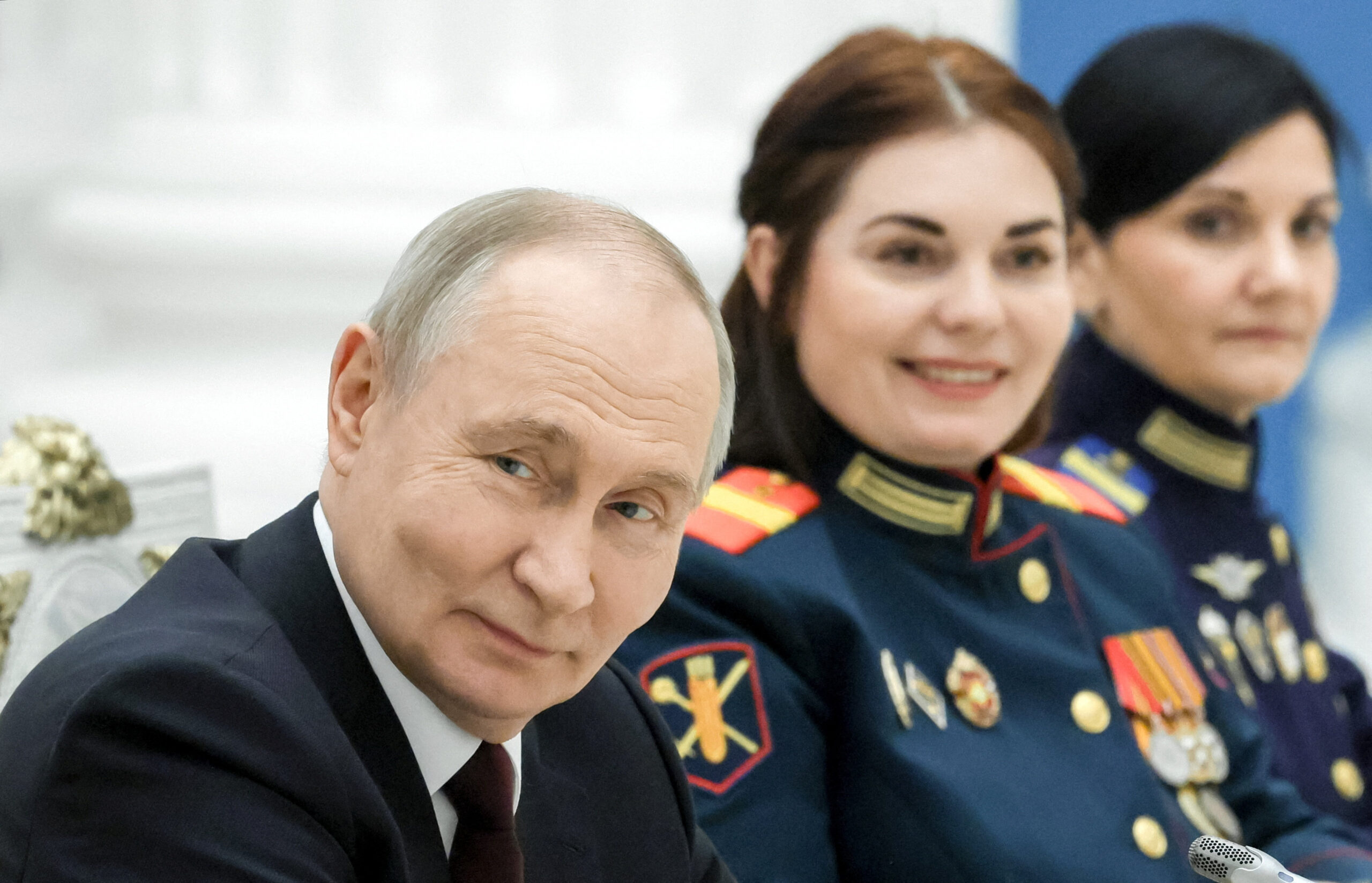
Image: Russian President Vladimir Putin attends a meeting with women representing various professional fields to congratulate them on the upcoming International Women’s Day at the Kremlin in Moscow, Russia March 5, 2026. (Sputnik/Mikhail Metzel/Pool via REUTERS)