

If you are a regular at Mercadona, you will have noticed that the stores are constantly evolving. From time to time new sections are opened, new services are offered, certain products disappear and there is an increasing commitment to private labels. The company closed 2025 with a new purchase that had nothing to do with food: that of the company that has been supplying it with boxes and pallets for decades. Now we know one of the reasons.
The new Mercadona T9.
Mercadona pilot. It is not just an aesthetic renovation, but also a functional and conceptual one. As the FRS media commented a few days ago, Mercadona is testing a new type of store in Xirivella, Valencia. Known as “T9 format”, it is a prototype that seeks to optimize processes. What does this translate into?
In a store more similar to the automated ones that we have been seeing for a few years, with the products available and visible, well organized so that the customer can put them in the cart and their only interaction with a human is at the checkout. This format relies on a reorganization of space that, in theory, optimizes staff productivity when replenishing products while reducing both consumer waiting times and unnecessary movements.
Apáñate usual. As FRS points out, the shelves will now have more products directly on the pallets, with wider aisles to avoid crowding. There is also a reorganization of the categories into something called “purchase missions.” For example, the popular prepared meals are located next to the bakery, unifying sections that make sense and were previously separate.
And that search for a more open space is taken to its ultimate consequences. According to the media, in the Xirivella pilot store there are almost no communicative visual elements. This translates into a lack of traditional signage and signage to identify the sections.
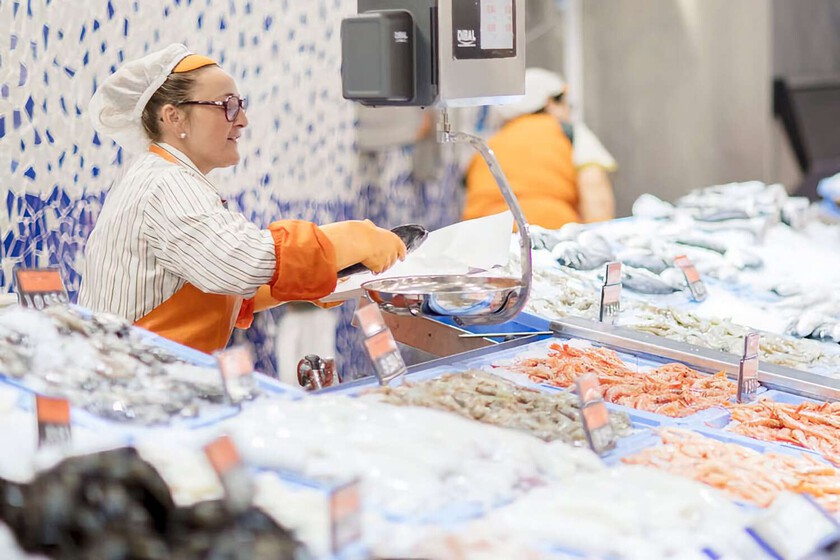
Fishmongers. Yes. Again. Within this store format, there are two sections that are clearly affected: fishmonger and butcher. If you are one of those who are going to order sliced ham or a filleted hake, if the t9 format prospers and is exported to the rest of the company’s stores, you will have to look for another fishmonger.
Directo al Paladar already told us that these sections were adapting to new needs in which current generations do not have the ease or knowledge to order a sliced fish, prioritizing packaged products. The new format dispenses with these traditional models and opts for more packaging and less assisted purchasing. Take the product and leave. No waiting, no talking to anyone, no choosing the freshest.
What happens to the workers. Nothing. At least, according to Mercadona. Questioned about this online, the company has come out to confirm that “the entire fishmonger’s team is still part of Mercadona.” But, if they are not attending, where are they? To other things, adapting, according to the company, “to other needs within the store and the section itself.”
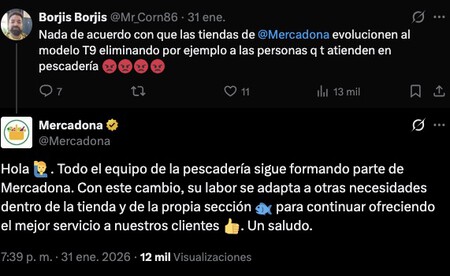
Click to go to X
Controversy. But of course, this lack of workers in a section does not only imply knowing where they are located, but also what directly affects the customer: who is there to ask for advice about a piece, quantities or whether a product is fresh or not. There have been some complaints about this, also about the bagging of products or queues at the checkout.
Because if one of the objectives is the flow of customers, and in a Mercadona with the usual format there are already moments in which queues form at the checkout, in one in which the flow is improved in the rest of the business, the bottleneck may be at the time of paying. It will surely be one of the aspects that Mercadona will evaluate to see if this model can be exported.
Future takeaway. In any case, the different movements of Mercadona and the monopolization of almost 30% of the supermarket share, prove the owner of the chain right, more or less like it. Juan Roig has been evangelizing for years about the benefits of ready-to-go and ready-to-eat food, and the data proves him right.
There are potato omelettes as an example, but also ready-to-eat dishes. According to a study, the chain has a 51.2% dominance in prepared dishes.
Whether the Mercadona t9 model works or not, we will see. At the moment, it is a pilot program and, as Digital Economy points out, Xirivella is a strategic laboratory.
Images | Mercadona
In WorldOfSoftware | Mercadona has grown so much in Spain that for the US it is no longer just a supermarket chain: it is a “cultural phenomenon”


