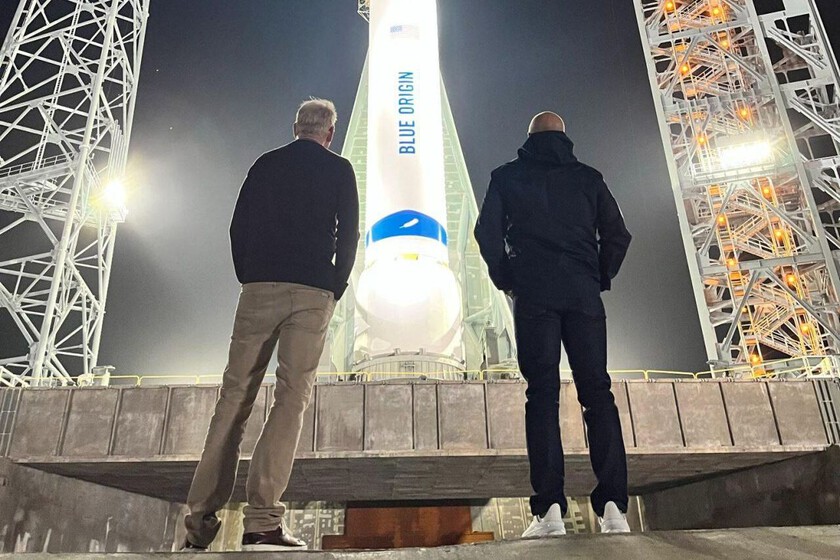
The most surprising fact about Blue Origin is that it was founded before SpaceX. Obsessed with space since childhood, Jeff Bezos saw the potential the aerospace industry would have and began selling thousands of Amazon shares to build a rocket company. He founded Blue Origin in 2000, when his net worth was around $6.1 billion.
Two years later, a young Elon Musk obsessed with the conquest of Mars invested $100 million (more than half of what he had from the sale of PayPal) in founding SpaceX. Who would suspect that the company that would end up revolutionizing the sector would be that of the eccentric South African businessman and not that of the CEO of Amazon, who multiplied his assets by 30.
The sleeping giant

The Blue Origin coat of arms
For almost two decades, Blue Origin was the butt of industry jokes: an infinitely funded company that sold 15-minute suborbital trips to millionaires, but when it came time to reach orbit it only produced PowerPoints and legal lawsuits to stop its opponents.
Blue Origin was aware of its apparent slowness in the face of SpaceX, to the point of deliberately adopting it as its motto. The company’s coat of arms includes two turtles and a Latin phrase that Jeff Bezos has proudly defended publicly: Gradually fiercely“step by step, fiercely.”
But although projects such as the powerful BE-4 engines and the reusable New Glenn rocket had been in development for years, the reality is that Blue Origin did not step on the accelerator until the end of 2023, when Bezos said enough and caused a CEO change that has been like night and day.
The Dave Limp Effect
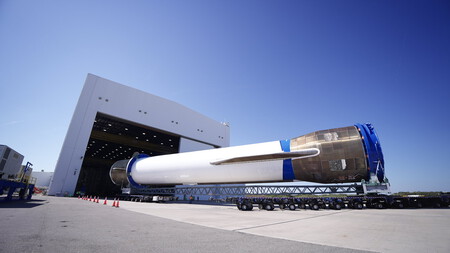
The first stage of the New Glenn rocket returning to the factory
A little context. By 2023, under the leadership of Bob Smith, Blue Origin had become a bottleneck for US national security. The new Vulcan rocket from ULA (the company that had a monopoly on government launches until the arrival of SpaceX) depended on Blue Origin’s BE-4 engines, which kept falling behind schedule.
At the end of that year, Jeff Bezos made the decision to remove Bob Smith and entrust the company to the executive who had led Amazon’s devices division during the creation of Alexa or Kindle: Dave Limp.
Today, the engine crisis is more than resolved. Blue Origin has celebrated the delivery of the 30th engine to ULA, which will allow its partner to meet its launch obligations for the Space Force. But it has not been the only thing that Dave Limp has managed to channel as the company’s new CEO.
Under old management, Blue Origin operated with a crippling risk aversion. He sought perfection on the first try, which translated into eternal development cycles. Limp arrived with the Amazon system under its arm: Blue Origin went from being an R&D company to becoming a real rocket factory willing to take risks.
The internal culture had already begun to improve when, in February 2025, Limp laid off 10% of the workforce. “We grew too fast and lost focus,” he explained. But the effect was immediate: Blue Origin has become a company that is agile in decision-making. Instead of having a single rocket that’s scary to break, they’re a real rocket factory. So when the New Glenn finally took off, crashing on the landing attempt, it was not a single prototype: there were other stages of the rocket already on the production line.
Del New Glenn al Super New Glenn
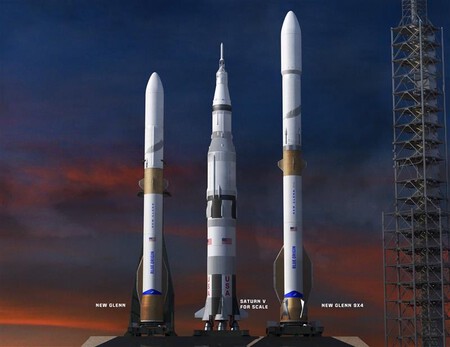
New Glenn vs Saturn V vs New Glenn 9×4
If anyone had doubts about Limp’s management, the events of this last year have dispelled them. Blue Origin has successfully completed two orbital launches that have completely changed the narrative, and which have soon been overshadowed by the company’s roadmap.
The maiden flight of the New Glenn was a partial success. The rocket reached orbit (and there are few rockets that can say that on the first try), but the first stage disintegrated while trying to land. Far from stopping to investigate the failure for a year, Blue Origin analyzed the data, adjusted the software and moved forward with the second attempt, as SpaceX would have done.

In November, the second New Glenn successfully launched NASA’s ESCAPADE mission, two probes that were placed at the L2 Lagrange point awaiting gravitational assistance to travel toward Mars. But even a Martian mission can take a backseat when, against all odds, the first stage of the rocket landed on the Jacklyn maritime platform in the Atlantic Ocean.
Blue Origin is only the second company to achieve the propulsive landing of a rocket. For the first time, SpaceX has a real competitor capable of recovering orbital-class boosters. One that uses methane for cleaner and cheaper combustion, and that promises to carry up to 45 tons to low Earth orbit.
Shortly after the launch, taking advantage of the momentum of success, Blue Origin announced an improved version of the BE-4 engine and a new variant of the rocket: the New Glenn 9×4, which instead of seven engines in the first stage and two in the second, carries nine and four. In addition to a larger 8.7 meter diameter canopy, to launch larger space stations, telescopes and satellites.
What does this mean? That Blue Origin is going for the “Super Heavy” category, in which SpaceX competes with the Falcon Heavy and the gigantic Starship, still in development. This variant of the New Glenn will be able to carry 70 tons to low orbit, which with Starship’s permission surpasses almost everything else on the market and, most importantly, with an architecture that has already flown and landed.
To conquer the orbit and the Moon
With the New Glenn 9×4 scheduled for 2027, Jeff Bezos and Dave Limp’s attention is now focused on scaling the rocket’s manufacturing and reusability capacity to reach 24 launches per year between now and then.
SpaceX continues to play in its own league with 160 launches so far this year and the fully reusable Starship in development. But the gap, which seemed insurmountable two years ago, has stopped growing. And Blue Origin is taking advantage of all the gaps left by SpaceX to enter them.
Now Jeff Bezos’ company is better positioned for the United States’ return to the Moon with Blue Moon’s simpler architectures and Starship program delays. Blue Origin is developing its own commercial space station and sees cislunar space, rather than Mars, as where millions of people will live in the near future.
Imágenes | Blue Origin, Dave Limp
In WorldOfSoftware | We already know why Jeff Bezos invests so much money in space: he believes that in 20 years millions of people will live there