The landscape for digital advertising has been changing for quite a while now.
In the past, marketers crafted very strategic campaigns with highly focused targeting to reach their target audiences. Messaging was tied extremely closely to the campaign’s keywords, sometimes exactly, and performance usually flowed from the high relevance of the ad to the user query.
More recently, the machines are capable of doing much of that highly focused targeting for us, and honestly, they can do a much better job. They make decisions based on combined and compiled user behavior rather than a one-time search.
This has led many in the space to say that keywords are dead and intent-based marketing is the way forward.
While I do agree that intent-based marketing is integral to seeing performance in paid media, I don’t think the keyword is dead. It’s what it always has been: a tool. But this tool’s job has now changed, and we have to use it differently than we did before.
In this article, I’ll talk about how keywords are still an integral part of your Google Ads campaigns but how they should be used differently than they used to.
Contents
How the shift from keywords to intent is happening in Google Ads
For this article, I’m not going to go too far into the actual details about how query mapping and matching are different on Google Ads. That information can be found in other articles, and while it might be interesting to some folks, it’s not fully required learning for you to build Google Ads campaigns that lean into its strategies.
For our purposes today, here’s what you need to know:
- Google isn’t abandoning keywords. They’re simply layering in additional signals on top of them.
- Keywords will instruct Google on what your business cares about. The intent signals will help Google understand who is most likely to convert now.
Here’s a rundown of the intent signals Google uses in determining whether to show your ad or not:
- Recent search behavior
- Browsing activity across all Google-owned platforms
- In-market and affinity audience signals
- Device
- Location (and any geographic intent)
- Time of the day
- Previous ad iterations
- Website visits
- Remarketing behavior
- Customer Match data
- First-party conversion values (when using value-based bidding)
While there are some differences by match type (specifically exact and phrase vs. broad), this intent signaling is why our match types aren’t nearly as precise as they’ve been before.
As a reminder, here is a visual breakdown of how match types work within Google Ads and some examples of what queries will match to which keywords.
The gist: Two users who search for the exact same query are no longer treated the same based on the information they’ve given to Google via the signals above.
🛑 Want to know how your Google Ads campaigns are doing right now? Find out with a free, instant audit >> Google Ads Performance Grader
What the shift from keywords to intent looks like
Let’s go through a couple of examples of what this transition will look like.
First, let’s take two separate people searching for “kitchen remodeling.”
The first person has the following characteristics:
- Has recently searched for financing options for home renovations and HELOCs.
- Has been looking at reviews for local contractors.
- Is in the In-market audience for home renovations.
The second user:
- Has been watching DIY videos on YouTube.
- Searched “how to replace a kitchen backsplash.”
- Has no commercial engagement.
In the traditional model of query matching, they would have each been served the same ad by a contractor. But in the new model, a contractor’s ad campaign will bid higher for the first user and may not even show for the second, even though the query matches the keyword they’re targeting.

These results would likely vary for consumers in the same area.
As a second example, let’s look at a B2B SaaS offering of revenue operations software. At times, companies know they need something, but they’re just not sure what. This is something that happens a lot with startups I work with.
While we will target keywords like “rev ops software” and “platforms designed for revenue operations,” we know the volume there is low. Google can use the keywords we provide, then follow intent signals from potential customers and match to search queries like “increase customer revenue” and “improve rev ops efficiency.” While these terms may not totally match the keywords we have in place, the goals for those users are the same as what the SaaS company can provide.
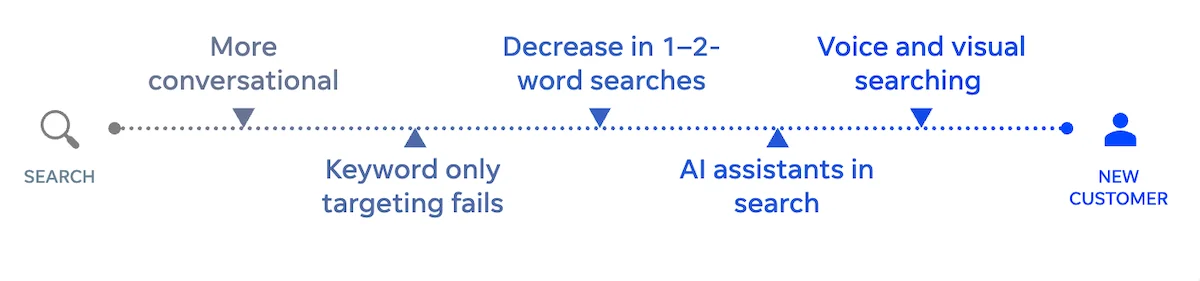
Here’s a visual of what the new search experience looks like:
🚀 Want to learn how AI can supercharge your ads strategy? Free guide >> 9 Powerful Ways to Use AI in Google & Facebook Ads
How to adjust your campaign strategy for intent signals
Now we can get down to brass tacks. What do you need to adjust in your Google Ads setup to get the most from these intent signals while not abandoning your keyword strategy altogether?
1. Keep keywords as anchors
While the entirety of your Google Ads strategy might not be around keywords, that doesn’t mean you shouldn’t use them. Continue to use keywords in Search campaigns and continue to use exact and phrase match terms just the same as you always would.
But also, leverage keywords where you can in Performance Max campaigns as well. For these campaigns, they’re technically not “keywords” so much as Search Themes, but you can treat the approach to selecting them the same way as you would for your Search campaigns.
🔎 Find the right keywords for your strategy with our Free Keyword Tool >>
2. Don’t throw out negative keywords
Hopefully, you’ve been using negative keywords all along, but to see good results, I encourage you to move away from using negatives to prevent synonyms that might feel irrelevant to you and use them instead to prevent intent mismatch.
For the rev ops example above, the query “increase customer revenue” doesn’t really have any specific ties to the keywords “rev ops software” or “platforms designed for revenue operations” aside from the word “revenue,” but that doesn’t mean they’re not relevant. Especially if the user has already been searching for software or is reading lots of content around rev ops efficiency. These are the signals Google can consider that we advertisers can’t when deciding who to bid on.
3. Consolidate campaign structure
Since we’ve already talked about how lots of keywords can have the same intent, that also means campaign structures can look quite a bit different than they did before. No more highly segmented campaigns and ad groups with only slight variances in terms. As long as the intent is the same, you can have more keywords grouped together.
Here’s a view of how I might take a traditionally structured account and revamp it for the new intent-influenced landscape.
The structure below uses the room in the house that is to be remodeled, broken down into its own campaign. Then, ad groups are used to distinguish people searching for the costs vs. contractors or just general queries.
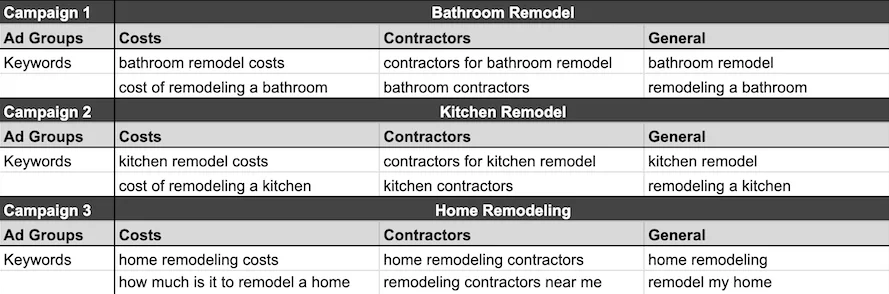
The updated version for 2026 combines all rooms into a single campaign because they’re all focused on someone searching for contractor services (i.e., a single conversion action), but also needs to take into account that the ad copy and landing page should speak to (and likely show) the different rooms to the user.

My general rule of thumb: If the messaging and landing page are the same, you can likely group the terms together. If your messaging or landing page must be different, then you likely are fine to have them segmented.
Bonus: There’s an added benefit to this shift as well. If you’re using any sort of automated bid strategy, Google does better when conversion actions are consolidated. More data in one place means a cleaner, simpler signal to optimize on.
⚡️ Is your Google Ads account set up for success? Download now >> The Last Guide to Google Ads Account Structure You’ll Ever Need
4. Write ads for varying intent stages
Since we’re accepting that Google is going to show our queries for users with differing intents, that means we need to lean into their system of dynamic ad serving and provide assets that can be used for as many of those use cases as possible.
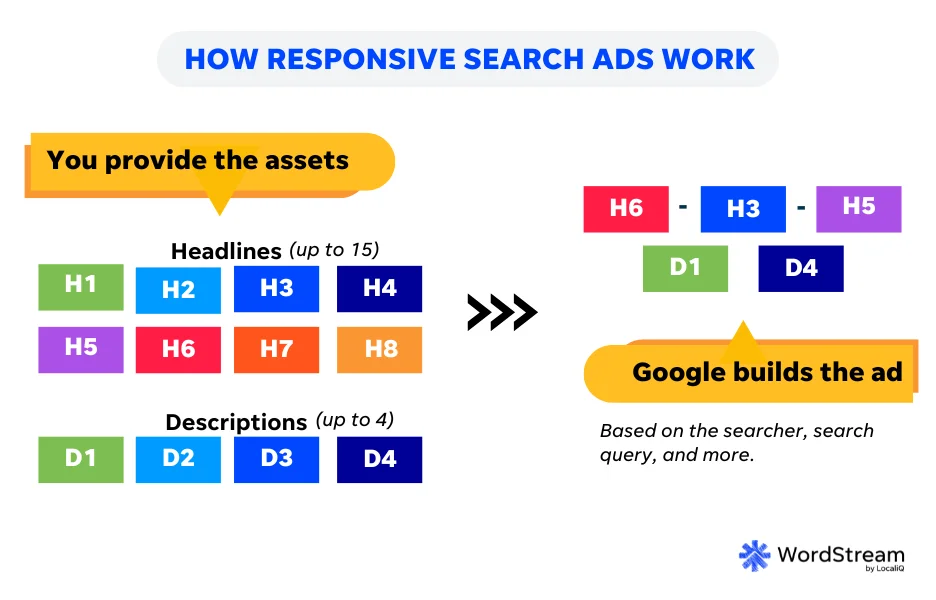
Here are some things to try to include in ads:
- Address pain point
- Offer education
- Include proof
- Highlight your differentiation from competitors
- Speak to customer objections
- Address FAQs
Try to include options to cover users who are problem-aware, solution-aware, and decision-ready. We’re not crafting ad copy simply to reiterate keywords anymore. Without compelling messages that can feel like what the person is searching for, you’re going to miss out on potential revenue. (Use this guide to overused marketing phrases to avoid in your ad copy!)
5. Become a platform manager, not a button pusher
Machines and systems always seem to work the same: Good data in, good data out.
That’s what we’re going for here. We need to be feeding Google Ads as much directional data as possible. This can look like many different things:
- Add brand guidelines for ad asset development and serving.
- Include values with conversion actions to help inform who is of higher value.
- Import offline conversions where possible to understand the full funnel impact of campaigns.
- Upload first-party customer lists to model for expansion and understand lifetime customer value.
Make the shift from keywords to intent seamless
Keywords aren’t dead. Intent isn’t the only targeting method. But tight restrictions on Google’s algorithm are likely going to cause you to underperform and miss out on good opportunities. Don’t plan to rip off the band-aid and redo everything at once, but do outline a plan to start leveraging the expanded intent targeting and potentially even loosen up previous negative keyword guardrails to start seeing the impact of Google’s user intent signals.
Want help shifting your strategy? See how we can help.