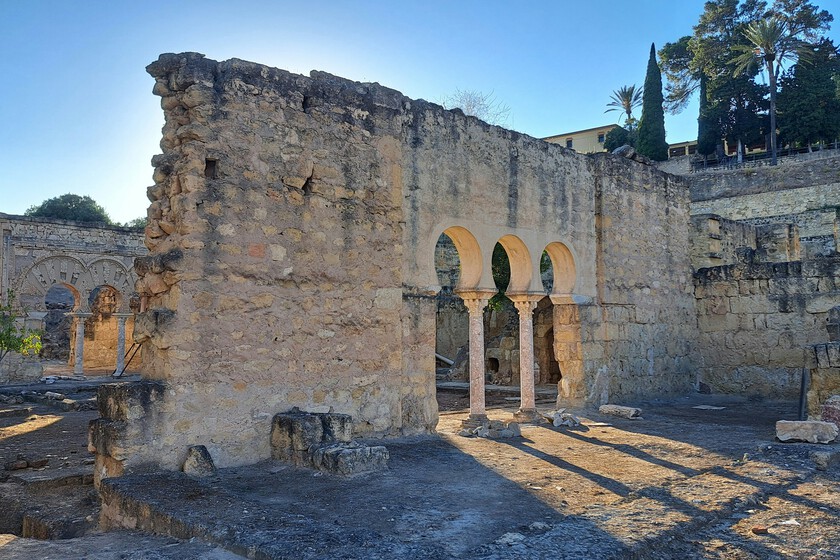
On the same day in 979 that Hisham II became Caliph of Córdoba, Muhammad ibn Abi Amir (Almazor), his most faithful servant, began the construction of Medina Alzahira, the ‘shining city’, a magnificent palace-city to the east of the city and on the right bank of the river.
For 20 years, while the Caliph lived locked up in Medina Azahara, the entire peninsula revolved around that small palatial villa. But power is a voracious monster and, more often than not, it ends up devouring oneself.
Thus, on February 15, 1009, the people of Córdoba, raised in arms, expelled the weak Caliph, invaded the city of the Amirids, looted its treasures and vandalized it with infinite fury. Shortly after and to ingratiate himself with the masses, the new caliph (Muhammad II) ordered it to be razed, burned completely, forgotten.
And boy did he forget.
The glow that never goes out completely
Torres Balbás explained that the ruin of Alzahira was so complete that it left no echo of its name in local tradition, nor memory of the place it occupied. According to the historian Juan Quiles, the last historical mention of the ruins of the city is dated June 12, 1172.
We had to wait until 1772, when a doctor and writer named Bartolomé Sánchez de Feria recovered the memory of the city and published a hypothesis about its location. There began an incessant search that has not borne fruit in the last two and a half centuries.
Progressively, as Professor Quiles explains, “the settlement of the Resplendent City has been moving, as if it were a spiral, from the center of the medina to its western end, to then pass along the banks of the river and head towards the east of the caliphal capital.”
Now, the University of Córdoba is convinced that the search is over.
One thing beneath the surface
Antonio Monterroso Checa, a UCO researcher, has just found something near Alcolea, in an area called Cabezos de Las Pendolillas, about 12 kilometers from the city’s Mosque. To do this, it has reviewed more than 120 hectares in that area thanks to data from the third LiDAR coverage of the Mining Geographic Institute.
And it makes sense. A priori, there are not many more buried structures (compatible with architecture and urban fabric) that could have those dimensions in that area of the river. However, as the authors themselves point out, identifying LiDAR-only structures is unlikely without field verification and they recall other hypotheses that have ultimately been discarded.
A fight revealed
There have been no shortage of voices against these findings. Many linked to other of those living hypotheses (such as those of Arenal/Fuensanta), which say that it is hasty to give too much credit to LiDAR without field work. And they are right: it is true that the data provided cannot confirm that the city is down there.

However, it should not be ignored that, as the UCO says, “it is the only proposal, of the twenty-two that have existed so far on the argument, that adduces certain and verifiable physical data.”
But it would be naive not to understand that what is at stake here is much more than the location of some stones: the discovery of such a site would be an injection of resources and work for the municipality (and the area). And that, of course, also counts.
Image | Sergio Guardiola Farrier
In WorldOfSoftware | We have discovered two “Machu Picchu” lost in Uzbekistan. And that tells us a lot about the Silk Road.