Photo by LinkedIn Sales Solutions on Unsplash
LinkedIn has become the most important platform for B2B marketing.
What used to be a recruiting network is now where brands build authority, reach decision makers, and start real business conversations. As B2B marketing shifts toward trust and influence, understanding how LinkedIn works can give you a clear advantage. If you aren’t fully leveraging it yet, keep reading.
In this guide, you’ll learn everything you need to know about LinkedIn marketing in 2026, from the content ideas that drive reach and engagement to how you can scale your LinkedIn efforts as a brand.
Why LinkedIn Is a Key Marketing Channel in 2026
LinkedIn has become the central platform for B2B visibility, networking, and social selling. Decision makers actively use it to discover expertise, evaluate vendors, and build professional relationships. For companies, this makes LinkedIn one of the few platforms where marketing, brand building, and sales conversations happen in the same place.
Several shifts explain why LinkedIn has become so important for companies: 👇
- LinkedIn is the world’s largest professional network. With more than 1.3 billion members and over 70 million companies listed, it has become the main digital hub where professionals connect, share knowledge, and discover new solutions.
- Social selling is now a core B2B growth strategy. Today, 75% of B2B buyers use social media to inform purchasing decisions, and half rely on LinkedIn as a trusted source when researching vendors. Companies that build relationships, share insights, and engage with prospects on LinkedIn can influence buyers long before the first sales call.
- Trust drives B2B purchasing decisions. Modern B2B marketing is moving toward long-term trust building rather than short-term funnel tactics, which makes platforms like LinkedIn ideal for building credibility through consistent content and conversations.
- Employee voices outperform brand messaging. Founders and employees typically generate higher engagement than corporate pages, helping companies reach new audiences through their teams’ networks.
In other words, LinkedIn has become one of the most important platforms for influencing B2B buyers. To take advantage of that opportunity, the next step is understanding how the LinkedIn algorithm actually works.
How the LinkedIn Algorithm Works in 2026
If you want your content to perform well on LinkedIn, you need to understand what the platform’s algorithm actually prioritizes. It’s also a smart idea 🧠 to stay on top of LinkedIn trends so you know what’s working on the platform.
At its core, LinkedIn is designed to promote content that sparks professional conversations and keeps users engaged. Here are the key signals that influence reach and distribution: 👇
- Your profile defines your authority. LinkedIn reads your headline, experience, and profile details to understand your expertise. If your posts align with that expertise, the algorithm is more likely to show them to the right audience.
- Saves are one of the most valuable engagement signals. When someone bookmarks your post, LinkedIn treats it as high-value content worth returning to, which can extend the lifespan and reach of your post.
- Comments and conversations boost distribution. Posts that generate meaningful discussions are prioritized over those that only receive quick reactions.
- Consistency matters more than timing. Posting regularly helps your audience learn when to expect your content, which increases early engagement signals.
- Content relevance matters more than hashtags. LinkedIn now relies more on the actual text of your post to understand its topic rather than hashtags.
Building a LinkedIn Content Strategy for Your Company
Understanding the LinkedIn algorithm helps explain why some posts gain traction while others disappear in the feed. But knowing the signals the algorithm rewards is only useful if you build your content strategy around them.
To build an effective LinkedIn content strategy, focus on a few core principles: 👇
- Define your primary objective. Most companies use LinkedIn for brand awareness, thought leadership, lead generation, or employer branding.
- Choose 3 to 4 content pillars. These are the topics your company will consistently talk about, such as industry insights, educational content, customer stories, or product expertise.
- Leverage personal profiles alongside your company page. Founders, executives, and employees often generate significantly more reach and engagement than corporate pages.
- Stay consistent with publishing. Regular posting helps build familiarity with your audience and increases the engagement signals the algorithm rewards.
With a strategy in place, the next step is understanding which content formats tend to perform best on LinkedIn.
LinkedIn Content Formats That Perform Best
When it comes to content formats, you are spoiled for choice. However, not all of them are created equal. Some formats are naturally better at generating saves, comments, and shares than others. Depending on your goal, you need to choose which formats to focus on.
Here are some options:
| Content format | Why it works | Best use case |
| Text posts | Simple posts often drive strong conversations and comments, which the algorithm rewards | Thought leadership, opinions, storytelling |
| Document/carousel posts | Highly shareable and often saved for later, especially when they include frameworks or practical insights | Educational content, frameworks, step-by-step guides |
| Short-form video | Video helps humanize brands and build trust quickly with audiences | Founder insights, product explanations, industry commentary |
| Industry insights or data posts | Data-backed content positions your brand as an expert and sparks discussion | Research insights, trends, market observations |
| Customer stories and case studies | Social proof builds credibility and helps potential buyers understand real outcomes | Success stories, client wins, before-and-after examples |
| Behind-the-scenes content | Authentic company moments tend to resonate and make brands more relatable | Team culture, company updates, product building |
Examples of Brands Doing LinkedIn Marketing Right
Alright, now that we’ve covered the theory, let’s take a look at some companies that are leaning into the best LinkedIn marketing strategies.
1. Circle
Circle is a SaaS platform that helps brands and creators build and manage online communities.
On LinkedIn, Circle frequently shares research-driven content to educate its audience. In this example, the company promotes its 2026 Community Trends Report through a document carousel based on insights from 12 experts and more than 750 community builders. The format encourages users to swipe through the slides directly in the feed, increasing engagement and dwell time.
This type of post works well because it combines original research, strong visual design, and educational value, which makes people more likely to save or share the content.
Key takeaway: Use LinkedIn to distribute valuable industry insights, not just product updates.
2. Gain
Gain is us. But bias aside, we want to share an example of CEO-driven content.
In this post, Albizu Garcia, CEO of Gain, shares a personal observation from more than a decade of working with agencies: clients are rarely lost because of a mistake, but because of how teams handle the next 24 hours.
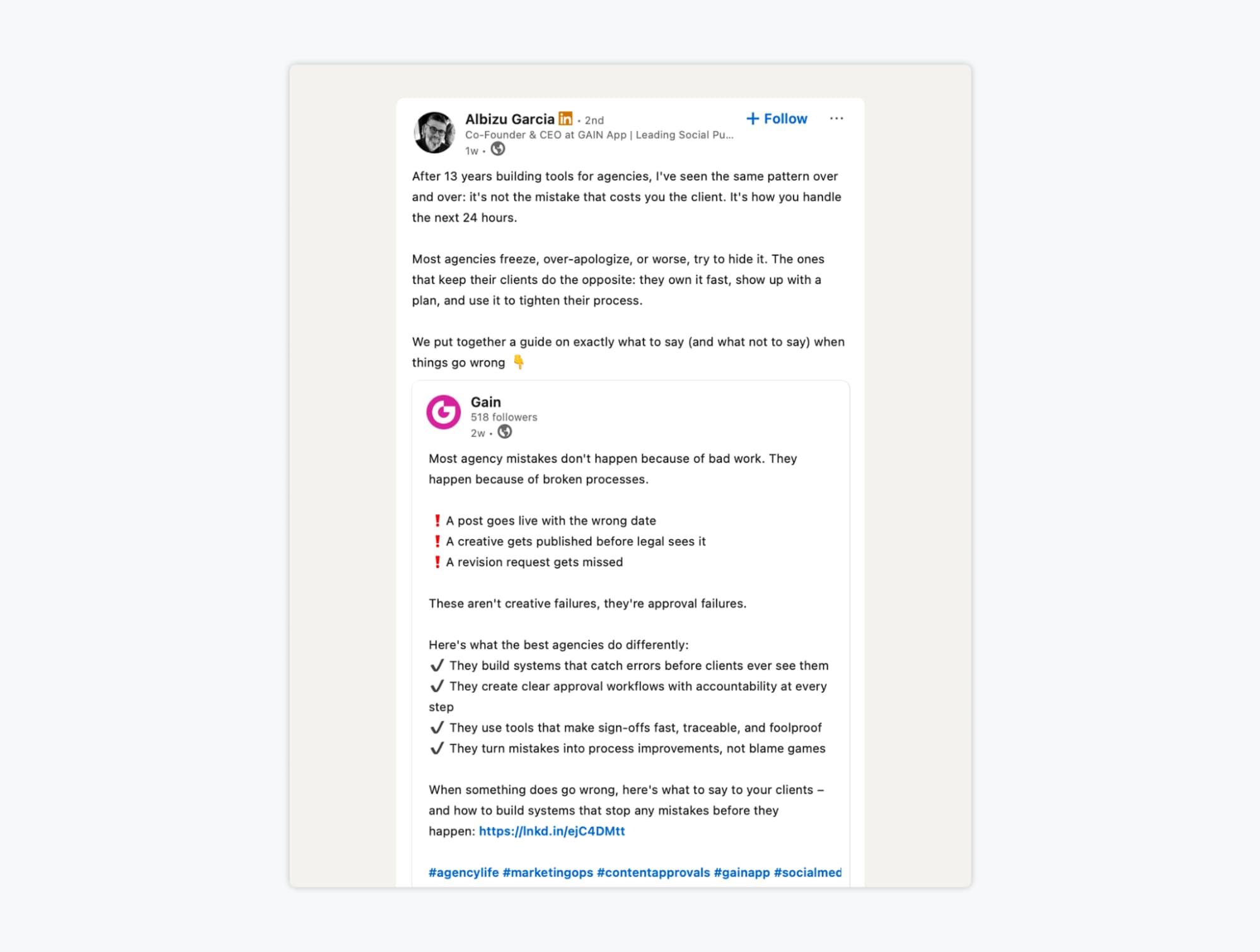
The post combines a short personal story with practical insights, which makes it relatable for agency professionals. It also naturally introduces a guide from our blog that explains how agencies can build better approval workflows and prevent these issues.
Key takeaway: CEO and founder posts tend to perform well on LinkedIn because they combine personal credibility with practical industry experience.
3. Ryanair
Ryanair, a low-cost Irish airline, uses LinkedIn for all kinds of company updates, announcements, and operational news. But the brand also brings its signature humor to the platform.
In this post, Ryanair pokes fun at corporate jargon with a meme comparing the simple reality of what the airline does, “I fly,” with an exaggerated LinkedIn-style CV description. The post plays directly into a common frustration many LinkedIn users recognize, which makes it highly relatable and shareable.

This approach works because the humor aligns perfectly with Ryanair’s broader social media strategy, which is known for being bold and playful.
Key takeaway: Even when posting from a company account, do not shy away from humor if it fits your brand.
4. HubSpot
HubSpot frequently uses LinkedIn to announce product updates in a way that is both clear and engaging for its audience.
In this post, HubSpot introduces updates to its Prospecting Agent feature. Instead of a long product announcement, the company starts with a simple message: “Sales teams: We listened.
Then we shipped it.” The post then highlights key improvements in a short, scannable list and uses a document carousel to explain the updates visually.

This format works well because it focuses on customer feedback, highlights tangible benefits, and keeps the message concise.
Key takeaway: When sharing product updates on LinkedIn, lead with the problem you solved and summarize the benefits clearly before diving into details.
Activating Employee Advocacy on LinkedIn
Many companies focus only on their company page, but much of LinkedIn’s reach actually comes from individual profiles. Employees, founders, and executives often have stronger engagement and broader networks than corporate accounts.
Research from Refine Labs found that content shared through personal LinkedIn profiles generates 2.75× more impressions and 5× more engagement than posts from company pages, even when those employees have smaller audiences. This reinforces a simple truth about LinkedIn: people engage more with people than with brands.
You should encourage your team to participate on LinkedIn. Here are a few ways you can activate employee advocacy:
- Encourage leadership visibility. Founders and executives sharing insights often generate strong engagement and trust.
- Make it easy for employees to share content. Provide internal guidelines, post ideas, or pre-approved content.
- Celebrate team expertise. Encourage employees to share lessons, industry insights, or behind-the-scenes perspectives.
Managing LinkedIn Marketing at Scale
If you want to build a solid presence on LinkedIn, knowing which content formats perform well won’t be enough. Like with any social media platform, success comes down to consistent posting. And that can be difficult to achieve without the right tools.
If you work at a marketing agency or manage multiple brands, posting consistently can become even more complex. You may need to coordinate with teammates, collect feedback from stakeholders, and get client approvals.
Social media management tools like Gain are designed to help you streamline your LinkedIn workflow. From one place, you can create posts, preview how they will appear in the LinkedIn feed, collaborate with your team, and schedule content once it is approved.
Some of the ways tools like Gain help you scale your LinkedIn marketing include:
- Simplifying content approvals by letting clients or internal stakeholders approve posts with a single click
- Planning and scheduling content in advance so your publishing stays consistent
- Collaborating with your team in one workspace instead of scattered messages and documents
- Sharing your content calendar with clients so they can see what is scheduled to go out and when
- Duplicating LinkedIn posts for use across different social media networks
With the operational side handled by a tool like Gain, you can focus on what LinkedIn marketing is really about: sharing valuable insights, building relationships, and staying visible to your audience.
FAQs
LinkedIn marketing is the practice of using LinkedIn to promote a brand, build professional relationships, and reach potential customers. Companies use LinkedIn to share insights, publish content, generate leads, and engage with decision makers through company pages, employee profiles, and targeted content strategies.
Less is more when it comes to posting on LinkedIn. A good rule of thumb is to post three to four times per week. That’s frequent enough to stay visible without overwhelming your audience. The real goal isn’t posting more; it’s posting consistently and sharing content that people actually find useful or interesting.
Companies should focus on both, but for different reasons. Company pages are important for publishing official updates, product news, and building a consistent brand presence. However, employee profiles often generate significantly more reach and engagement because people tend to interact more with individuals than with brands. A strong LinkedIn strategy usually combines the two: the company page provides the core content, while employees, founders, and executives help amplify it through their personal networks.
The Bottom Line
To win on LinkedIn, don’t focus too much on the volume of posts. What matters most is sharing quality insights and valuable, educational content that helps you build trust with your audience and establish credibility.
If you’re just starting out on the platform, focus on posting three to four times a week and mix different content formats. Tools like Gain make this process easier by helping you create and preview your LinkedIn posts, send them for approval to your clients or team members, and once approved, have them automatically published at a selected time.
Try Gain for free now!