Computer scientists have been researching new and better ways to store information ever since, well, computers were invented. PC components have come a long way since computers needed hard drives the size of your washing machine, and the hard drive might become a dead form of media thanks to a recent advance in what Microsoft calls “Project Silica.” The goal behind Project Silica isn’t necessarily to create a data storage unit that can hold more data and recall it faster than the world’s largest SSD unit, but instead create a medium that can store data semi-indefinitely and a method to encode it.
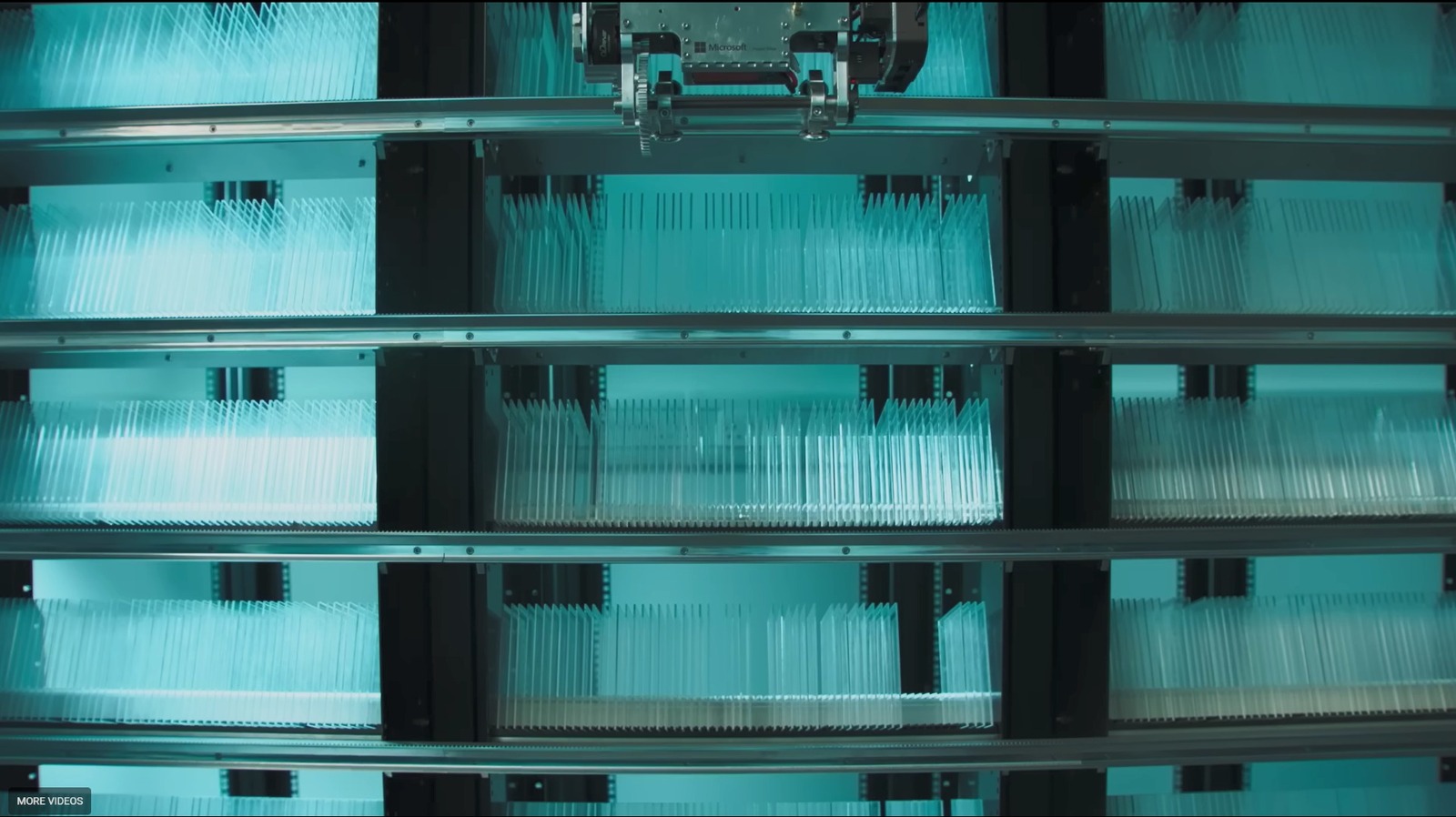
According to Microsoft, borosilicate glass was the best choice since it is “a permanent data storage material that is resistant to water, heat and dust.” The company published its latest findings in Nature and proclaimed that it chiseled information into the glass on a microscopic level using lasers that pulsed so rapidly they could only be measured in femtoseconds (one quadrillionth of a second). According to the report, Microsoft was able to store a grand total of 4.8 TB of data on a 120 mm square piece of borosilicate glass that was 2 mm thick.
Moreover, the laser allegedly transcribed 25.6 Mbit s-1 of data per beam and encoded them into the borosilicate as 3D voxels. When researchers artificially aged the glass, they predicted that the storage unit’s data would be legible for up to 10,000 years. Comparatively, while hard drive platters are 63.5 to 88.9 mm wide, they can generally only store 1 or 2GB and only last up to 20 years in storage — five years if you use them frequently.
Research into immortalizing data takes time
While Microsoft’s recent advances towards making data storage that can outlast human civilization sound impressive, researchers have been trying to get this far for decades. Previous iterations used pure fused silica glass, which, while an effective medium, was prohibitively difficult to manufacture. Moreover, Microsoft wasn’t the only company to try this.
In 2011, researchers at the University of Southampton created a “nanostructured glass technology” that could store data indefinitely as 3D voxels, and 2009 saw the invention of the M-Disc, which uses a carbon material to retain data for up to 1,000 years. But the history of these indefinite storage solutions goes back even further. You can probably trace the earliest renditions of Project Silica (in spirit, at least) to the 1960s.
This mechanism, known as a Holographic Data Storage System (HDSS), recorded data by splitting a laser into two beams and modulating one of them as they wrote info on the storage medium. The data wasn’t stored on any one point, but instead the “interference pattern” formed by the two beams. As time went on, researchers studied new signal processing techniques and system architectures. Many organizations tried their hand at HDSS, including IBM.
This isn’t the first time someone claimed X will kill Y
On paper, Project Silica sounds like it could revolutionize data storage techniques, but everyone has heard this song and dance before. Game journalists labeled the game “Haze” as a “Halo Killer” before it was released. Instead, “Haze” killed its developer, Free Radical. Netflix was touted as the “Blockbuster killer,” but Blockbuster died due to a number of factors, with Netflix being only one of them.
The same is true for Project Silica and its hypothetical rivalry with HDDs. After all, in 2006, prototype HDSS drives were shown off at the Consumer Electronics Show, and attendees expected holographic drives to hit store shelves in the near future. 20 years later, HDSSs are nowhere to be found. Plus, you can’t forget about Optane Memory, Intel’s failed SSD alternative that used a computer’s RAM to store and retrieve data at lightspeed.
At the end of the day, computer manufacturers still use HDDs because they are relatively inexpensive to produce. SSDs are faster, but many people prefer to save money at the cost of slower load times. When playing games, SSDs are king (and necessary for many newer titles), but if you aren’t a gamer and just want a computer for light web browsing and word processing, an HDD is the best solution simply because it is the most frugal. It’s not that Project Silica can’t carve out a niche in the computer and data storage industries, just that unless Microsoft figures out how to manufacture silicate drives for pennies on the dollar, HDDs probably won’t go away anytime soon.