We may receive a commission on purchases made from links.
Modern laptops have become more powerful and can last an entire workday as long as you’re not doing any processor-intensive and battery-hungry tasks like video editing or gaming. While companies have been addressing these two issues over the past few years, users have also experienced regression in modularity as more companies embrace the Apple philosophy of soldering key components to the motherboard, including the memory modules and solid-state drives.
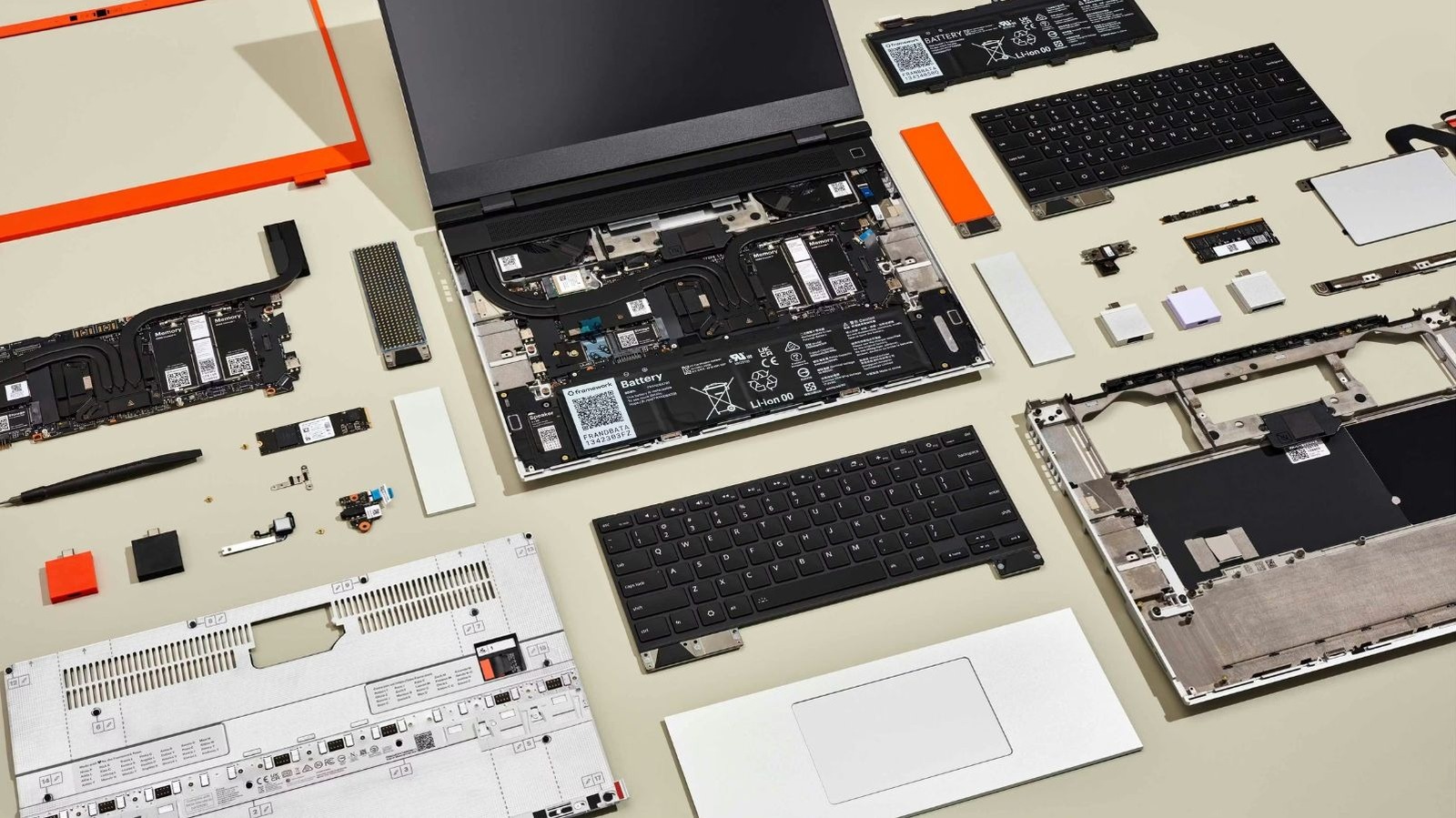
To combat this trend, Framework was founded (in 2020). It brought together experts from well-known brands in the industry like Apple and Lenovo, with a mission to create laptops that are modular and repairable. Framework’s first laptop was released in 2021, and it in fact delivered on the promise of modularity and upgradability. The company has launched several models since then, with the 2025 Framework Laptop 16 allowing you to upgrade the mainboard, storage, memory, graphics card, and swap a variety of other parts.
The concept of modular and repairable laptops is in itself great and very much welcomed and could be the future, especially in an industry that is continuously resisting user repair and upgrades by soldering components. But before the market can finally see modular laptops become mainstream, there’s one final hurdle left to surmount: cost. Truth be told, modular laptops are a bit expensive compared to the regular single-build laptops.
Laptop modularity comes at a premium
Framework is easily the leader in modular laptops, and its collaboration with Nvidia and AMD to offer upgradeable GPUs in the second-gen Framework Laptop 16 was a major milestone in the industry. But in order to snag one of the modular options from the company, you should be willing to pay a little bit more relative to a comparable single-build laptop from other manufacturers. Take the Acer Nitro 16 Gaming Laptop as an example and see how it stacks up against the Framework Laptop 16 Performance Pro model.
The Framework has an AMD Ryzen 7 7840HS processor, 16 GB of memory, and 512 GB of storage. You get the same CPU and memory on the Acer Nitro 16; however, it steps up the storage to 1 TB. The Acer Nitro 16 costs $1,179 while the Framework will set you back by $1,649 (after a 6% discount). That’s $470 more than the Acer, and you’re getting half the storage. For the 2025 version of Framework Laptop 16 with AMD’s AI 300 Strix Point series chips, it starts at $1,799 for a model with a Ryzen AI 7 350 CPU, 16 GB RAM, and 512 GB storage.
The Dell 16 Laptop comes with the same chip, twice the memory and storage, and is only going for $858 on Amazon. Modular laptops also start at a much higher price point than traditional laptops. Sure, you might see lower starting prices on Framework’s site from as low as $549, but that’s for the DIY models, which give you a bare-bones laptop with no processor, memory, storage, or power adapter.
Affordability could popularize modular laptops
For someone buying a new laptop, cost is one of the key guiding factors that’ll decide what you get. Even if you wish to get that $2,000 performance beast of a laptop because it meets your needs, you can’t have it without the cash. Unfortunately, Framework’s modular laptops aren’t cheaper than comparable single-build models, which alone could stop potential buyers from buying into the modularity and user-repairability philosophy. And that’s because buyers are known to be very sensitive to price.
Several users on Reddit point out the premium on Framework’s modular laptops, and they justify their purchase with various reasons. However, not everyone has the leeway to pay more for a given laptop over another with comparable performance just because it’s modular. Now imagine if modular laptops were going at similar prices to single-build laptops.
That could make a big difference and perhaps even make modular laptops popular, as users can buy the lowest spec and upgrade components as time goes by. Especially at moments like now, where AI is expected to make electronic devices more expensive, you can buy any low-spec modular laptop to save on cost and then upgrade once the prices of memory and storage improve. But if modular laptops continue to have a higher price tag, it’ll be tough for them to go mainstream. Perhaps 3D printing your own laptop will catch on, though.