For years, Mozilla and its Firefox browser have represented a rarity: a product shaped by demanding users, jealous of their control and unwilling to accept imposed changes. Therefore, when the word “AI” began to appear in its official discourse, it did not sound like a simple technical update, but rather a possible identity shift. It was not a discussion about specific functions, but about limits. How far can Firefox stretch while still being recognizable to those who choose it precisely because it doesn’t look like the others.
Before the controversy broke out, Mozilla had already begun to draw out its AI roadmap with a deliberately cautious tone. In his communications he talked about choice, transparency and preventing artificial intelligence from becoming a permanent layer of the browser. The AI, according to that initial approach, had to coexist with the classic Firefox experience without replacing it, offering specific and deactivatable tools, and maintaining the promise that the user decides if they use them, when they do so and under what conditions.
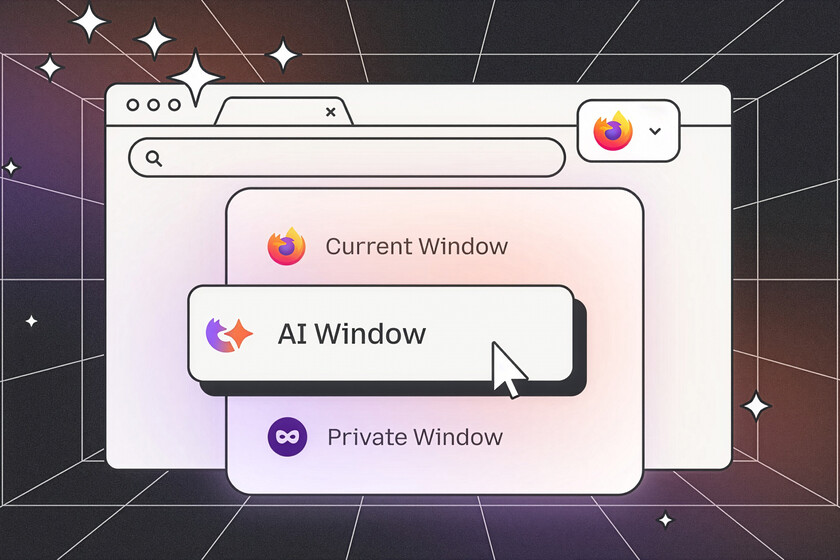
AI Window. The most visible piece of that roadmap is a new window designed specifically for interacting with an AI assistant while browsing. Mozilla describes it as a separate, completely voluntary space that allows you to ask for contextual help without altering the rest of the browser experience. It does not replace the classic or private window, but is added as an additional option that the user decides whether to activate or not. The company insists that it can be deactivated at any time and that its development is being done openly, with a waiting list to test it and send comments.
Why Mozilla thinks it’s important. The organization argues that AI is becoming a new way of accessing the web and that ignoring this change would leave the browser in a passive position. Their thesis is that, as more interactions go through assistants, it becomes essential to preserve principles such as transparency, accountability and decision-making capacity. Firefox, as a standalone browser, thus presents itself as an intermediary that uses AI to guide the user to the open web, rather than retaining them in a closed conversational environment. That balance began to break down in December, when the message about AI was publicly reinforced from Mozilla’s leadership.

The reaction was not accidental if you understand who Firefox is addressing. A good part of its users do not come to the browser out of inertia, but after having searched deliberately, moving away from options such as Chrome, Edge or Safari. This more technical and critical profile tends to monitor any change that it perceives as a transfer of control. In this context, AI is not evaluated only by what it does, but by the precedent it sets and the risk of normalizing decisions made without the user’s explicit consent.
The “AI kill switch” and the calendar. Faced with escalating criticism, Mozilla moved from generalities to explicit commitments. In a response to an open letter posted on Reddit, CEO Anthony Enzor-DeMeo wrote: “Rest assured, Firefox will always remain a browser built around user control,” adding: “You’ll have a clear way to disable AI features. A true kill switch (kill switch) will arrive in Q1 2026.” With that promise, Mozilla made a verifiable commitment: an option to completely disable all artificial intelligence functions by a specific deadline, the first quarter of 2026, as a way to reinforce trust.

When the deabte is still open. The announcement of the “kill switch” did not close the debate, but rather moved it to a more basic question: when does AI come into play. For many users, the fact that there is a switch to turn it off implies that the AI would be present from the beginning and that it is the user who must deactivate it. The alternative they demand is the opposite, that the AI is completely turned off when installing Firefox and is only activated after an explicit decision. On Mastodon, the Firefox for Web Developers account admitted that there are “gray areas” about what optional means in the interface, such as whether a new button counts as such, but insisted that the “kill switch” will disable AI entirely.
With the discussion already on the table, Mozilla has been forced to do something that was not in the initial script: specify, clarify and publicly commit more than expected. The discourse around AI in Firefox has moved from general principles to uncomfortable details, and that’s where the trust of its community is at stake. The promises are made, the deadlines marked and the words written. Now the difference will not be made by the communications, but by how these guarantees are translated into the final product and if Firefox manages to integrate AI without diluting what made it different.
Images | Firefox | Denny Muller
In WorldOfSoftware | AI has allowed developers to program faster than ever. That’s turning out to be a problem.