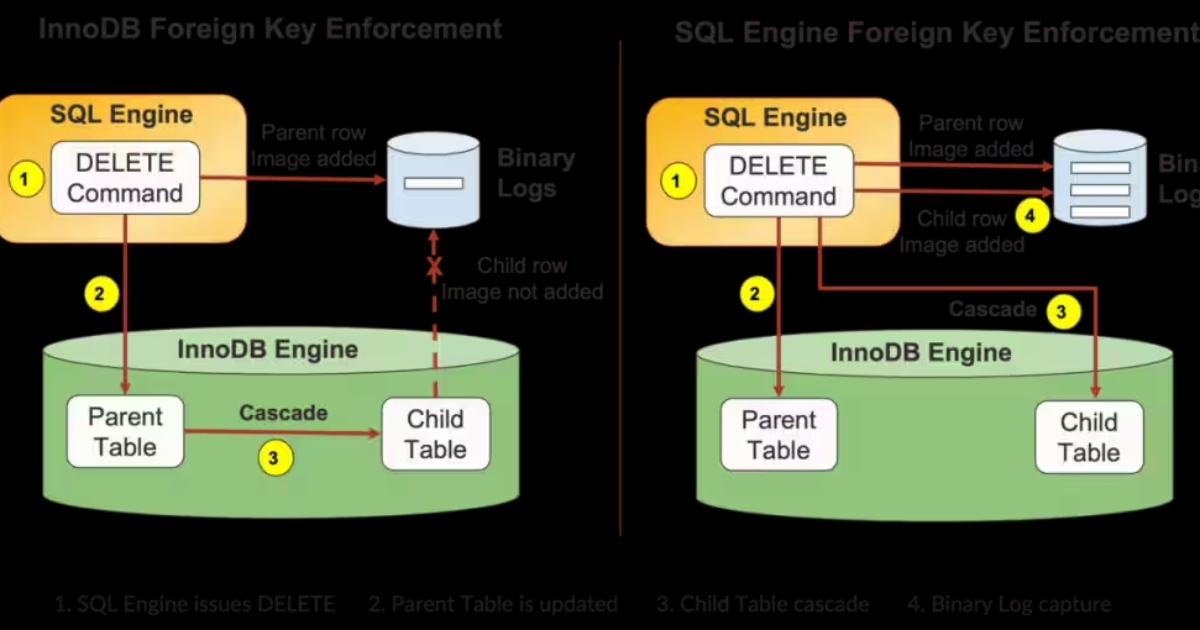
MySQL is changing the way foreign key constraints and cascades are managed. Starting with MySQL 9.6, foreign key validation and cascade actions are handled by the SQL layer rather than the InnoDB storage engine. This will improve change tracking, replication accuracy, and data consistency, making MySQL more reliable for CDC pipelines, mixed-database environments, and analytics workloads.
MySQL practitioners working with Change Data Capture (CDC) and replication have long faced a significant limitation: foreign keys are managed by the InnoDB storage engine, and cascading changes are not recorded in the binary log. Prabakaran Thirumalai, consulting member of technical staff at Oracle, writes:
Historically, MySQL enforced foreign key constraints and cascades at the storage engine layer (…) All cascaded operations were executed internally by InnoDB (…) Because these changes were hidden from the SQL engine and binary logs, downstream systems, such as CDC pipelines and analytics platforms could miss them. This could lead to inconsistent data, unreliable analytics, and replication issues.
For example, the SQL layer issues a single DELETE statement to InnoDB, and InnoDB might automatically delete rows in a child table due to cascade rules. These additional deletions are currently handled entirely within the storage engine and are not recorded in the binary log, which captures only the original DELETE on the parent table, not the changes made to the child table.
Source: Oracle blog
The change is implemented in MySQL 9.6.0, an Innovation release that became available in January as part of the MySQL 9.x Innovation series. A community concern about the change is its potential impact on performance. Thirumalai adds:
Extensive benchmarking across common transactional workloads confirms that SQL engine based foreign key enforcement and cascade performs nearly identically to the InnoDB approach. The cost of foreign key checks and cascades remains effectively unchanged, resulting in no observable regression in throughput or latency.
In a popular Hacker News thread, Evan Elias, owner and principal engineer at Index Hint, writes:
I’m glad Oracle did a blog post about this, because otherwise it’s largely missing from the MySQL documentation (…) The MySQL 9.6 release notes make no mention of foreign key changes whatsoever (…) As an independent software vendor providing solutions focused on MySQL, honestly I find this situation to be deeply concerning. I have heard that an Oracle exec made a lot of promises about renewed MySQL Community Edition attention (…) can we take any of that seriously if even basic documentation updates are not occurring?
The change comes at a time when many in the community are questioning Oracle’s commitment to MySQL and its community edition, with community meetings discussing MySQL’s future and new tracking forks already underway to extend MySQL capabilities. In the “MySQL 9.6: Foreign Key Cascade Operations Finally Hit the Binary Log” article, Marcelo Altmann, senior software engineer at ReadySet, comments:
For MySQL users who have worked around the cascade visibility limitation for years—or worse, discovered it only after data inconsistencies appeared in downstream systems—MySQL 9.6 closes a significant architectural gap. The binary log finally tells the complete story of what happened to your data.
Banty Kumar, senior software engineer at Uber, notes:
This would be a very compelling reason to upgrade if Oracle gives LTS.
According to the announcement, the Oracle team plans to add broader support for triggers on cascaded changes and foreign key enforcement for additional storage engines in the future. MySQL 9.6.0 is available for download from the MySQL Community Server downloads page.