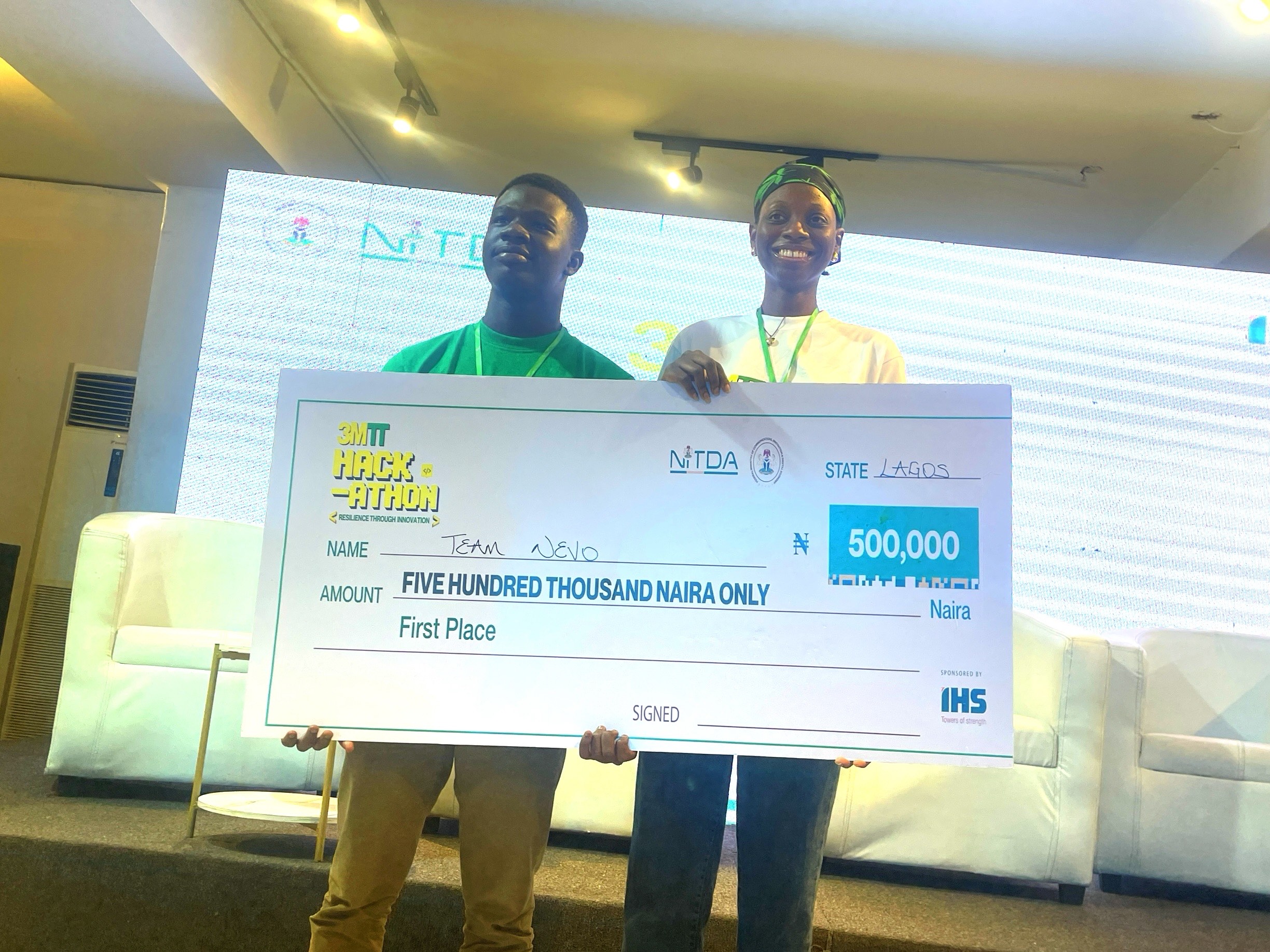
The Lagos team behind NEVO, an AI-powered personalised learning platform for neurodivergent children, has won the South-West regional hackathon of the third cohort of Nigeria’s 3 Million Technical Talent (3MTT) programme, taking home the ₦500,000 ($339) grand prize at the event held on Tuesday in Lagos.
Their victory capped weeks of state-level contests across Lagos, Ogun, Oyo, Ondo, Osun and Ekiti, where young innovators pitched the digital solutions they built during the third cohort of the 3MTT programme, an initiative of the Federal Ministry of Communication, Innovation and Digital Economy. The regional showcase gathered all state winners in a final round that tested not only technical competence but the real-world potential of their products.
The competition reflects the programme’s broader ambition to build young tech talent and accelerate digital skills adoption across Nigeria in ways that lead to homegrown, market-ready innovation.
NEVO, which emerged top after presentations and deliberations by a six-member judging panel, focuses on an AI-powered personalised learning platform for children with dyslexia, ADHD, autism, and other neurodivergent conditions that affect how they learn.
The Microbiz team from Oyo State emerged first runner-up with their financial record digitalisation tool for micro and small businesses, winning ₦300,000 ($204). Fincoach, representing Ondo State, was named second runner-up for its digital financial literacy platform and received a ₦200,000 ($136) prize.
Meet the winning projects
The first-place winner, NEVO offers an AI-powered personalised learning platform that diagnoses a child’s learning pattern and neurodivergent tendencies, then tailors lessons to their strengths. Through assessments, visual cues, structured learning paths, teacher dashboards and parental analytics, the platform adapts to each learner.
Lydia Solomon, the team’s pitch presenter, said the solution emerged from the team’s research into the challenges faced by neurodivergent children, which found that many of them are mislabelled or misunderstood in classrooms.
“These children are not slow; they just don’t learn the same way other children do,” she said. “NEVO personalises learning so every child can understand at their own pace, and the platform keeps learning the child as the child learns. If a child improves, the system upgrades the curriculum too.”
The second-place winner, Microbiz, targets what presenter, Clement Okelola, described as an overlooked economic gap: the lack of formal financial records among Micro, Small and Medium Enterprises (MSMEs). The platform digitises sales and expense records and generates invoices.
Okelola said the platform will help businesses gain visibility and access to their finance and loan opportunities, often denied due to poor financial documentation.
“Because many MSMEs don’t have structured financial data, they’re shut out of credit, government grants and growth opportunities,” he said. “Our app evaluates your credit score, checks turnover and tells you when you’re ready for a loan. Microfinance banks can also view your records instantly without paperwork.”
The third-place winner, Fincoach, from Ondo state, focuses on gamified financial literacy delivered in local languages. The platform uses audio-based lessons, dialect voiceovers and AI to teach users how to save, invest, budget and build better financial habits. The team presenter, Goddey Iyanuoluwa, said the solution targets young adults and low-income earners who struggle with financial decision-making.
Other products at the event
Beyond the top three, other teams showcased innovative solutions addressing Nigerian’s social issues, including mental health, waste management and enterprise efficiency.
MindBuddy, a wellness product developed by a team from Ekiti State, was inspired by the team leader’s personal struggle with severe anxiety after losing a parent. The product combines AI chatbots, guided exercises, mood tracking and emergency contact alerts. It is designed as a “first-aid toolkit” for mental wellness.
The Ogun State team-built Ecocycle focuses on solving the growing waste issue littering the state roads and corridors. The platform is powered by AI and data intelligence to facilitate waste recycling that redirects materials into productive cycles, aligning with broader environmental sustainability goals.
InventoryPro, built by the Osun State team, offers a real-time, multi-branch inventory management system equipped with AI-powered low-stock alerts, demand forecasting and batch-based profit calculation.
“Many inventory systems don’t calculate profit by batch,” said presenter Okunola Gold. “We built ours to help businesses capture the true cost of goods and separate batch performance.”