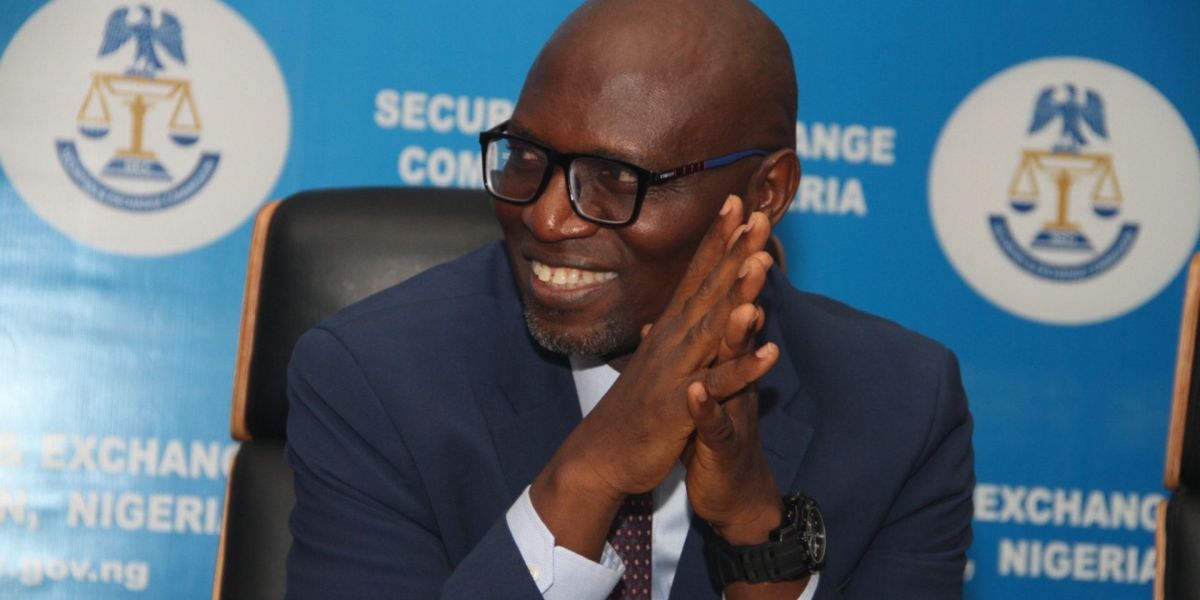
Nigeria’s Securities and Exchange Commission has raised the minimum capital requirements (MCR) across the capital market ecosystem, doubling down on its push to strengthen oversight of fintechs and digital asset firms, months after the country formally legalised cryptocurrencies.
In a circular dated January 16, 2026, and titled “Circular No. 26-1: Revised Minimum Capital for Regulated Capital Market Entities,” the SEC said the new thresholds apply to all categories of regulated operators, spanning traditional capital market intermediaries, fintechs, virtual asset service providers, and commodity market players.
Under the new framework, Digital Assets Exchanges (DAXs) and Digital Assets Custodians, which operate trading venues and safeguard users’ digital assets, must now maintain a minimum capital requirement (MCR) of ₦2 billion ($1.4 million), up from ₦500 million ($351,000).
The ₦2 billion ($1.4 million) threshold doubles an earlier ₦1 billion ($703,000) proposal floated by the SEC during industry consultations in 2024, a move the regulator later walked back after pushback from market participants. The final requirement now goes well beyond that abandoned proposal.
The changes signal the SEC’s intent to treat digital assets and fintech platforms as systemically relevant parts of Nigeria’s capital markets, not fringe innovations. By sharply raising capital thresholds, the regulator is prioritising investor protection and market stability in a newly legalised sector, even as critics warn the rules could favour well-funded incumbents over early-stage local startups.
Other digital-asset categories affected include: Digital Assets Offering Platforms (DAOPs), which facilitate primary issuance of digital tokens, now required to hold ₦1 billion ($703,000) up from ₦500 million ($321,000); Digital Assets Platform Operators (DAPOs), including token issuers that design and manage blockchain-based platforms, set at ₦500 million ($321,000); Digital Assets Intermediaries (DAIs), which provide brokerage, routing or facilitation services between users and platforms, also set at ₦500 million ($321,000); Ancillary Virtual Asset Service Providers (AVASPs), firms offering supporting services, such as wallet infrastructure, analytics or compliance tooling, must hold ₦300 million ($211,000); Real-World Assets Tokenisation and Offering Platforms (RATOPs), which structure and issue tokenised versions of physical assets like real estate or commodities, face a ₦1 billion requirement ($703,000).
The regulator said the overhaul is designed to bolster market resilience, align capital adequacy with rising risk profiles, and ensure firms have the financial capacity to protect investors as Nigeria’s capital markets expand into new asset classes, such as digital assets and tokenised products.
“The high barrier to the capital requirements puts pressure on early, innovative players, and confines the market to a few, well-funded players,” said Oluwasegun Kosemani, technical consultant on strategy and innovation to the Ad-Hoc Committee, House of Reps, in an interview with . “This could lead the bigger players to raise prices, passing cost onto consumers.”
Fintechs, advisers, and robo-advisors are also affected
Beyond crypto, the SEC extended higher capital thresholds to financial technology operators that sit at the intersection of markets and digital distribution.
Robo-advisers, automated investment platforms that use algorithms to provide portfolio recommendations and discretionary investment management, saw their MCR raised tenfold to ₦100 million ($70,300), from ₦10 million ($7,000) previously.
Crowdfunding intermediaries, which host online platforms connecting startups and small businesses with retail and institutional investors, must now maintain ₦200 million ($140,600), double the previous requirement.
Investment advisers, issuing houses, registrars, trustees, portfolio managers, and exchanges also face steep increases, with full-scope portfolio managers overseeing large collective investment schemes (CIS) now required to hold as much as ₦5 billion ($3.5 million), depending on assets under management.
All affected entities are required to meet the revised capital thresholds by June 30, 2027, with the SEC warning that failure to comply could result in suspension or withdrawal of registration. The commission said it may consider transitional arrangements on a case-by-case basis.
Industry response and delicate trade-offs
The circular has drawn criticism from some participants in the virtual asset industry, who say the higher thresholds risk stifling early-stage Nigerian digital asset companies that may not have the capital base to meet requirements at inception, unlike well-funded foreign or incumbent firms. They warn that this could entrench market concentration, create an innovation mismatch, and slow the growth of local intellectual property in blockchain and financial infrastructure.
“We need to be uptight with doing the right thing in terms of regulation, because that’s the only way African countries can measure up with this emerging tech,” said Rume Ophi, convener of Decentralised Nigeria, an annual blockchain industry conference. “Nigeria is supposed to be the giant of Africa, but unfortunately, this is where we find ourselves.”
Concerns are shared by industry groups representing blockchain operators, who warn that the revised thresholds may be out of step with the sector’s level of development.“
This policy places a huge overwhelming capital and liquidity burden on the blockchain sector,” said Mela Claude, President of the Stakeholders in Blockchain Technology Association of Nigeria (SiBAN), an industry advocacy group. “Even traditional capital market operators who have had decades to operate and establish deep global finance networks might still struggle with compliance.”
The blockchain sector is not mature enough for these capital requirements, said Claude, urging the SEC, as a matter of urgency, to review this policy as it affects blockchain operators. Policies like this will stifle innovation and harm the budding blockchain sector. It stands the risk of causing capital flight and a rise in unemployment, said Claude.
Yet the higher bar could help filter out under-capitalised operators with weak internal controls, inadequate monitoring systems or questionable intent; firms whose failures could undermine investor confidence in the nascent sector.
“If you think the minimum capital requirement [will] scare bad actors away, I don’t think so,” said Ophi. “As I’m talking to you, a scam could be going on in my village, and unless the SEC has a satellite for monitoring, they will not be able to see everything going on.”
The SEC now faces a delicate balancing act: raising standards to protect investors and systemic stability without weeding out innovation entirely, or discouraging compliant startups from entering a sector that remains in active development.
Striking that balance will be a key test of the regulator’s approach as Nigeria positions itself as one of Africa’s largest regulated digital asset markets.
A newly legal market still finding its footing
Nigeria formally legalised digital assets, including cryptocurrencies, in March 2025, when President Bola Tinubu signed the Investments and Securities Act into law. The legislation designated the SEC as the primary regulator of digital assets.
The SEC launched the Accelerated Regulatory Incubation Programme (ARIP) in June 2024, a sandbox designed to onboard and monitor digital-asset companies before full licencing.
Only two Nigerian startups, Busha and Quidax, have received provisional licences, and neither has yet been granted a full operating licence. No additional startups have been admitted into the ARIP programme since August 2024, underscoring how tightly controlled entry into the sector remains even as capital requirements climb.
For an industry still in its formative stage, the SEC’s latest move marks one of the most consequential regulatory shifts yet, one that could shape who survives, who scales, and who is locked out of Nigeria’s digital asset future.