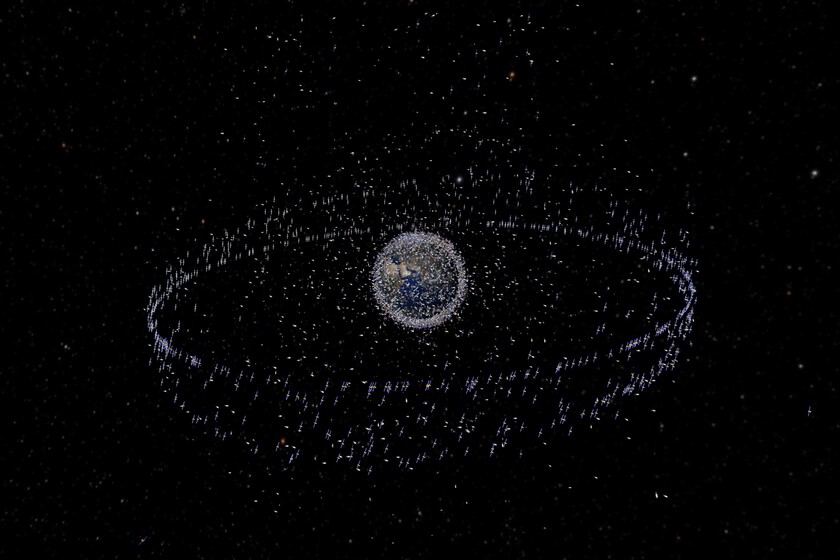
Launching the first commercial satellites, Telstar-1 and Telstar-2, cost almost $400,000 per kilogram in the 1960s. Today it costs about $6,500 per kilogram if SpaceX’s Falcon 9 program is used to send cargo, according to data from the venture capital fund Kfund. The drastic reduction in costs has enabled organizations and companies to send more and more satellites per year and, consequently, the Earth’s orbit to become saturated at an unprecedented rate.
filling the sky. What was once the exclusive territory of governments and large corporations is now within the reach of startups with modest budgets. FOSSA Systems, a Spanish company, has deployed more than 20 satellites with less than €10 million in total funding, according to Kfund. In Spain, the number of objects launched into space has more than tripled between 2021 and 2024, going from 21 to 69 payloads. At a global level, the change is even more dramatic, because while it previously took decades to deploy entire constellations, now this is achieved in a matter of months.
Changes. The drop in prices is mainly due to a series of converging factors. On the one hand, the reuse of rockets that have been perfected by SpaceX. In addition to this, there is now standardization of satellites (from giant, customized machines to modular microsatellites), while economies of scale are also being exploited.
Everything indicates that the cost per kilogram would continue to trend downward, and the next jump could come from Starship, SpaceX’s heavy-lift rocket that promises to reduce costs even further.
More satellites, also more problems. This democratization has been a complicated scenario. Now the barrier to entry for sending objects into space is much lower than before, so the risk of launching satellites without centralized coordination also increases. A while ago we also talked about the risk of collision, which has accelerated in recent years due to the overcrowding of low Earth orbit.
Among the consequences we find space debris that grows exponentially (each collision generates fragments that can cause new collisions), interference between communication frequencies, and a growing orbital militarization that is difficult to monitor.
Insufficient legal frameworks. Outer space operates under international treaties designed since the Cold War, when only two powers had orbital access capacity. Today, with hundreds of private and state operators, these legal frameworks are insufficient. For this reason, the limitations on how many satellites an operator can launch, where they should be located or where they end up at the end of their useful life are issues that are not managed by any global authority.
The result is a kind of orbital “tragedy of the commons” in which everyone benefits from cheap access, but no one fully bears the costs of this massive traffic.
Fragmentation. “The world is continually changing, in some places faster than before,” Silviu Pirvu, Chairman and CTO of Optimal Cities, tells Kfund. Space infrastructure serves us more than ever to respond to crises, manage risks or make decisions in real time, although the control and governance landscape of this same infrastructure is difficult.
Meanwhile, Europe is trying to gain sovereignty with initiatives like IRIS² to reduce dependence on non-European suppliers, but regulatory fragmentation persists.

The long-term risks. The scientific community has been warning for years about Kessler syndrome: a scenario in which the density of objects in low orbit reaches a critical point where cascading collisions make the use of certain orbits unfeasible for generations. Although we are far from that extreme, each year that passes without effective regulation brings us closer to that reality.
The European Space Agency estimates that there are already more than 36,000 objects larger than 10 centimeters in orbit, most of them junk.
Regulate a common good. There are several questions on the table, but perhaps the most interesting would be to know how a global common good is regulated when there are commercial and strategic incentives that push in the opposite direction. Although there are numerous space monitoring systems, such as ESA’s SSA (Space Situational Awareness), this capability is not a solution to the underlying problem of establishing limits.
Cover image | THAT
In WorldOfSoftware | The Challenger explosion: 40 years of the accident that forever changed the course of NASA and space exploration