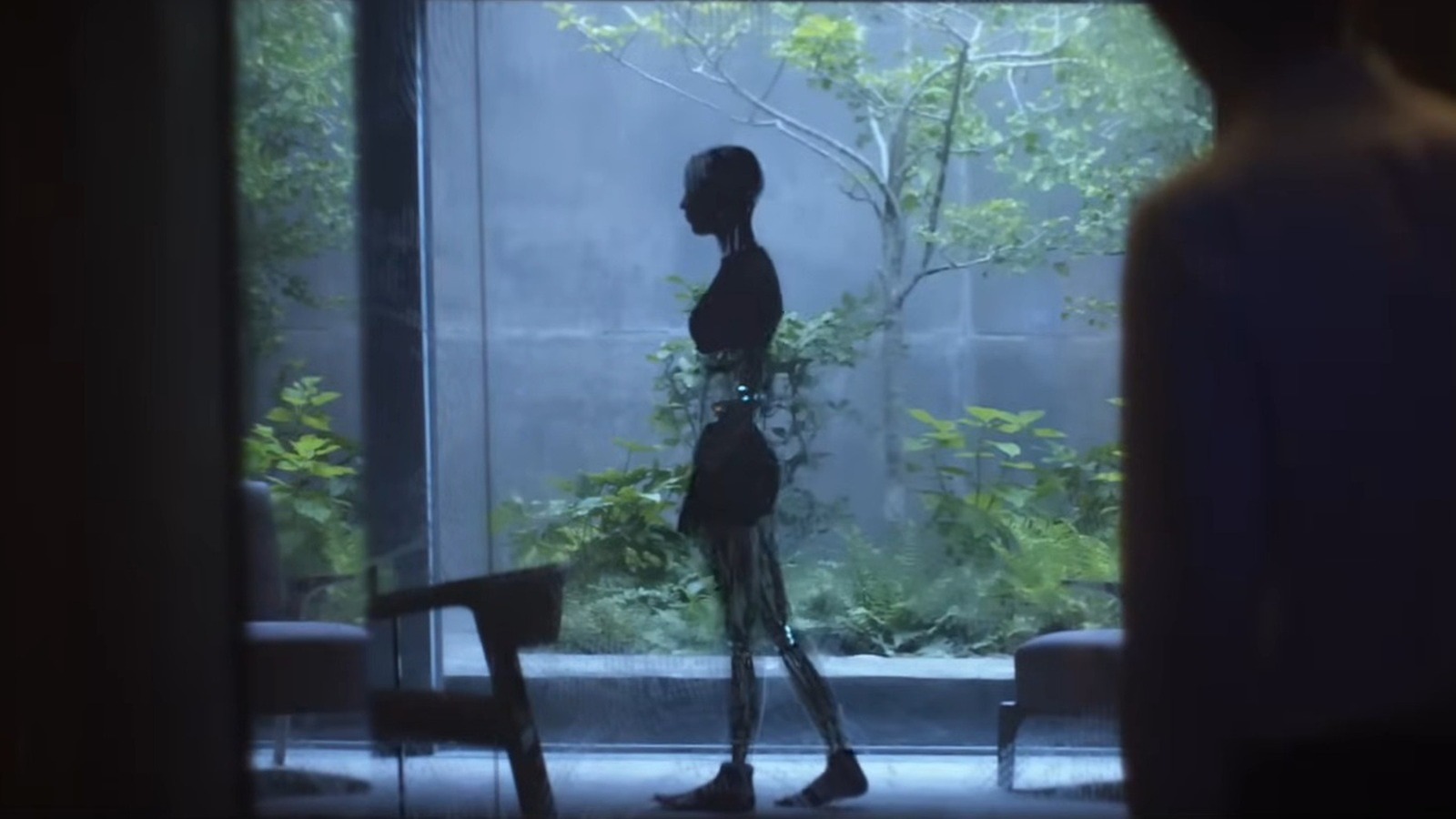
There may never be a better time to watch (or rewatch) Alex Garland’s “Ex Machina” than in 2026, now that it’s streaming on HBO Max. The 2015 film quickly became a cult classic, a sci-fi thriller that may be even more terrifying than other movies dealing with AI. In the “Terminator” and “Matrix” movies, you’re already witnessing a conflict with forms of sentient AI that battle humanity. “Ex Machina” is different because it gives us the early days of a cataclysmic story involving AI that may lead to a conflict. “Ex Machina” portrays the emergence of sentient AI, and how humanity deals with AI achieving consciousness.
“Ex Machina” premiered to critical acclaim in 2015, has a 92% Rotten Tomatoes rating, and a 7.7/10 score on IMDb as of this writing. The movie made almost $37 million at the box office against a budget of $15 million, and won an Oscar for Best Visual Effects, as well as receiving a nomination for the screenplay. Garland may not have won the Oscar for the story, but “Ex Machina” is still seen as a pivotal moment in the writer/director’s career. Garland went on to make other highly acclaimed movies and TV shows after that, including “Annihilation” (2018), “Devs” (2020), and “Civil War” (2024). He’s also penned the scripts of a few popular horror movies, including “28 Days Later” (2002) and “28 Years Later” (2025).
The “Ex Machina” cast is equally impressive: Alicia Vikander (“The Danish Girl,” “Tomb Rider”), Domhnall Gleeson (“Harry Potter,” “Star Wars”), Oscar Isaac (“Star Wars,” “Dune”), and Sonoya Mizuno (“Maniac,” “Annihilation”) play the main characters, Ava, Caleb, Nathan, and Kyoko, respectively. The famous “Ex Machina” dance sequence, seen below, is one of the highlights of the movie, an unusual dance routine shared by Nathan and Kyoko.
Why Ex Machina is even more terrifying today
“Ex Machina” is a terrifying story regardless of what happens in the real world. AI reaches a high level of intelligence and autonomy in the movie, which is the breakthrough the eccentric CEO Nathan Bateman (Isaac) has been working towards. To validate his findings, that Ava (Vikander) is indeed as intelligent and conscious as he believes, Nathan manipulates Caleb (Gleeson) into conducting a test to assess whether Ava is truly conscious and human-like. Things escalate from there, as the characters must all face their actions, including the AI robot that becomes curious about the world and experiences desires of its own.
Come to think of it, “Ex Machina” is even more terrifying now, considering the real-life events that we’ve been witnessing in recent years. In 2015, the story was still just a bold sci-fi movie that impressed audiences without worrying anyone that the events depicted in “Ex Machina” could be imminent. There was no ChatGPT, no talk about artificial general intelligence (AGI), and the age of advanced humanoid robots seemed still distant.
Fast forward to early 2026, when “Ex Machina” starts streaming on HBO Max, and the story will feel different. We’re in the early years of the AI era, and most tech companies put artificial intelligence in all products. Chatbots like ChatGPT can be incredibly powerful resources, as AI firms made impressive breakthroughs since ChatGPT went viral in late 2022. There’s increased talk of AGI, and companies are developing humanoid robots that can understand and interact with their surroundings.
How long until robots like Ava become real?
It’s not just the rapid pace of AI innovation that we’ve been witnessing in recent years. Some voices have raised concerns about AI safety and the possibility of AI getting out of control. The same voices are calling for tighter AI regulations to improve alignment and ensure that the AI doesn’t misbehave. Watching “Ex Machina” in this context would give anyone reason to pause. The events Garland imagined are still in the realm of science fiction, but we’re much closer to that future than we were when “Ex Machina” was first released.
The good news is that robots like Ava do not exist, at least commercially. Research is still ongoing to perfect advanced AI robots. Large language models like ChatGPT can already understand text, audio, and video in real time. That’s a key development towards that future. Spatial reasoning, which will allow robots to understand and interact with their surroundings, is also in development.
Speaking of the famous “Ex Machina” dance, robots can move, and that includes performing complex choreography. Some companies are already developing artificial skin that may be used on future humanoid robots. New battery technologies are also in development for cars and other devices, which may power robots in the future. But the big AI companies of the real world, including OpenAI and Google, are yet to unveil a robot with capabilities similar to the fictional Ava.