OpenAI Secures Historic $122 Billion Funding Round, Valued at $852 Billion

By Markos Symeonides
In a landmark event that has sent shockwaves through Silicon Valley and the global technology ecosystem, OpenAI announced the successful closure of a staggering $122 billion funding round in April 2026. This unprecedented infusion of capital sets a new record for the largest funding round in Silicon Valley’s history and catapults OpenAI’s valuation to an extraordinary $852 billion.
The funding round attracted heavyweight investors including Amazon, Nvidia, and SoftBank, alongside a cadre of wealthy individual investors and a prominent ETF money manager. This monumental financial backing arrives as OpenAI solidifies its position at the forefront of the fiercely competitive artificial intelligence landscape, generating $2 billion in monthly revenue—a testament to the company’s rapid commercial success and growing enterprise footprint.
Strategic Shifts Amid Rapid Growth
While the influx of capital underscores OpenAI’s dominance, it comes amidst strategic recalibrations within the company. Notably, OpenAI recently shuttered its Sora video generation platform, choosing to realign its focus towards core developer and enterprise solutions. This pivot reflects a broader emphasis on consolidating AI product offerings and enhancing integration for end-users.
Central to this strategy is the plan to merge OpenAI’s flagship tools—ChatGPT, Codex, and the Atlas browser—into a unified desktop application. This move aims to streamline user experience and offer a more cohesive AI-powered productivity suite that caters to developers, business users, and consumers alike.

Investor Profile and Market Context
The participation of Amazon, Nvidia, and SoftBank in this funding round highlights the strategic importance these tech giants place on AI innovation. Amazon’s investment signals a deepening commitment to AI-driven cloud services and enterprise solutions, while Nvidia’s involvement reflects its critical role as a hardware enabler for AI workloads. SoftBank’s backing continues its trend of aggressive investments in transformative technologies.
Additionally, the involvement of an ETF money manager and affluent individual investors underscores growing enthusiasm for AI as a cornerstone of future economic growth. This diversified investor mix provides OpenAI with both financial muscle and strategic partnerships to accelerate product development and market penetration.
Leadership Perspectives and Internal Dynamics
OpenAI’s leadership team is driving the company’s next phase with clear focus and ambition. Greg Brockman, OpenAI’s President and COO, is spearheading the product consolidation efforts, aiming to fuse the company’s diverse AI capabilities into a seamless platform. This initiative is expected to reduce fragmentation and amplify the impact of OpenAI’s offerings in both enterprise and developer communities.
Fidji Simo, CEO of OpenAI Applications, notably referred to the success of Anthropic’s Claude Code as an internal “wake-up call.” Claude Code, a direct competitor in the developer tools space, has challenged OpenAI’s Codex, pushing the company to accelerate innovation and refine its developer-oriented products. This candid acknowledgment underscores the intensifying rivalry in AI-powered coding assistants and the broader developer tools market.
Implications for the AI Industry and Competitive Landscape
The scale of OpenAI’s latest funding and its lofty valuation signify a pivotal moment in the AI industry. As the market matures, OpenAI’s dominant position is increasingly contested by established tech companies and ambitious startups alike, fostering a hyper-competitive environment that drives rapid innovation.
OpenAI’s consolidation strategy and focus on enterprise-grade AI solutions position it to consolidate leadership in a market that is shifting from experimental to mission-critical applications. This funding round arms OpenAI with the resources to accelerate research, scale infrastructure, and enhance product offerings, raising the bar for competitors.
However, competitors such as Anthropic, Google DeepMind, and emerging AI startups continue to invest heavily, ensuring that the AI landscape remains dynamic and fiercely contested. OpenAI’s ability to maintain its lead will hinge on its execution of integrated products and its capacity to deliver tangible business value to enterprise customers.
Enterprise AI Adoption Accelerated
The $2 billion monthly revenue milestone demonstrates OpenAI’s successful transition from a research-centric organization to a revenue-generating powerhouse. Enterprises across sectors are increasingly adopting AI to drive efficiencies, enhance customer experience, and innovate new services.
OpenAI’s unified desktop app, combining ChatGPT’s conversational AI, Codex’s developer assistance, and Atlas’s browsing capabilities, is poised to become a critical tool for knowledge workers and developers. This integration simplifies AI adoption by reducing the complexity of juggling multiple applications, which is a significant barrier to enterprise deployment.
Moreover, OpenAI’s decision to discontinue Sora highlights a strategic prioritization of core enterprise and developer products that generate consistent revenue and customer engagement, signaling a maturation of the company’s business model.
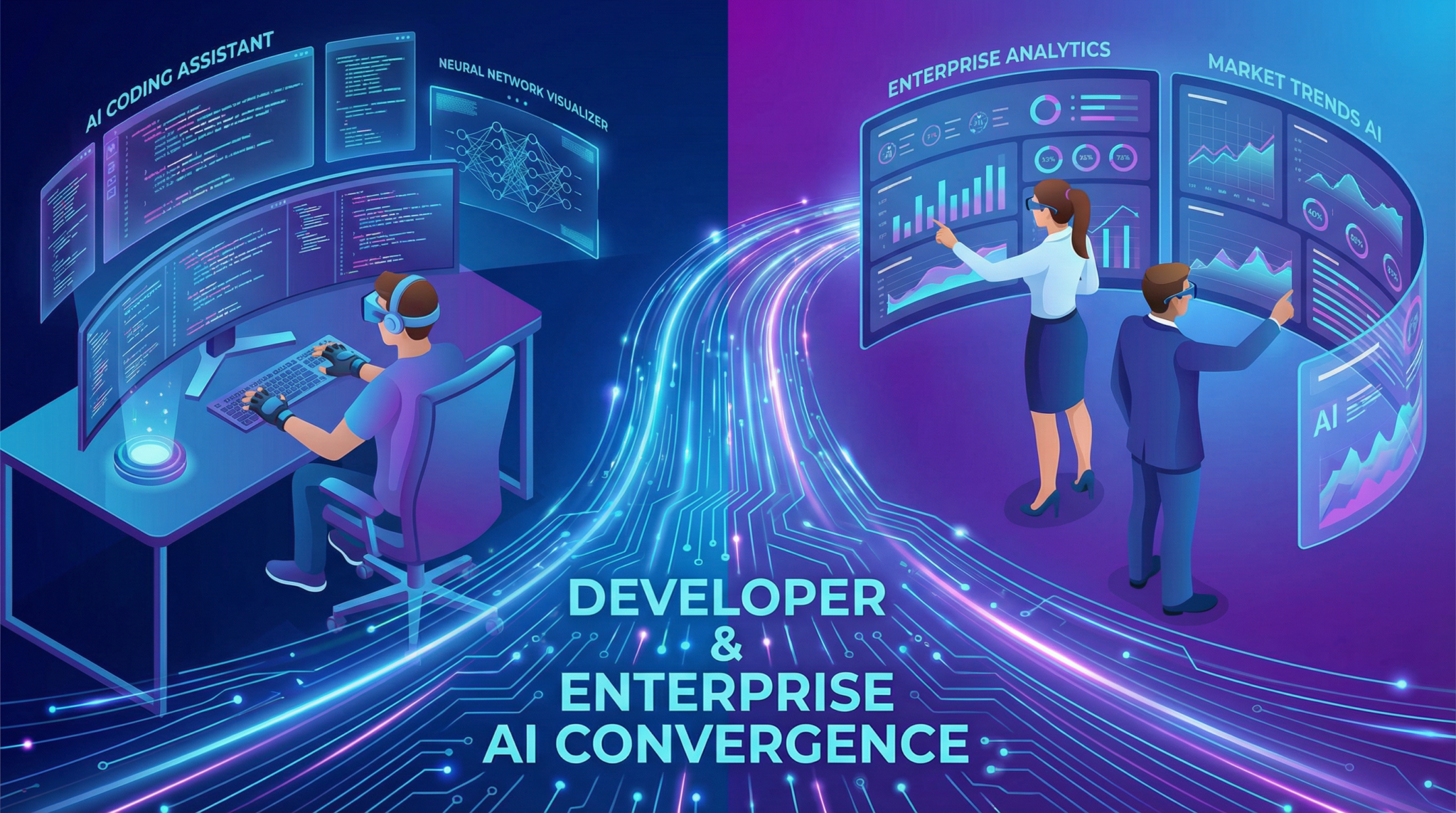
Developer Tools Market: Codex vs. Claude Code
OpenAI’s Codex has been a trailblazer in AI-assisted coding, powering tools that enable developers to write code more efficiently and with fewer errors. However, the rise of Anthropic’s Claude Code has introduced fierce competition in this category, prompting OpenAI to rethink its approach.
Fidji Simo’s reference to Claude Code’s success as a “wake-up call” highlights the intense pressure on OpenAI to innovate faster and deliver superior developer experiences. The planned integration of Codex into the unified desktop app is a direct response to these market dynamics, aiming to offer developers a more powerful, versatile platform.
This competition is beneficial for developers, spurring rapid advancements in AI coding assistants, language understanding, and contextual code generation capabilities. The developer tools market is evolving into a battleground for AI-driven productivity, with OpenAI and Anthropic at the forefront.
Broader Tech Investment Landscape Impact
OpenAI’s historic funding round sends a strong signal to the technology investment community that AI remains the most compelling sector for capital deployment. The massive valuation and investor enthusiasm could trigger a new wave of funding rounds, mergers, and acquisitions as companies vie to participate in AI’s transformative potential.
However, the size of this round also raises questions about market concentration and the future of competition. With such vast resources, OpenAI can attract top talent, build unparalleled infrastructure, and set industry standards, potentially crowding out smaller players.
Investors will be closely watching how OpenAI translates this capital into sustainable growth, innovation, and market expansion. The company’s ability to balance aggressive scaling with responsible AI development and regulatory compliance will be critical factors shaping the future tech investment landscape.
Conclusion: OpenAI’s Growing Influence and Market Evolution
OpenAI’s $122 billion funding round and $852 billion valuation mark a watershed moment in the AI industry’s evolution. Backed by some of the world’s most influential technology companies and investors, OpenAI is positioned to deepen its leadership through strategic product consolidation and a renewed focus on enterprise and developer markets.
The company’s response to competitive pressures, especially in the developer tools segment, demonstrates a nimble approach to innovation amidst intensifying market rivalry. As AI adoption accelerates across enterprises and developers, OpenAI’s integrated AI platform could become a cornerstone of future digital workflows.
At the same time, the scale of investment underscores the transformative potential of AI and its central role in shaping the broader technology and economic landscape. The coming years will be critical in observing how OpenAI leverages its resources to sustain innovation, navigate competition, and influence the trajectory of AI worldwide.
For a deeper dive into OpenAI’s AI model advancements and developer ecosystem strategies, see our coverage on GPT-5.4 Complete Guide: OpenAI’s Most Powerful AI Model Explained and Emerging Trends in AI 2026. Additionally, our analysis of OpenAI’s 2026 Strategy: Driving Enterprise Growth Through Practical AI Adoption offers valuable insights into the factors driving AI integration in business environments.