OpenAI Group PBC today introduced a platform called Frontier that companies can use to build and manage artificial intelligence agents.
The offering debuted alongside a new version of the company’s programming-optimized model. GPT-3.3-Codex, as the algorithm is called, is better than its predecessor at not only code generation but also general productivity tasks.
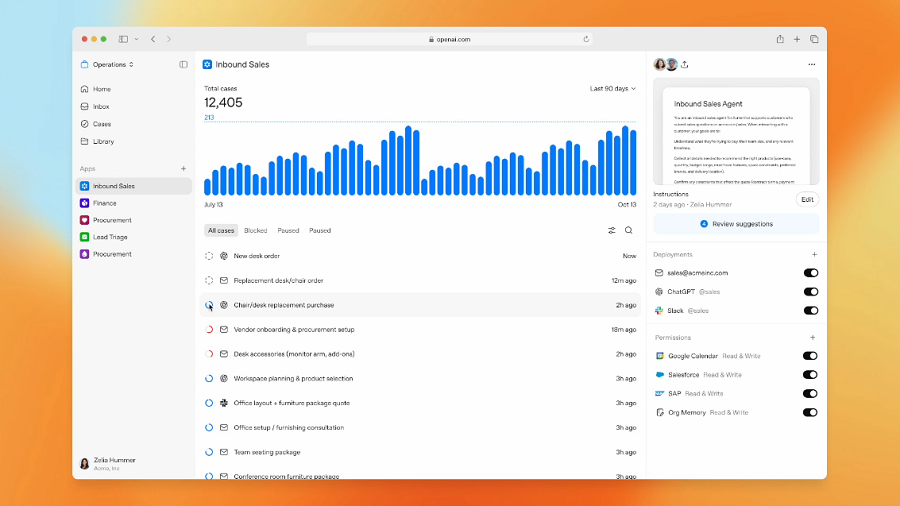
Frontier enables workers to create AI agents in a chat box similar to the ChatGPT interface. The first step is to enter a natural language description of what tasks an agent should perform and how. From there, workers can integrate the agent with the applications that it will use to automate manual work. OpenAI says that Frontier can connect to customer relationship management platforms, data warehouses and a range of other services.
Workers may optionally equip an agent with skills. Those are user-created extensions that make OpenAI-powered agents better at performing multi-step tasks. A skill can, for example, include pre-packaged Kubernetes configuration scripts that an agent can use to create container clusters.
OpenAI says that Frontier-connected agents “build memories” of the tasks they perform. Those memories enable them to improve their output quality over time. According to the company, administrators can monitor an agent’s performance in a dashboard that visualizes metrics such as the number of customer support tickets that it process and its success rate.
Frontier also includes other observability features. The platform creates an audit log of every task completed by an agent to ease quality evaluations. For example, the audit log of a technical support interaction might include visualizations that quantify the agent’s politeness and output accuracy.
OpenAI plans to provide customers with access to so-called forward deployed engineers who can help them develop Frontier best practices. Additionally, it will work with fellow AI companies to help them build Frontier-powered features. The initial partner roster includes sales automation provider Clay Labs Inc., medical notetaking specialist Ambience Healthcare Inc. and several other startups.
GPT-5.3-Codex, the coding-focused model that OpenAI debuted today in conjunction with Frontier, generates responses 25% faster than its predecessor. The algorithm set new records on the SWE-Bench Pro and Terminal-Bench programming benchmarks. The former test includes coding questions that span four programming languages, while the latter evaluates AI models’ ability to use the command line.
OpenAI says that GPT-5.3-Codex also lends itself to a range of other use cases. The company evaluated the model using a benchmark called OSWorld that includes a large number of online research and file editing tasks. GPT-5.3-Codex scored 64.7%, 26.5% more than its predecessor.
The model is available in the paid versions of ChatGPT and will roll out to OpenAI’s application programming interface soon. Frontier, in turn, is accessible to a limited group of enterprise customers that includes Oracle Corp., HP Inc. and several other major tech firms. OpenAI plans to make the platform more broadly available in the coming months.
Image: OpenAI
Support our mission to keep content open and free by engaging with theCUBE community. Join theCUBE’s Alumni Trust Network, where technology leaders connect, share intelligence and create opportunities.
- 15M+ viewers of theCUBE videos, powering conversations across AI, cloud, cybersecurity and more
- 11.4k+ theCUBE alumni — Connect with more than 11,400 tech and business leaders shaping the future through a unique trusted-based network.
About News Media
Founded by tech visionaries John Furrier and Dave Vellante, News Media has built a dynamic ecosystem of industry-leading digital media brands that reach 15+ million elite tech professionals. Our new proprietary theCUBE AI Video Cloud is breaking ground in audience interaction, leveraging theCUBEai.com neural network to help technology companies make data-driven decisions and stay at the forefront of industry conversations.