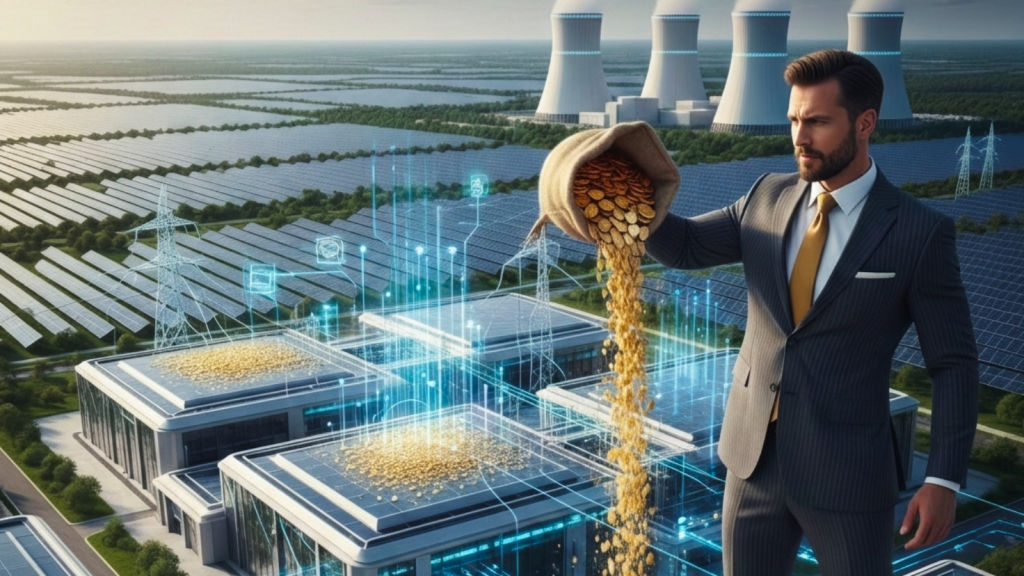
Forget the chatbots. Follow the $200 billion flow into the “Silicon and Concrete” era.
Just a few short months ago, back in November 2025, investors were writing OpenAI‘s obituary.
That’s when Google unleashed Gemini 3, which actually looked like it had a better reasoning engine. Analysts were busy charting the “trough of disillusionment” while pointing at OpenAI’s rumored $9-billion 2025 burn rate like it was a terminal diagnosis.
Many believed that the nimble startup had run out of road and that incumbent tech behemoths were about to steamroll Sam Altman into a footnote of history.
Then, in response, Altman issued a ‘Code Red,’ “delaying initiatives like ads, shopping and health agents, and a personal assistant, Pulse, to focus on improving ChatGPT” as quickly as possible.
And after a few months of quiet persistence, the startup ‘king’ has returned – in more ways than one. This time, he didn’t come back to negotiate; he came to re-capitalize the entire Western world’s compute budget.
Reports hitting the wire this week suggest we are witnessing the single largest capital-raising event in corporate history.
We are talking about a syndicate of the Mag 7 and sovereign wealth funds potentially loading a $200 billion war chest to win the race to AGI.
But don’t mistake this for a simple bank deposit. This isn’t just “more money.” It is a fundamental reset of the global economic order.
If you want to know who is truly terrified of a Google monopoly – and who is betting their entire corporate survival on a post-GPU world – just look at the ledger.
Inside the OpenAI $200B Capital Raise: The New Ledger of Global Compute
Among the numerous reports and numbers tossed around this week regarding potential OpenAI investors…
- Nvidia (NVDA), up to $30 billion: Jensen Huang is pulling the ultimate “circular” power move. By putting $30 billion into OpenAI, he isn’t just buying shares – he’s financing his own demand. That $30 billion will be wired right back to Nvidia to pay for its new Rubin architecture chips. It’s a closed-loop economy where the currency is HBM4 memory and the profit is “strategic alignment.”
- Amazon (AMZN), up to $50 billion: Andy Jassy’s biggest shock of the year. The reason? Being the “other” cloud provider wasn’t working. By forcing OpenAI to use AWS Trainium chips alongside Azure, Amazon has effectively broken Microsoft’s exclusive grip on the frontier of AI.
- The “X-Factors,” SoftBank (SFTBY) & The Middle East: Masayoshi Son is back in “God Mode,” potentially adding $30 billion on top of his massive $40 billion December commitment. Meanwhile, Altman’s recent tour of Abu Dhabi was reportedly about trying to secure another $50 billion from MGX and sovereign funds. And even Microsoft is supposedly chipping in another $10 billion here.
Add it all up, and OpenAI is potentially raising somewhere between $100- and $200 billion right now at a valuation north of $800 billion. For those keeping score at home, that makes a “private” startup more valuable than Meta (META) was just a few years ago – and it would be the biggest private capital raise in history.
Why OpenAI Is Pivoting to Project Stargate
For the past two years, we’ve been playing a “software game.”
Which company has the best chatbot? Who can write a better Python script or make a more realistic video of a cat playing the piano?
But that era is over. Now we have entered the Industrial Phase.
OpenAI’s $200 billion isn’t going toward “research.” It’s going toward Project Stargate: the rumored $500 billion plan to build data centers that consume more power than most European nations.
To put that in perspective, a single “Stargate” cluster will require 5 GW of power – more electricity than Virginia’s entire existing data center industry consumed in 2023 (3.9 GW). We are talking about a civilization-scale shift. For 20 years, we built the “Cloud.” Now, we are building “The Forge.”
This is why the energy crisis is no longer a political talking point; it’s the ultimate bottleneck for AGI. If you can’t secure the gigawatts, your $200 billion in silicon becomes the world’s most expensive pile of paperweights.
Now, in our view, this incoming cash flow is the best news investors have had in three years – because a “spending war” this intense creates a massive, multi-year tailwind for the companies that build the AI infrastructure.
While the ‘Mag 7’ burn billions fighting for the crown, the AI Infrastructure stocks are the landlords of the new digital economy. They don’t care who wins the chatbot wars – they get paid every time a photon moves or a cooling pump turns.
The Infrastructure Playbook: Where to Put Your Money
If OpenAI is looking to spend $200 billion, it won’t be buying software. That cash will go toward power, cooling, and light.
Project Stargate and the 10-Gigawatt Bottleneck
The biggest AI bottleneck in 2026? Energy.
Project Stargate needs 10 gigawatts of power – roughly the output of 10 nuclear reactors. You can’t get that from the public grid. You need your own power plant.
- The Nuclear Play: Stocks like Constellation Energy (CEG) and Vistra (VST) have become the “new tech” stocks. They own the nuclear assets that provide the 24/7 carbon-free energy these AI factories demand.
- The Microgrid Play: Watch companies like Bloom Energy (BE). As OpenAI builds data centers in places like Texas to bypass the grid, it will also need on-site fuel cells and natural gas microgrids to stay online.
Nvidia’s HBM4 and the End of the “Thermal Wall”
Nvidia’s Rubin architecture – the star of the show at CES 2026 earlier this month – is a marvel of engineering. By utilizing HBM4 memory and the new 3nm “Vera” CPUs, it processes data at speeds that make the old H100s seem like dial-up.
But there’s also a big catch: Rubin is designed for “Agentic AI” – models that don’t just chat but actually reason and act in real time. The density of these chips creates a “thermal wall.” At these wattages, traditional air fans are useless – they’d just be blowing hot air around a furnace.
If a data center can’t handle the heat, it can’t run the model. That makes the companies owning the “liquid patent” the new gatekeepers of the AI era.
- The Liquid Leaders: Vertiv (VRT) is the undisputed king here. It provides the liquid-to-chip cooling systems that make these trillion-parameter models run smoothly. Its backlog is already stretching into 2028 – and this OpenAI round just effectively guaranteed revenues for the next half-decade.
Replacing Copper With Light Speed
When you have 1 million GPUs in a single cluster, you hit the “Copper Limit.” As data speeds increase, resistance turns that data into heat. By the time a signal travels across a football-field-sized data center, the signal is degraded, and the copper wire is melting.
To win the race to AGI, we need a “photonic pivot,” where we replace electrons with photons. Light doesn’t generate heat, and it travels at the speed of… well, light.
This is the only way to keep a million-GPU cluster from melting into a puddle of silicon. And that means the “toll-booth operators” of this new photonic highway are about to see a generational windfall.
- The Optical Trade: Fabrinet (FN) and Arista Networks (ANET) are the primary beneficiaries of the “Stargate” scale. As these clusters move to 1.6 trillion transceivers, the companies that manufacture and switch that optical data are the “toll booths” of the internet’s new backbone.
Your Blueprint for the U.S. Government’s AI Manhattan Project
I know what the bears are saying. “This is circular; a bubble! It’s 1999 all over again!”
In the long run, maybe they’re right… But in the short run, liquidity is king.
When $200 billion in fresh capital enters a specific sector, that entire sector benefits.
When the three biggest companies in the world decide they will spend “whatever it takes” to avoid losing to Google, the suppliers of that “whatever” will have the best years in their corporate history.
The AI “Code Red” is over. The spending war is officially on. And in a war this big, you don’t bet on the generals – you bet on the guys selling the ammunition.
But here is the most important part: This isn’t just a private war between OpenAI and Google.
This is now a matter of national security.
On Nov. 24, 2025, a landmark executive order quietly launched the Genesis Mission. It is the modern-day equivalent of the Manhattan Project or the Apollo Program – a massive, public-private mobilization designed to ensure America wins the AI race against China.
The government is about to dump trillions into six critical sectors: AI, Quantum, Nuclear, Biotech, Semiconductors, and Advanced Manufacturing.
And the clock is ticking.
Feb. 22 marks the 90-day “Inventory Deadline” where the Department of Energy will finalize the resource allocation for its 52 Genesis Partners. When that happens, the window of opportunity will slam shut.
I’ve used my Silicon Valley network to narrow down the buy list into the eight best plays to own before the February announcement. These are the companies that will receive the contracts, the subsidies, and the “unfair” advantages of the Genesis Mission.
Click here to watch my free briefing on the Genesis Mission – and get the eight stocks to buy before Feb. 22.