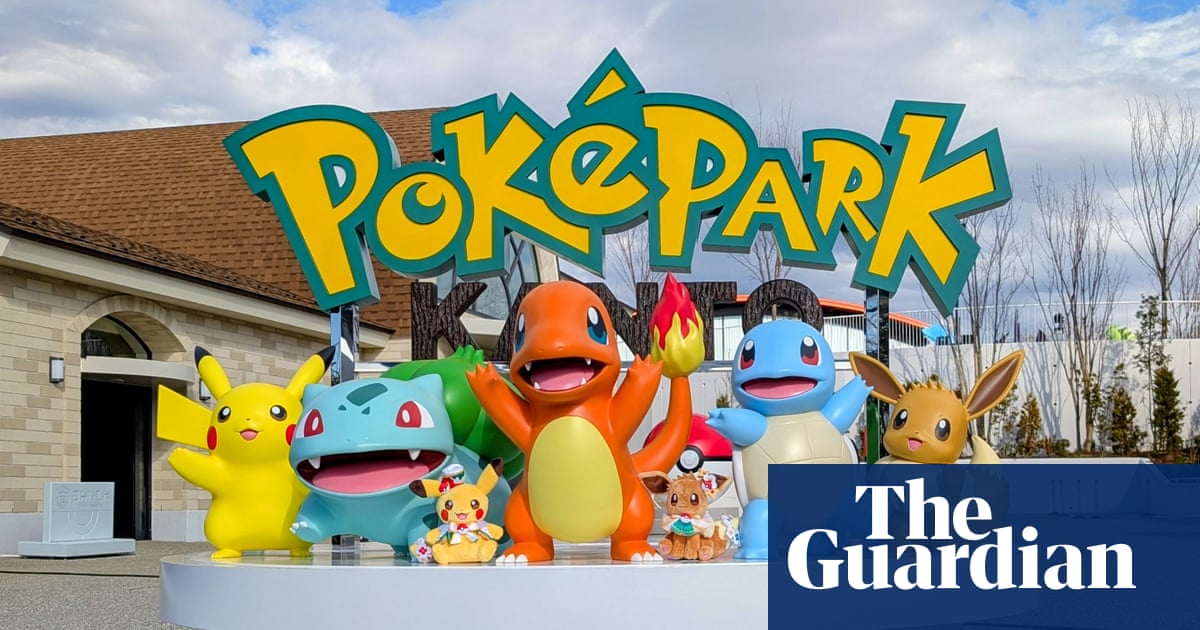
In Japan, February is normally a period of quiet reflection, a month defined by winter festivals in Sapporo’s snowy mountains and staving off the cold in steaming hot springs. Traditionally, international tourists start to arrive with the blossoms in spring – but thanks to the opening of Pokémon’s first ever amusement park on 5 February, this year, they are likely to come earlier.
Unlike the rollercoaster-filled thrills of Tokyo Disney Sea or Universal Studios Japan in Osaka, PokéPark Kanto is essentially a forest populated by models of the creatures from the perennially popular games. Nestled in the quiet Tokyo suburb of Inagi, half an hour from the city centre, the park is a walkable forest with more than 600 Pokémonin it. Where the Mario-themed Super Nintendo World slots neatly into the massive Universal Studios Japan, PokéPark Kanto is hidden in the back of the less glitzy, funfair-esque Japanese theme park Yomiuri Land.
Taking up 26,000 sq metres, the family-friendly attraction is divided into two main areas: Pokémon Forest and the plaza-esque Sedge Town. Tickets for the park are bought via a lottery system – and currently sold out for the next three months – ranging between ¥7,900 (£38) for a standard adult ticket and ¥14,000 (£66) for a queue-skipping priority pass.
The park’s creative direction has been overseen by one of the original Pokémon creators, Junichi Masuda. Visitors roam a series of explorable habitats, littered with endearingly lifelike statues of hundreds of Pokémon, arranged in fun tableaus where various species are interacting with each other. Walking through PokéPark Kanto feels akin to becoming a Pokédex-clutching David Attenborough, a re-creation of what it would be like to observe these fantastical creatures in the wild. Beaver-esque Bidoofs use their two front teeth to cut down a real tree. Worm-like Diglett burrow above the soil to greet a smiling Eevee.
Each Pokémon is presented in full scale too, making the larger creatures especially awe-inspiring. From a lorry-sized re-creation of the rocky behemoth Onix to a herd of rhinoceros-sized Rhyhorns lining the main path, each habitat is a joy to behold, with hidden creatures dotted throughout the trees and grass as a reward for eagle-eyed kids.
In many ways, it’s surprising it has taken this long for a permanent Pokémon theme park to be erected. With Pikachu and pals celebrating their 30th anniversary this year, Pokémon is still comfortably the highest-grossing media brand in the world: its total estimated lifetime revenue of $150bn comfortably surpasses Disney properties such as Star Wars and Marvel. The Pokémon company’s profit rose to ¥70.3bn in the year ending February 2025 – roughly £337m – and with a range of new games, merchandise and the new theme park, its profits in 2026 are only likely to increase.
After clearing the Pokémon forest, visitors are greeted by a Pokémon parade in Sedge Town square, where there are also Pokémon-themed versions of fairground games such as ring toss, Pokémon-themed food, and an Eevee-themed carousel. Visitors can also walk into a real-life Pokémon Centre (an iconic building from the games and anime) and grab a seat at a gym where they can watch a live Pokémon battle that blends human performers with cutting-edge animatronics.
The Pokémon Company has numerous Pokémon Centre shops all over Japan selling exclusive merchandise. PokéPark Kanto will continue this lucrative trend, selling plushies and clothing that people will have to travel there to own. Video games are huge business in Japan, one of the country’s main cultural exports – but theme parks based on the country’s virtual stars are a newer phenomenon. Since Super Nintendo World first opened its doors at Universal Studios Japan in 2021, it has been transplanted to Universal’s parks in Hollywood and Florida, with all locations helping to drive multi-billion dollar quarterly revenues.
Thanks to a weak yen post-pandemic, recent years have seen tourists flock to Japan. While it has been a boon to the economy, the flood of incomers has led to tension. From phone-camera-weilding influencers behaving badly, to overcrowded streets inconveniencing locals, the 42 million visitors who arrived in Japan in 2025 have come alongside a notable nationwide rise in anti-foreigner sentiment. Newly appointed prime minister, Sanae Takaichi, is already doubling down on anti-tourist legislation. It’s safe to say that PokéPark Kanto, with its family-friendly international appeal, will only increase visitors to Japan’s overcrowded capital.