Artificial intelligence (AI) stocks may have hit a rough patch lately, driven by external factors such as the war in Iran, investor concerns about an AI bubble and the increasing likelihood of a US recession. However, a closer look at AI-driven demand for hardware and software suggests the weakness may not last long.
While companies adopting AI have witnessed increased productivity, leading to a surge in demand for AI software offerings, companies selling AI hardware are experiencing robust demand that exceeds their supply. The market researchers from GartnerFor example, estimates that 40% of enterprise applications will be integrated with AI agents this year, up from just 5% in August 2025.
This is great news for a company like Palantir Technologies (PLTR 1.87%)an AI software specialist that helps companies build AI agents, along with other AI tools. On the other hand, heavy spending on AI data center infrastructure will likely remain a tailwind Intel (INTC +1.07%). This semiconductor stock posted excellent gains last year and remains in good form so far into 2026.
Let’s take a look at the reasons why these AI stocks could have a solid year and deliver impressive gains for investors.
Image source: Intel.
Intel: A favorable supply-demand environment should pave the way for better-than-expected growth
Shares of Intel are already up 67% through 2026, despite some bouts of volatility along the way. The company has impressed investors lately thanks to advances in AI data centers, where demand for custom processors and central processing units (CPUs) for servers is increasing. In fact, Intel is struggling to meet data center demand for its chips.

Today’s change
(1.07%)$0.66
Current price
$62.38
Key data points
Market capitalization
$312 billion
Day range
$60.75 -$63.39
Range of 52 weeks
$6.25pm -$63.39
Volume
99M
Avg. full
109M
Gross margin
35.24%
Demand for server CPUs deployed in data centers is reportedly outpacing demand, fueled by artificial AI and inference applications. This explains why hyperscalers are reportedly looking for long-term deals with Intel to secure their supply of server CPUs. So there’s a good chance that Intel will capitalize by raising its prices.
Market research firm Omdia estimates that the shortage of server CPUs could lead to a price increase of 11% to 15%. Given that Intel is working to improve production yields and expects to bring additional production capacity online throughout the year, the company is well-positioned to take advantage of healthy demand for server CPUs.
Meanwhile, the company’s growing traction in custom AI processors known as application-specific integrated circuits (ASICs) should be another critical tailwind for the company this year. Intel reported a 50% year-over-year increase in its custom AI processor business in the fourth quarter. The company has already achieved annualized revenues of $1 billion, and has the potential to grow even further as demand for ASICs to handle AI workloads continues to grow.
So don’t be surprised if Intel’s 2026 earnings growth exceeds the 15% jump to $0.48 per share that analysts expect on average. In fact, the chipmaker’s revenues are also expected to rise at a healthy pace in the coming years.
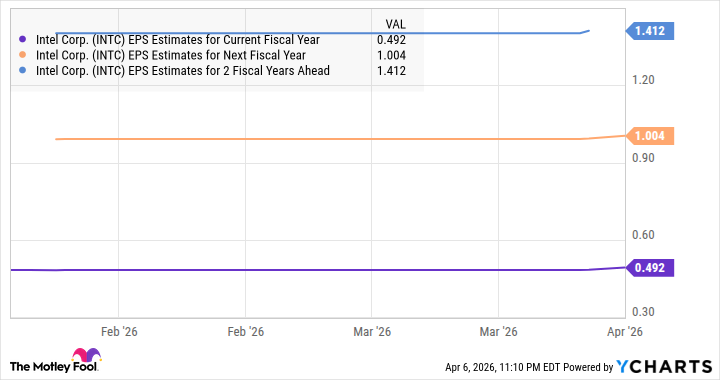
INTC EPS estimates for current fiscal year data according to YCharts.
As such, there’s a good chance that Intel stock will rise not only in 2026, but also over the long term.
Palantir: Helping customers put AI into action
The productivity gains that AI helps adopters achieve are the main reasons for the massive investments in this technology, and Palantir is emerging as a go-to name for companies and governments looking to use AI to their advantage.

Today’s change
(-1.87%)$-2.44
Current price
$128.05
Key data points
Market capitalization
$306 billion
Day range
$122.68 -$129.20
Range of 52 weeks
$89.31 -$207.52
Volume
4.4 million
Avg. full
51M
Gross margin
82.37%
Customers using Palantir’s Artificial Intelligence Platform (AIP) have reported significant cost savings by automating processes, reducing redundancies, and shortening deployment times of generative AI solutions. General Millsfor example, points out that it saves $40,000 per day by using Palantir’s generative AI software platform.
This makes it clear why Palantir’s customer base is growing rapidly and the company is generating more revenue from existing customers. While customer numbers increased 34% year over year in Q4 2025, the net dollar retention rate was an impressive 139%. (Net dollar retention is calculated by dividing a company’s trailing twelve-month revenue from established customers at the end of a period by the trailing twelve-month revenue from that same group of customers a year earlier.)
Importantly, Palantir’s net dollar retention rose 19 percentage points year over year in the fourth quarter. This clearly indicates that established customers continue to spend more and more money on the offering over time. As a result, Palantir signed a record $4.3 billion in new contracts in the last reported quarter, up 138% year over year. That was well above the 70% increase in revenue to $1.4 billion.
Of course, Palantir stock would have to step on the gas to end 2026 higher, as it has lost nearly 27% so far this year. The company’s valuation remains a sticking point as it has an earnings multiple of 107 and a revenue multiple of 81. But it could justify these multiples by beating consensus growth expectations in the coming quarters. If that happens, it could be enough to help the stock regain its momentum and fly higher as the year progresses.