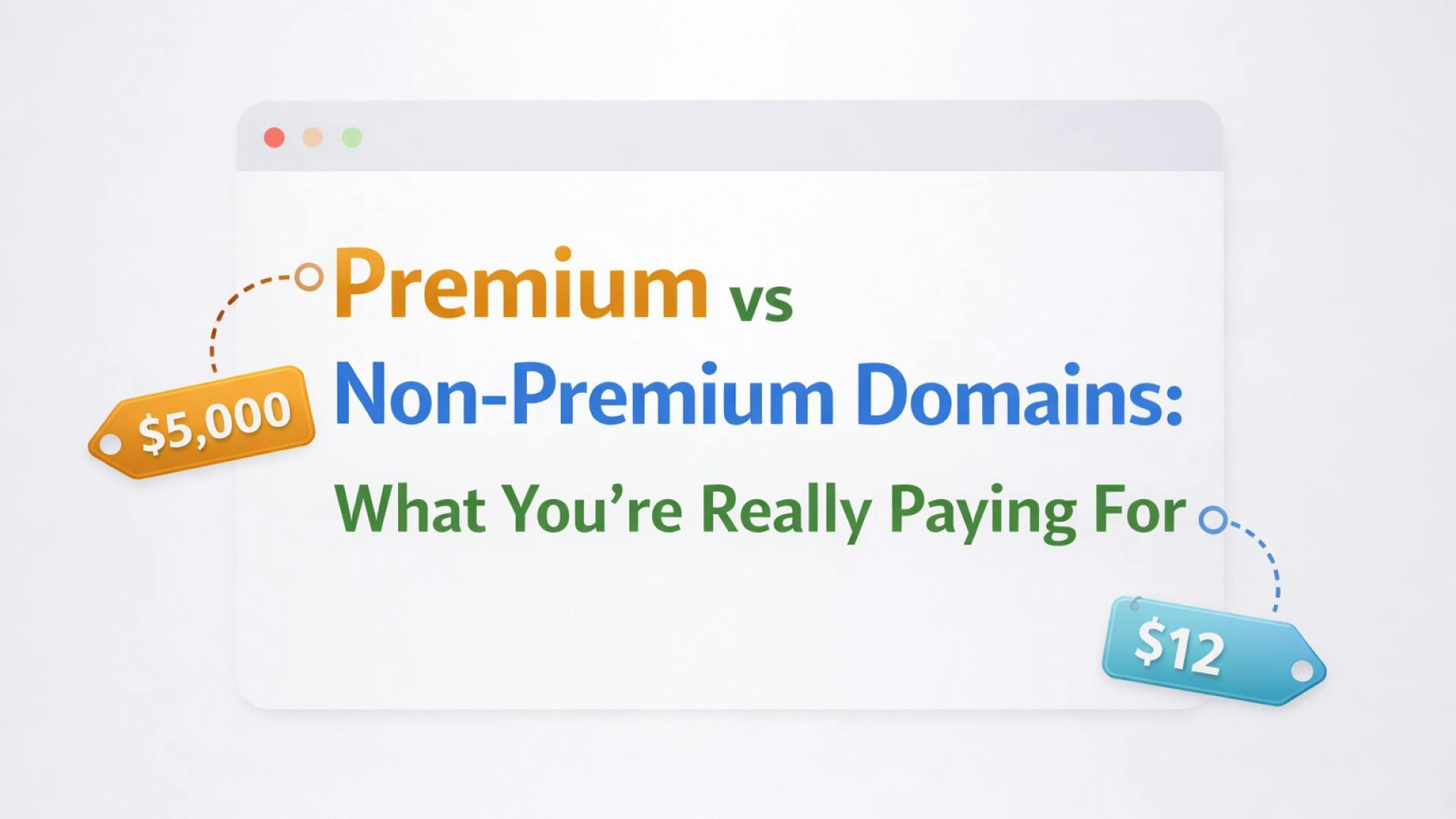
When people talk about premium domains, the conversation usually stops at price. A domain that costs $12 per year versus one that costs $1,200 up front feels like an obvious tradeoff. But the difference between premium and non-premium domains isn’t just branding or vanity. There are technical, economic, and product-level implications that matter more than most founders realize.
This article breaks down what actually makes a domain “premium,” how that differs from standard registrations, and when paying extra is rational from a technical and business standpoint.
What “Premium” Means at the Registry Level
A premium domain is not just a domain someone is reselling at a higher price. There are two distinct categories:
- Registry premium domains n These are domains priced higher directly by the TLD registry (e.g. .page, .io, .app). The premium price applies at first registration and sometimes on renewals.
- Aftermarket domains n These are domains previously registered by someone else and resold via marketplaces.
This article focuses on the first category, because registry premiums behave differently in ways that affect long-term cost and product decisions.
Registries mark domains as premium based on factors like:
- Length
- Dictionary meaning
- Industry relevance
- Memorability
- Commercial intent
A short, meaningful word in a modern TLD is far more likely to be premium than a random string in a legacy extension.
DNS and Resolution: No Technical Advantage, But No Penalty Either
From a DNS perspective, premium and non-premium domains are identical. They resolve through the same infrastructure, use the same DNS record types, and are subject to the same TTL behavior and propagation rules.
There is:
- No performance boost
- No inherent SEO advantage
- No DNS-level priority
That said, premium domains also carry no technical penalty. The DNS layer does not “know” or care how much you paid. Any advantage comes from how humans and systems interact with the domain after resolution.
Renewal Structures Matter More Than the Purchase Price
One of the most misunderstood aspects of premium domains is renewal pricing.
Some premium domains have:
- High upfront cost, normal renewals
- High upfront cost and high renewals
- Normal upfront cost but premium renewals
If you’re building a product, the renewal structure matters more than the purchase price. A $1,000 domain with $12 renewals is often safer than a $50 domain with $200 annual renewals. The latter quietly turns into technical debt because it becomes expensive to keep your production hostname alive.
Before committing to a premium domain, you should treat renewal pricing like any other recurring infrastructure cost.
Email Deliverability and Trust Signals
Premium domains tend to be:
- Shorter
- Easier to type
- Less error-prone
This has real technical implications for email systems. Fewer typos reduce bounce rates. Clear domains reduce phishing suspicion. When SPF, DKIM, and DMARC are configured correctly, a clean, readable domain is less likely to be flagged by human recipients even if filters don’t explicitly favor it.
While spam filters don’t whitelist premium domains, user behavior still matters. Open rates and reply rates affect sender reputation over time.
Developer Ergonomics and API Design
This is rarely discussed, but domain quality affects developer experience.
Short domains:
- Reduce visual noise in API endpoints
- Are easier to read in logs
- Fit better in documentation and code samples
- Reduce line wrapping in terminals and dashboards
This sounds minor until you’ve lived with a long or awkward domain in production for years. Domain names become part of your system surface area.
SEO: Indirect, Not Magical
Search engines do not rank premium domains higher by default. However, premium domains often:
- Match search intent more closely
- Earn higher click-through rates
- Are easier to remember and return to
These behavioral signals matter more than the domain itself. A meaningful name improves discoverability because humans interact with it better, not because Google assigns it extra weight.
When a Premium Domain Makes Sense
Paying for a premium domain is rational when:
- The domain is the product interface
- The name communicates function without explanation
- The product relies on repeated direct access (not just links)
- The domain replaces a longer or more complex URL pattern
This is especially true for tools positioned as utilities, platforms, or identity layers.
A Practical Example: Link-in-Bio Tools
Link-in-bio products are a good case study because the domain is part of the value proposition. The domain itself is what users paste into profiles, share publicly, and expect others to remember.
A domain like makers.page works because:
- It’s descriptive without being generic
- The TLD reinforces the idea of a personal or professional page
- The URL itself explains the product
In this context, a premium domain isn’t about prestige. It’s about reducing cognitive load. Users don’t need to remember a brand plus a suffix or path. The domain is the explanation.
Premium Domains as Product Infrastructure
Founders often think of domains as marketing assets. In practice, they’re closer to infrastructure. They affect:
- Developer workflows
- Email reliability
- User trust
- Product comprehension
- Long-term operating costs
A premium domain won’t fix a bad product. But a well-chosen one can remove friction at multiple layers of the stack.
Final Thoughts
The right question isn’t “Is a premium domain worth it?” The right question is “What problems does this domain remove over the lifetime of the product?”
Sometimes the answer is none. Sometimes it’s enough to justify the cost many times over.
If your domain is central to how users access, share, or understand your product, it’s worth thinking about the decision with the same care you’d apply to backend architecture or API design.