
Why I ditched the standard Python stack for a Kotlin-C++ hybrid to achieve microsecond-level inference on the edge.
Let’s be real for a second: the AI world is currently high on “clever prompts.” Everyone is a “Prompt Engineer” until they have to build a safety system for a warehouse robot or a real-time monitor for a smart city. In the high-stakes world of Industry 4.0, a prompt is just a string. To actually do something, you need a system.
Analysts say IoT devices will puke out 79.4 zettabytes of data by 2025. Sending all that to the cloud isn’t just expensive—it’s suicide. If your latency spikes by 500ms while a robotic arm is moving, you don’t just get a slow response; you get a broken machine.
This is why I built FogAI. I decided to ignore the “Python-first” crowd and built a distributed inference platform that actually survives when the internet goes dark.
The Elephant in the Room: Why I Ditch Python
Python is the undisputed king of the research lab. But as a production gateway for a Fog node? It hit a wall so hard I could hear the fans screaming. Here is why I chose Kotlin + Vert.X (Netty) instead.
1. The GIL is a “Saturation Cliff”
Standard Python servers like FastAPI are tethered to the Global Interpreter Lock (GIL). In edge environments with only 1–4 cores, this is a death sentence. When concurrent requests ramp up, Python hits what I call the “Saturation Cliff”—performance drops by 20% or more the moment thread contention takes over.
My Vert.X implementation uses a Multi-Reactor pattern. While a Python worker is busy suffocating on a single core, Vert.X is out there handling 47,000+ requests per second with a median latency of 271 microseconds.
2. The RAM Tax
On an industrial ARM gateway with 2GB of RAM, memory is gold. To bypass the GIL, most devs just spawn more workers. But each Python worker adds 20–30 MB of overhead. Do the math: you’ll run out of RAM before you even load your model. The JVM (specifically Java 17) handles massive concurrency with a fraction of that footprint.
Stop Guessing, Start Profiling
Most AI devs treat hardware as a distant abstraction. I don’t. When you’re building for the Fog, you have to embrace the metal.
While a Pythonista might never need to run: perf stat -e cache-misses,instructions./mnn-service
I had to.
In high-performance systems, cache misses are the silent killers of inference speed. Python is so high-level that profiling this way is useless—you’d just see the interpreter’s own bloat. By using Kotlin and C++, I can optimize for the CPU’s cache hierarchy, ensuring data structures are contiguous and JIT-friendly.
The Dual-Engine Core: MNN and ONNX Runtime
I didn’t want a “one-size-fits-all” engine. I built a native C++ layer that bridges two specific beasts:
-
Alibaba MNN: This is the “speed demon” for ARM. In my tests, MNN delivered an 8.6x speed boost in pre-fill tasks compared to
llama.cpp. On models like DeepSeek r1 1.5B, I’m seeing 50 tokens/sec directly on-device. -
ONNX Runtime (ORT): This is my “universal key.” It gives FogAI the versatility to support almost any model and leverage hardware-specific Execution Providers (NPUs/GPUs) without a rewrite.
The Microsecond Bridge: Zero-Copy or Bust
In high-performance land, moving data is a “latency tax.” If you copy data between the network, the JVM, and the C++ engine, you’re losing up to 30% of your performance.
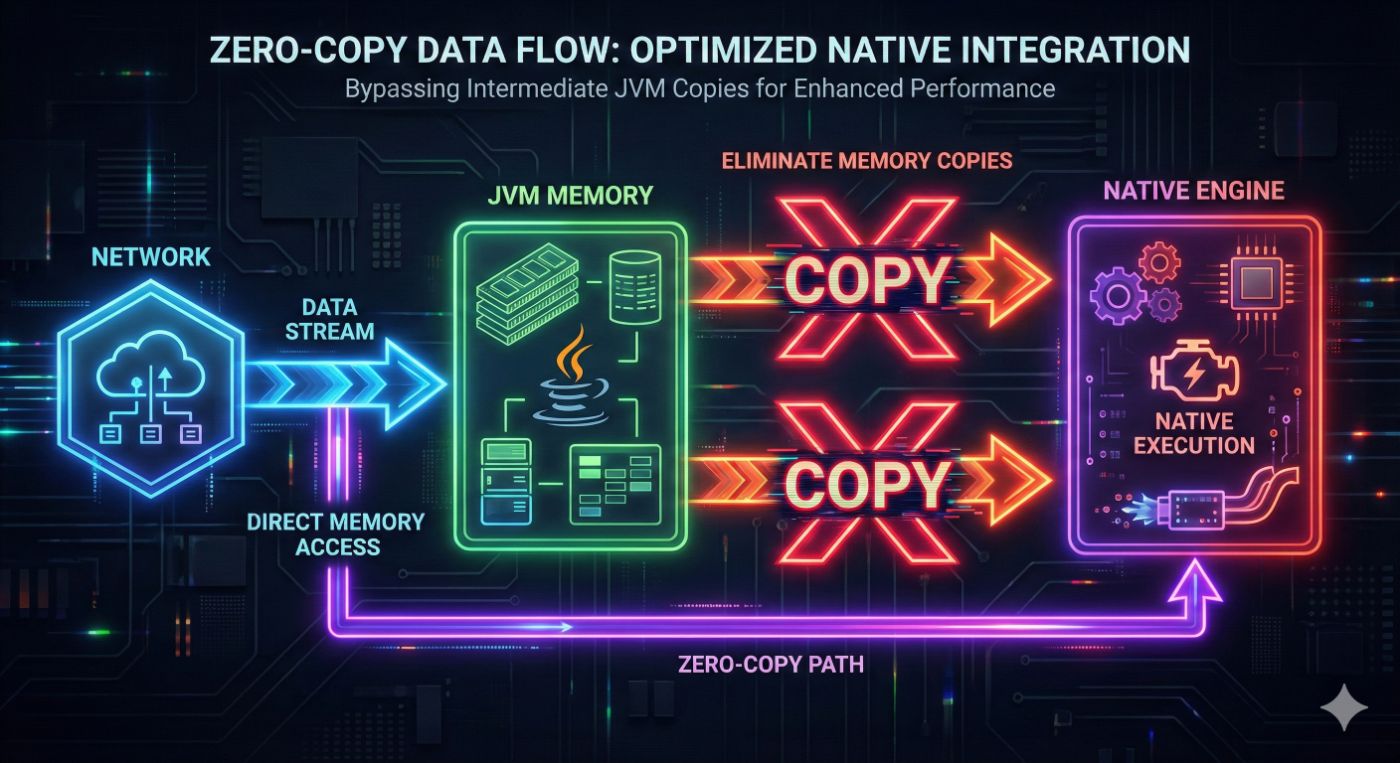
I bypassed this with a Zero-Copy pipeline:
- Vert.X/Netty reads the HTTP request directly into off-heap memory (
DirectByteBuffer). - I pass a raw pointer to this address via JNI straight to the C++ engines.
- MNN or ONNX Runtime creates a tensor view over that same memory.
Zero memory copies. Call overhead dropped to 20–50 microseconds, while a standard gRPC-based microservice would waste 3–5 milliseconds.
Intelligence When the Wi-Fi Quits

A defining feature of my FogAI node is Offline Resilience.
I mapped the architecture to the ISA-95 industrial standard, making the node a virtualized controller (vPLC). By keeping “context memory” local and using Deep Reinforcement Learning (DRL) for task scheduling, the system continues making autonomous decisions even if the cloud link is physically cut.
Reality Check: The Horror Stories are Coming
I’m currently polishing the code for an open-source debut. But let’s be honest: making JNI play nice with JVM memory safety and getting ONNX Execution Providers to behave on janky hardware was a journey through engineering hell.
I’m talking about segmentation faults that leave no stack trace and documentation that exists only in a single developer’s head.
In my next post, I’ll be dropping the repo link alongside a “Technical Post-Mortem” where I break down the real bugs, JNI memory leaks, and the hard lessons I learned building FogAI.
Follow me to get the “Hardware Horror Stories” drop.