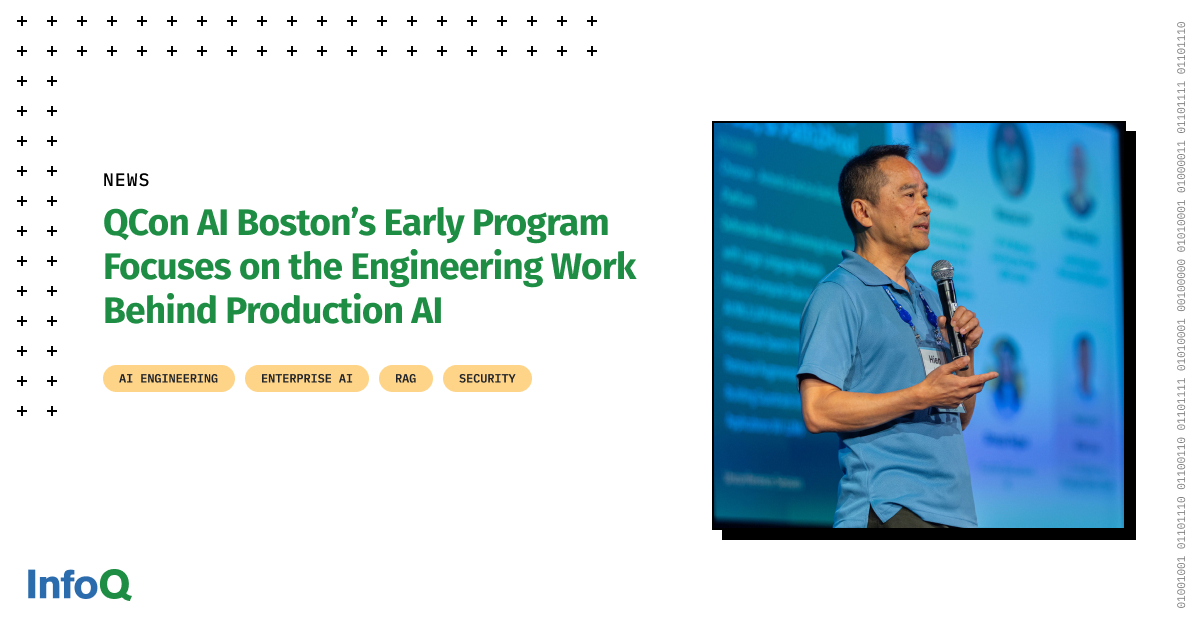
As more teams move from AI pilots to production systems, the technical discussion is shifting with them. The first confirmed talks for QCon AI Boston, scheduled for June 1 to 2, suggest that the event’s early program is less concerned with AI as a novelty and more focused on the engineering work needed to make these systems usable under real operating conditions. Getting a demo to work is one thing; building something that remains reliable, observable, explainable, and secure in production is another.
Curated by Eder Ignatowicz, Senior Principal Software Engineer and Architect @Red Hat AI, Meryem Arik, Co-Founder and CEO @Doubleword (Previously TitanML), recognized as a Technology Leader in Forbes 30 Under 30, and Hien Luu, Sr. Engineering Manager @Zoox & Author of MLOps with Ray, the program tackles a central question: what does it actually take to get AI into production in a way teams can trust?
Key AI Engineering Themes for 2026
The early lineup highlights several recurring themes:
- Context Engineering Over Prompting: Ricardo Ferreira, Lead, Developer Relations @Redis, explores how prompts that ace demos often fail under real-world constraints such as latency and limited context windows, reframing AI as a systems design problem rather than a prompt-writing exercise.
- Agent Explainability: Hannes Hapke, Head of 575 Lab @Dataiku and Google Developer Expert for ML/AI, addresses the need to inspect why an agent selected a specific tool. When tool calls are wrong and failures propagate downstream, teams need visibility into the decision path itself, not just output logs.
- Moving Beyond Basic RAG: Cassie Shum, Vice President of Ecosystem, Product Engineering @RelationalAI, examines how knowledge graphs can elevate systems from simple retrieval to complex reasoning across entities, dependencies, and domain context.
- Bridging Offline and Live Performance: Mallika Rao, Engineering Leader @Netflix, broadens the scope beyond LLMs, tackling the gap between offline evaluation and messy real-world user behavior through inference, evals, and system design.
- Security and Governance: Advait Patel, Senior Site Reliability Engineer @Broadcom, focuses on building Zero Trust Agent Systems that pass strict audits while remaining functional, reflecting AI’s integration into existing engineering and operational environments.
- The GenAI Platform Layer: Siddharth Kodwani, Software Engineer, AI Infrastructure @DoorDash, and Swaroop Chitlur, Staff Engineer / Engineering Manager, Machine Learning Platform @DoorDash, break down the internal infrastructure needed to support AI capabilities across teams, including retries, fallbacks, prompt versioning, and cost tracking.
Additional confirmed speakers include Francesca Lazzeri, Principal Group Director of Data and Applied AI Science @Microsoft, on trusted AI systems, Sudeep Das, Head of Machine Learning and Artificial Intelligence, New Business Verticals @DoorDash, on consumer AI at scale, and Rust lead designer Niko Matsakis, Senior Principal Engineer @Amazon, on opening up AI agent development.
The question is no longer simply whether a model can produce an impressive output. It is whether teams can build the surrounding systems needed to make that capability dependable and scalable under production constraints. This means managing context, reasoning, evaluation, observability, platform architecture, governance, and operational trust.
Learn more for QCon AI Boston 2026.